Sign In

Menu
Suggested Searches
Recent Searches
Suggested Searches
Product Ratings
Resources
Chat With AskCR
Resources
All Products A-ZThe payment for your account couldn't be processed or you've canceled your account with us.
Re-activateMy account
Sign In
My account
Sign In
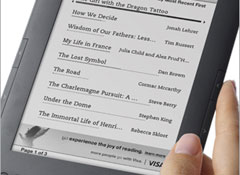
The Kindle with Special Offers, the new low-priced version of Amazon's e-book reader, keeps its advertising and deals from interfering with the reading experience, as Amazon CEO Jeff Bezos asserted in an interview yesterday. And in over a week of using the device, I've found the offers to be generally welcome--or at least inoffensive, since they've been discounts from Amazon on items I'd consider buying.
Priced at $114, $25 less than the ad-free (and otherwise identical) Kindle Wi-Fi, the KWSO delivers a rotating series of ads on the device's screensaver. A miniature version of the ad runs in a band along the bottom of the device's home screen, which displays one fewer book per page in order to accommodate the ad. As Amazon promised, ads are not present in any way within books, and CEO Bezos spoke strongly against such intrusions in our interview.
Not every pitch on the e-reader has been for products sold by Amazon: I saw a number of ads for Buick and Oil of Olay, for example. I generally found these to be benign, even though I have little interest in buying a new car or eliminating wrinkles from my face.
Although you can't select the types of products and services you'd like to be pitched, Amazon does let you select screensaver preferences. But so far, I've seen little impact from my preferences (for more screensavers that are illustrated and have literary references, and fewer with landscapes and scenery) on what I'm served up. An Amazon rep confirmed that is because relatively few screensaver ads have been developed. Also, the company hasn't yet launched AdMash, which will allow owners to vote on specific screensavers they like.
While I tested, I received and accepted an offer to buy an MP3 album from Amazon's considerable online store for $1, rather than the typical $5 to $10. I also had the chance to buy a $20 Amazon gift card for $10, which I would have bought—but I waited too long to respond to the time-limited offer.
You can't necessarily use the Amazon offers as rapidly as, say, buying a Groupon. To choose an offer, you click on the ad or the offers-page link, which e-mails a confirmation. You then make your purchase, which is processed through your Amazon account. (You can also easily navigate from your Kindle to a page listing all current offers). But where Groupons, for example, typically have a delay of only a day or so before you can use them, my offer took more than four business days to arrive—and the confirmation had warned me it might take up to seven days. An Amazon spokesperson said most offers should have a shorter time frame than the MP3 album deal, though she couldn't specify how long might be typical.
Bottom line: An e-book reader that sports ads, however unobtrusively, isn't for everyone. For my part, I'd take the savings from selecting the Kindle with Special Offers over a more expensive ad-free Kindle; offers I received promised to further offset the cost of the device, since they were for Amazon purchases I likely would have made anyway—and they're not available in any other manner than owning a Kindle with Special Offers.
You may not get the same offers I did, of course, and the types of ads and offers could also change, for good or ill. But Amazon's CEO Bezos told me yesterday that the opportunity to let Kindle owners know about the likes of the Amazon Denim Shop—an offer for which was up on the KWSO screen during my interview with him—was a key attraction to the device, so I'm guessing that Amazon offers will remain a key part of the mix.
—Paul Reynolds

 Build & Buy Car Buying Service
Save thousands off MSRP with upfront dealer pricing information and a transparent car buying experience.
 Get Ratings on the go and compare
while you shop

