Sign In

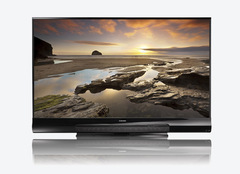
Mitsubishi, which earlier this year exited the LCD TV market, is taking its rear-projection DLP TV business even bigger in 2011. New models start at 73 inches and go all the way up to a mammoth 92-inch set, which we first saw at CES this past January.
The company, which is the sole remaining rear-projection TV manufacturer, will also continue to offer the only laser-backlit TV on the market, a 75-inch LaserVue model. The company's apparent strategy is to continue extending the screen sizes of its rear-projection sets beyond what flat-panel plasma and LCD TVs can offer. For example, the largest consumer-model TVs we saw at CES this year were 70-inch Aquos LCD sets from Sharp. Several companies have shown even larger models, but they are not widely available.
All of the new Mitsubishi TVs are 3D-capable sets, and the larger screen sizes will better deliver the excitement of the new technology to consumers, the company believes. "Bigger is better, especially as 3D captures the imagination and passion of consumers who want more from their TV viewing," Max Wasinger, executive VP of sales and marketing, said in a statement announcing the new models. "They want TV entertainment on an order of magnitude larger than what they've experienced up to now." The company points out that the new 92-inch set has four times the viewing area of a 46-inch TV.
Mitsubishi says all of the new TVs support multiple 3D formats, including the "frame packing" format (1080p/24Hz and 720p/60Hz) used by Blu-ray players and some game consoles; side-by-side (1080i/60Hz, 1080p/24Hz/30Hz/60Hz, and 720p/60Hz), the format used by most cable and satellite TV services; top/bottom (1080p/24Hz and 720p/60Hz); and checkerboard (1080p/60Hz).
The 92-inch TV will be part of a new Diamond 840 Series, which includes the company's integrated 16-speaker, Dolby Digital 5.1 Immersive Sound Technology (IST). Models in the series can be controlled by an Apple iPhone, iPod touch or iPad via a free app from the iTunes store. Models in both the 740 and 840 series have built-in wireless, plus Mitsubishi's StreamTV Internet service, with access to online content including streaming movies from Vudu, Pandora Internet radio, and access to Facebook and Twitter.
Here's the 2011 Mitsubishi TV lineup by series:
640 series
There is just one model in this entry-level series, a 73-inch, 1080p, 3D-capable DLP TV with 120Hz technology and three HDMI inputs. The TV will arrive later this month with a suggested price of $1,600.
740 series
There are two models in this step-up series, a 73-inch set ($2,100) and an 82-inch model ($3,500). Both arrive later this month. These sets have all the features of the 640-series model plus a new 3D emitter, built-in Wi-Fi, the StreamTV service, and the ability to use an iPhone, iPod touch, or iPad as a remote control.
Diamond 840 series
There are three screen sizes in this flagship DLP series: 73 inches ($2,600), 82 inches ($4,200), and 92 inches ($6,000). Models in this series, which ship in July, have all the features found in the 740 series, plus the 16-speaker Dolby Digital 5.1 immersive sound system, Bluetooth audio, an output for adding an optional subwoofer, and 4HDMI inputs. It also has ISFccc capability, which allows for calibration by a trained technician.
LaserVue TV
Mitsubishi continues to offer a laser-backlit DLP set in its lineup. The sole LaserVue model (L75-A94) has a 75-inch screen size, and it's expected to sell for about $6,000 when it hits later this month. The TV has many of the features offered in the 840 series, including built-in Wi-Fi, Stream TV, and ISFccc calibration. In addition to potential improvements in color due to a wider color gamut, laser light engines are very energy efficient.
Because the market for rear-projection TVs has shrunk so considerably—and only one company continues making sets—CR no longer tests this type of TV, and they are not included in our TV Ratings (available to subscribers). It is possible that we might test a single model as a First Look if we believe it offers a unique technology or feature, though.
If you'd still consider a rear-projection TV, let us know why, and how happy you are with your purchase should you decide to buy one. Clearly, they still offer a lot of screen bang for the buck, though the TV market is now almost exclusively a flat-panel business.
—James K. Willcox

 Build & Buy Car Buying Service
Save thousands off MSRP with upfront dealer pricing information and a transparent car buying experience.
 Get Ratings on the go and compare
while you shop

