Sign In

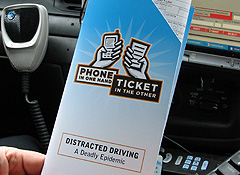
After a year-long pilot program testing high-visibility enforcement of distracted driving laws in Hartford, Connecticut and Syracuse, New York, new research shows the program has helped to reduce these dangerous behaviors considerably.
A report from the National Highway Traffic Safety Administration (NHTSA) shows that after four enforcement waves, running for a year starting in April 2010, hand-held cell phone use while driving dropped 57 percent in Hartford and 32 percent in Syracuse. Texting while driving declined 72 percent in Hartford and 32 percent in Syracuse. (The difference may be partially attributed to New York state's texting law being a secondary offense, meaning police must pull over the driver for another offense, whereas in Connecticut it is a primary offense.) This information was determined through cell phone use observed by NHTSA before and after each wave.
The government agency also surveyed the public on their knowledge of the distracted driving program and found that awareness of the main "Phone in One Hand, Ticket in the Other" slogan increased from 5 percent before to 54 percent after the waves in Hartford and 5 percent before and 29 percent after in Syracuse. After the program, 71 percent of respondents in Hartford heard about the stepped up police enforcement and 76 percent in Syracuse.
After the one-year program, Syracuse police issued 9,587 tickets to drivers who were talking or texting on cell phones behind the wheel and police in Hartford issued 9,658 tickets.
For each state, the $300,000 program, structured like the national seat belt campaign "Click It or Ticket," was supported by $200,000 in federal funds and $100,000 from the state. It looked at whether increased police enforcement, when coupled with paid advertising and media coverage, could reduce distracted driving. NHTSA plans to test this same formula at the statewide level. Currently, 34 states, the District of Columbia, and Guam have texting bans. Nine states, the District of Columbia, and the Virgin Islands have laws against hand-held cell phone use while driving.
Last week, the Governor's Highway Safety Administration (GHSA) published a research report on distracted driving. The organization urged states to look into a variety of countermeasures such as edgeline and centerline rumble strips, which alert motorists when they are drifting out of their driving lane, and record distracted driving in crash reports.
In addition, the GHSA thinks states should consider enacting a texting ban for all drivers and a complete cell phone ban (both hands-free and hand-held) for novice drivers.
See our special section on distracted driving.
Related:
Year-long distracted driving enforcement program ends—over 18,600 tickets handed out
Challenges of enforcing cell phone laws
Riding along as Syracuse police enforce distracted driving laws
Secretary LaHood speaks at Consumer Reports, launches national campaign against distracted driving
U.S. Department of Transportation and Consumer Reports launch partnership to fight distracted driving
—Liza Barth

 Build & Buy Car Buying Service
Save thousands off MSRP with upfront dealer pricing information and a transparent car buying experience.
 Get Ratings on the go and compare
while you shop

