Sign In

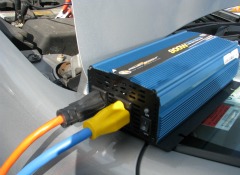
The snow hasn't been piling up like it did last season, but there have been several weather events that have caused power outages and other problems across the country. Witness this morning's tornadoes that tore through parts of the Midwest. When such things happen, it's good to have a generator at the ready. But not everyone does, which led us to ask whether a small power inverter could help homeowners survive an outage. The answer was—in some cases.
Just after we got two power inverters in the labs at Consumer Reports, a freak snowstorm hit much of the Northeast leaving millions of homeowners in the dark. One of them was our own lab technician who took advantage of his bad luck to test the power inverters under real-life conditions. He tested two models from PowerBright, a brand sold in home centers, warehouse clubs, and other retailers such as Sears and Walmart. The PW900-12, $80, provides 900 watts (1,800 peak) and 7.5 amps; the PW1500-12, $180, is rated for 1,500 watts (3,000 watts peak) and 12.5 amps.
An inverter resembles a rectangular box about the size of shoe box. At one end are wires for connecting to a power source; at the other are AC receptacles. An inverter takes in direct-current (DC) power—in this case, from your car's 12-volt system—and converts it to the alternating-current (AC) power required by refrigerators, sump pumps, and most other household devices. Our staffer found that the inverters could keep at least some of his home's essentials energized. Even the smaller, 900-watt PW900-12 was able to run a freezer, two refrigerators, two sump pumps, lights, and chargers for various electronics—but not all at once.
While an inverter may have advantages over a standby generator—it costs less and you don't need to fuel it with gasoline (it runs off your car's battery), there are some safety precautions you should take if you use one including keeping a running car a safe distance from your home. A good place to start is by reading the owner's manual. To learn more, read our full report.
—Mary H.J. Farrell

 Build & Buy Car Buying Service
Save thousands off MSRP with upfront dealer pricing information and a transparent car buying experience.
 Get Ratings on the go and compare
while you shop

