Sign In

Menu
Suggested Searches
Recent Searches
Suggested Searches
Product Ratings
Resources
Chat With AskCR
Resources
All Products A-ZThe payment for your account couldn't be processed or you've canceled your account with us.
Re-activateMy account
Sign In
My account
Sign In
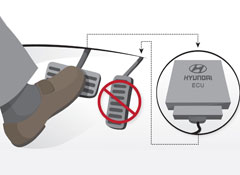
In the wake of the sudden unintended acceleration (SUA) crisis that rocked Toyota's safety reputation in 2009 and 2010, automakers have sped up implementation of smart-throttle technology, also known as brake override. With this safety feature, should a stuck throttle problem occur, the driver can intuitively apply the brake pedal and the engine management system will reduce the power, allowing the vehicle to quickly stop. The full Hyundai line starting with May production will come standard with brake override.
The National Highway Traffic Safety Administration (NHTSA) is considering a mandate to require such technology, a move supported by Consumer Reports. (Read: "How to improve U.S. car safety.") Other automakers, including General Motors, Nissan, Toyota, and Volkswagen have already deployed this seamless technology across their portfolios.
Without a smart throttle, applying the brakes will not necessarily bring a car to quick or even a complete stop. (Read: "Consumer Reports demonstrates how 'brake override' stops runaway cars.") While the potential causes posited for SUA during the Toyota investigation ranged from floor mat entrapment to an electronic glitch, simply having the brake pedal override the throttle would help the driver to come to a complete and controlled stop in most conceivable scenarios.
This is a good move on Hyundai's part, and we hope other automakers likewise roll out the technology to their full model lines.
—Jeff Bartlett

 Build & Buy Car Buying Service
Save thousands off MSRP with upfront dealer pricing information and a transparent car buying experience.
 Get Ratings on the go and compare
while you shop

