Sign In

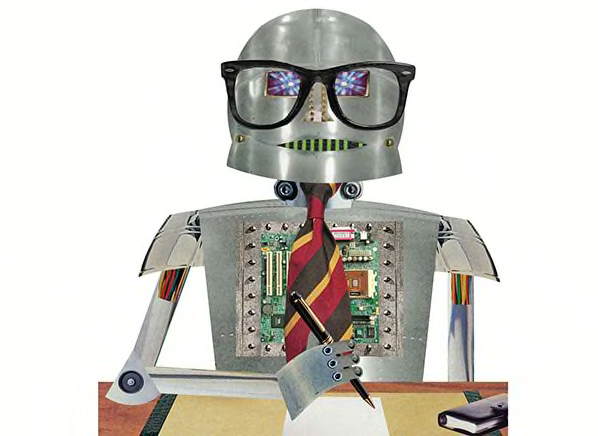
Another election season, another few million dinners interrupted by political robocalls. This has been the most expensive midterm election season in U.S. history, with expenditures approaching $4 billion. There are pricier gadgets in the vote-getting toolbox, but for many voters the most annoying tools are automated calls.
Not everyone receives the same share of the calls. Older voters get more. A study released last week by the Pew Research Center found that 55 percent of those older than 65 received robocalls this election cycle, while the figure was just 25 percent for voters below the age of 30. Jocelyn Kiley, an associate research director at Pew, works on the survey. "That age difference was driven by two things," she said. "Younger voters tend to be less actively engaged in politics, and the cell phone question."
Federal regulations restricting automated calls to landlines leave a big exception for political calls, but that exception doesn't apply to cell phones. If you haven't given an organization explicit permission to call your mobile number, it's not allowed to send the robots after you. Last spring, the Federal Communications Commission announced it would fine one Republican political robocaller $2.9 million for calling cell phones in the 2012 election. The FCC has also added rules for robocalls to landlines: The scripts need to identify who is paying for the campaign, and provide that group's phone number.
Check our Ratings of mobile phones and carriers, and of cordless phones.
According to one company that generates robocalls, the FCC rules resulted in the industry constricting. "A lot of the fly-by-nighters have left, the ones who didn't want to comply with the transparency rules," said Moses Ross, the owner of PoliticalRobocalls.com. Ross works solely with Democratic candidates and issues, normally in municipal and regional elections. He says the United States has only about 10 partisan robocalling outfits, which work with Republican or Democratic campaigns. And they are all scrambling to target a smaller group of voters. "There's been a definitive drop in the number of voter landlines," he said. "And it does skew the target audience toward older voters." Since those people tend to vote in disproportionate numbers, it's not an entirely bad thing for politicians. But the same issue can also make it harder to generate representative polling data, Ross says.
Switching to a mobile phone was one way to limit robocalls this year. An option for some consumers using a VoIP phone service was to sign up with a free service called Nomorobo. The service also works to reduce communications from telemarketers. The phone carrier routes calls to your phone and to Nomorobo simultaneously; if a call comes from a robocalling outfit, the service hangs up on it. The company recently released a sort of rogue's gallery of political robocallers. Topping the list for the sheer number of calls interrupted by Nomorobo was the Presidential Coalition, a group associated with the conservative group Citizens United (yep, you've heard that name before). The runner-up was the National Rifle Association. Robocalls are a relatively inexpensive way to reach potential voters. A company named Republican Robo Calls lists a price range of below 2 cents to 7 cents per dial, varying with volume.
While the federal rules allow political campaigns to make automated calls, laws vary at the state level. Indiana and North Dakota have outlawed political robocalls; Indiana's law was upheld by a federal court last January. In some other states, calls have to be introduced by a live operator, who is required to ask permission to play a recording. Ross, who is based in Oregon, said that his state requires robocalling companies to scrub out numbers registered with the federal Do Not Call List. (Federal rules exempt political campaigns from complying.)
It may be that robocalling has peaked. The Pew study found that 41 percent of all voters received such a call, down from 55 percent in the 2010 midterm elections. During that election, Pew found that two-thirds of the people who received such a call just hung up. And many more may have screened their calls and never even answered the phone. Kiley speculates that it's just harder to get people to engage in unwanted phone calls these days, even if they aren't pushing a product or a message.
Pew has been running a broad political survey once every three years since 1997. That year, 36 percent of the people called agreed to an interview. The number declined steadily, hitting just 9 percent in 2012—and Kiley says that same sort of decline in response rates are being seen by other phone survey organizations. For political polls used to tracking election trends, Ross says the rule of thumb is that you need to call 7,000 to 10,000 people to get more than 300 full, complete polls.
But if robocalls are declining, they are far from gone—which could be one more incentive for anyone already planning to drop their landlines next year. By the time 2015 ends, we'll be into the next presidential election cycle, and the robots will be oiling up their dialing fingers.
—Jerry Beilinson

 Build & Buy Car Buying Service
Save thousands off MSRP with upfront dealer pricing information and a transparent car buying experience.
 Get Ratings on the go and compare
while you shop

