You might think that with lower gas prices, consumers would want to rush out and buy bigger cars. While SUV sales have increased recently, that's not the intent for most motorists, according to a new survey by the Consumer Federation of America.
According to the nationally representative poll, 85 percent of consumers say that gas mileage will be an important consideration in their next vehicle purchase, and 56 percent say it will be very important.
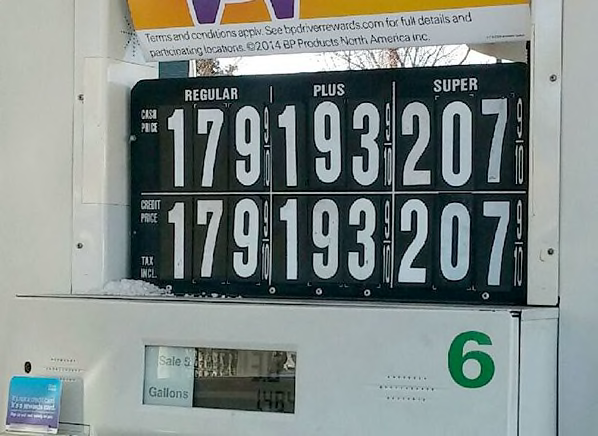
The reason is pretty clear: While short-term price forecasts don't predict gas prices will rise much in the next 18 months, the average car loan in the United States today lasts more than five years. And consumers have learned to expect volatility in gas prices.
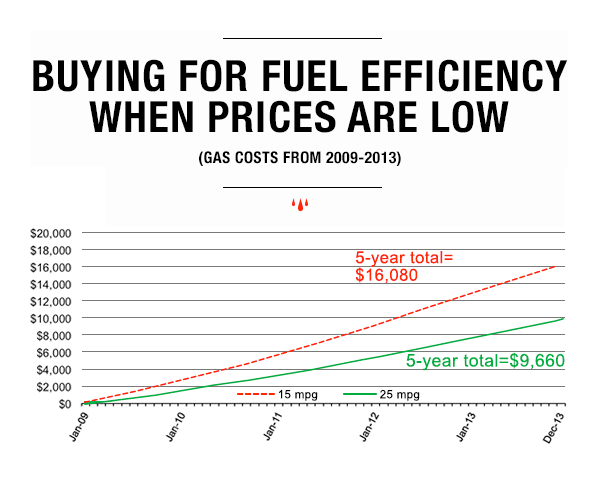
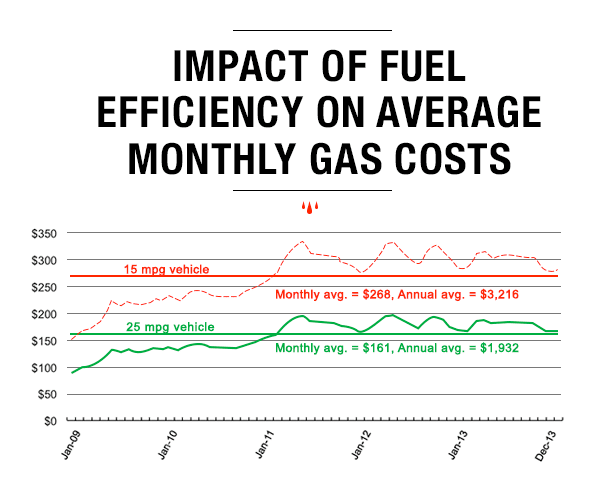
For example, the last time gas prices bottomed out was in 2008, when a gallon cost $1.84. Five years later, the price had risen to $3.36 per gallon. So while their monthly gas bills on a 15 mpg SUV would have started out at $153, by 2013 those fuel bills hit $268 a month. Over five years, the 15 mpg car cost $6,400 more in gas than one that got 25 mpg.
"Buying an inefficient vehicle … condemns the consumer to wider swings in monthly costs [and] much higher monthly peaks," says CFA Director of Research Mark Cooper.
Consumers expect this trend to continue, according to the CFA poll. On average, respondents said they expect gas prices to rise by more than 55 percent in the next two years, to about $3.20 a gallon, and by 90 percent, to $3.90 a gallon in the next five years. Whether these predictions hold true or not, they are informing people's purchase decisions today. (And they track the last rise in gas prices from 2008 to 2013.)
Survey respondents reported on average that they expect their next car to get 30 mpg, compared with 25 mpg today. Steadily increasing federal fuel economy standards that reach 54.5 mpg by 2020 (before downward mathematical adjustments) will play a key role in delivering that efficiency.