Your membership has expired

The payment for your account couldn't be processed or you've canceled your account with us.

Re-activate

Save products you love, products you own and much more!

Save products icon

Other Membership Benefits:

Savings icon Exclusive Deals for Members Best time to buy icon Best Time to Buy Products Recall tracker icon Recall & Safety Alerts TV screen optimizer icon TV Screen Optimizer and more

    FilmOn might soon be able to offer broadcast-TV shows

    A court ruling in favor of the Internet TV company would mean more choices for you

    Published: July 20, 2015 03:00 PM
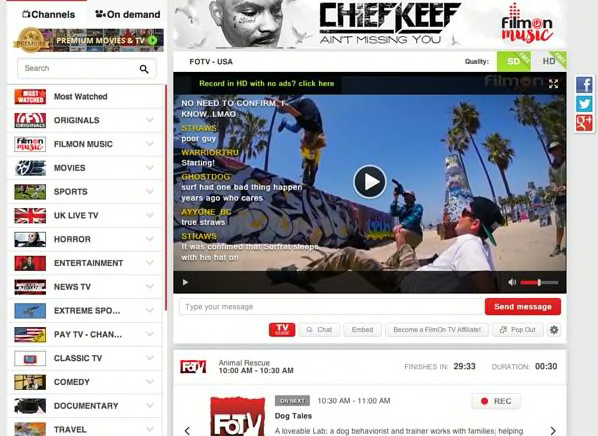
    FilmOn, an Internet TV company, may succeed where Aereo failed.

    Remember Aereo, the now-defunct company that set up a warehouse of TV antennas that let people get over-the-air TV broadcast via the Internet? A pair of court decisions put that company out of business, but now a lower court has decided that a company called FilmOn that runs a similar service may be treated like a cable company and get the compulsory licenses it needs to transmit TV offerings.

    If FilmOn is ultimately successful, it could be a huge win for consumers looking for more TV service choices. The company and other emerging digital services would be able to automatically license programs from the major broadcasters, such as ABC, CBS, Fox, and NBC, at a special, discounted rate—just like a cable company.

    However, it's not a done deal. In making his ruling, the U.S. District Court judge acknowledged that his preliminary decision is at odds with the Aereo case, and he is allowing an immediate appeal. Like Aereo, FilmOn was sued by the major broadcast networks, and is currently enjoined from operating its service.

    Legal twists

    The ruling comes as a bit of a surprise, since Aereo lost its case in the Supreme Court. Aereo had been offering a service that combined major network broadcasts plus a cloud-based DVR to subscribers for $8 to $12 per month. The company wasn't paying anything to the broadcast networks, basically arguing that since it provided tiny individual antennas for every user, it was really more in the antenna-rental business than in the re-broadcasting business. Aereo won many of its earlier legal battles, but the Supreme Court essentially said that Aereo looked too much like a cable company to avoid paying licensing fees for the broadcasts, and was violating copyrights.

    After that decision, Aereo went back to a lower court to see if it could obtain a compulsory license to rebroadcast the channels, just like a cable company. But a New York district court, citing an earlier case against a company called Ivi, ruled the company wasn't entitled to the license, and Aereo went out of business, selling some of its assets and technology to TiVo. Ivi, one of the first digital re-broadcasting services, claimed that it should be considered a cable system under Section 111 of the Copyright Act (enacted in the 1970s to make licensing broadcast content easier for cable companies), and therefore was entitled to a statutory license. The court disagree and Ivi was shut down.

    Would you consider subscribing to a service such as FilmOn? Should consumers have more choices for TV watching? Share your opinion by adding a comment below.

    In ruling for FilmOn last week, the judge acknowledged the Ivi decision, but disagreed with its conclusion. Given the importance of the case, he authorized an immediate appeal, and the injunction against FilmOn remains in effect until the case is decided.

    "We are pleased that this court has is backing greater competition in the video marketplace," said Delara Derahkshani, policy counsel to Consumers Union, the policy and advocacy arm of Consumer Reports. "Consumers want and deserve more options than what's currently offered by the biggest cable operators.  We hope this decision begins to pave the way to robust competition."

    Broadcasters, not surprisingly, weren't as thrilled. In a statement, Fox said the opinion "contravenes all legal precedent" and said it would appeal the ruling.

    Why the FilmOn case matters

    If FilmOn wins its case, the ruling will not only allow the company to operate its business but will also open doors to other competitors that want to develop and run similar services. The case comes at a time when the FCC is reviewing the definition of an MVPD (multichannel video programming distributor) to see whether it should encompass new digital services as well as traditional pay-TV providers, such as cable and satellite companies.

    —James K. Willcox


    Find Ratings

    Streaming Media Ratings

    View and compare all Streaming Media ratings.

    Telecom services Ratings

    View and compare all Telecom services ratings.

    E-mail Newsletters

    FREE e-mail Newsletters! Choose from cars, safety, health, and more!
    Already signed-up?
    Manage your newsletters here too.

    Electronics News

    Cars

    Cars Build & Buy Car Buying Service
    Save thousands off MSRP with upfront dealer pricing information and a transparent car buying experience.

    See your savings

    Mobile

    Mobile Get Ratings on the go and compare
    while you shop

    Learn more