New TV Technology Coming in 2026
Expect to see more TVs with AI, ever-larger screens, and new RGB Mini LED TVs from brands such as Hisense, LG, Samsung, and TCL


Anyone shopping for a new TV in 2026 will encounter a few developments that could affect their buying decision. The most widespread change will be the increased use of artificial intelligence (AI). Among other AI features, chatbots like Gemini and Microsoft Copilot will let you use more conversational voice commands.
You’ll also see more jumbo-sized TVs that push screen sizes to new limits—100 inches and beyond—as well as lots of "lifestyle" TVs that display artwork and photos when you’re not watching a show.
But the biggest innovation could be the launch of new RGB Mini LED TVs. These sets use red, green, and blue LEDs rather than the conventional white or blue LEDs, along with a color filter. It’s a major change in display technology, which you’ll mainly see in high-end sets. The result is supposed to include higher brightness levels, a wider color range, and other benefits.
We’ll test all those claims in our labs once these sets go on sale. (CR buys every product in our ratings at retail outlets, just like any other shopper.)
AI Is Now Everywhere
If you see a TV company that’s not boasting AI in its sets this year, it’ll be unusual; it was a big part of almost every TV brand’s CES announcements.
Artificial intelligence in TVs isn’t new; TV manufacturers have been using it to enhance picture quality for several years, primarily for upscaling lower-resolution content to a TV’s native 4K display. It has also been used to enhance TV audio processing, often by tailoring the TV sound to the listening environment and/or the program material itself, or upmixing stereo sound to multichannel audio and enhancing the quality of dialogue.
Those capabilities are expanding in 2026. For example, companies are claiming that their AI tools, backed by powerful processors, will recognize the type of content being played and make adjustments on the fly to reduce problems like motion blur during fast action or banding, where visible horizontal lines appear instead of smooth color transitions. AI is also supposed to enhance tone mapping in HDR, where the TV adjusts the content’s dynamic range to match its display capabilities. And it’s being used to make targeted program recommendations and create unique, customized home screens for each user in the household.
In 2026, AI is also supposed to bring you more intuitive and natural ways to control your TV. Samsung, for example, says its Vision AI Companion platform will let you ask questions about actors, locations, and soundtrack music while you’re watching a film. Or, if you’re watching a program with a dining scene, AI could identify the meal, suggest a recipe, and then send it to your phone or maybe a Samsung kitchen product like a Family Hub fridge.

Photo: Samsung Photo: Samsung
LG’s "Affectionate AI" aims to give the technology a more human-like focus while enhancing interactions across various types of devices. The company says its AI Home vision pairs smart devices with AI to work together seamlessly. A "Sense Think Act" demo at CES featured LG’s new CLOiD home robot performing tasks such as doing laundry and making breakfast after checking what’s in the fridge, all without any homeowner intervention.
Many TV remotes this year will feature a dedicated AI button that lets you call up an AI assistant, such as Google Gemini or Microsoft Copilot. Some sets will let you choose the AI agent, while others will select one automatically based on the type of query you make or the task you want performed.
We don’t know yet whether people will really like having a chatbot in their TV. But even if this does result in more convenience, it could also mean more personal data collection by large tech companies and their numerous partners. (We have instructions on how to turn off TV snooping features.) Perhaps that’s why several companies, most notably LG and Samsung, say they are introducing improved privacy and security technologies.
RGB TVs Make a Colorful Debut
One of the biggest TV stories of the year is the arrival of RGB Mini LED TVs from Hisense, LG, and Samsung. These LCD sets use thousands of tiny red, green, and blue LEDs in the backlight to create color directly, rather than relying on a white or blue backlight with color filters. Like other Mini LED TVs, they use local dimming, which allows each zone to be adjusted for both brightness and color. Samsung calls its versions Micro RGB, LG uses Micro RGB evo, and Hisense brands them as RGB MiniLED TVs.
RGB Mini LED TVs promise extremely high brightness—up to 10,000 nits in some cases—and a wider color range than current standards. By comparison, most 4K content is mastered at 1,000 nits, with some Dolby Vision titles hitting 4,000 nits, levels very few TVs can reach today. Once limited to massive, ultra-expensive displays, RGB TVs are now coming in more practical sizes, starting at 55 inches. Pricing will be announced later this spring.
LG plans Micro RGB evo models in 75-, 86-, and 100-inch sizes, while Hisense showed a 116-inch flagship 116UXS and says its more mainstream UR8 and UR9 series will span 55 to 100 inches. The 116UXS is unusual in that it adds a fourth primary color—cyan. Samsung, meanwhile, unveiled what it calls the world’s first 130-inch Micro RGB TV, the R95H, featuring a gallery-style design and floor-standing “Timeless Frame” stand, alongside smaller models starting at 55 inches.

Photo: Hisense Photo: Hisense
TCL is taking a different tack this year. While it will offer a Micro RGB TV in its RM9L Series, the company is focusing instead on a new flagship line, the X11 SQD-Mini LED TV. These sets skip colored LEDs in favor of an enhanced Super Quantum Dot layer paired with a Mini LED backlight featuring thousands of local dimming zones—up to 20,000, according to TCL. The company claims peak brightness of up to 10,000 nits, along with improved color range and accuracy.
Pricing reflects the premium positioning. TCL says the X11 series, available in 75-, 85-, and 98-inch sizes, is now available for preorder, with launch prices ranging from $7,000 to $10,000.
Meanwhile, the rise of RGB Mini LED TVs has pushed another promising technology, MicroLED, further into the background. MicroLED sets don’t use a backlight at all; each pixel is made up of self-emissive red, green, and blue LEDs, allowing for pixel-level control similar to OLED and the potential for excellent contrast and color. At CES, Hisense showed a 163-inch MicroLED TV that adds a yellow subpixel to the usual RGB mix.
TV Screens Keep Getting Bigger
Last year, we began to see TVs as big as 100 inches become more widely available at surprisingly low prices. For example, two of our top Black Friday TV deals were a 98-inch TCL set and a 100-inch Hisense set selling for around $1,000.
While 65-inch TVs are likely to remain the most dominant screen size in 2026, jumbo TVs are expected to gain market share again this year.
"The sales of [extra-large] TVs have really taken off because the prices for those panels have dropped considerably,” says Paul Gagnon, industry adviser for consumer technology at research firm Circana. “But more importantly, we’ve also seen that the competition has really intensified, particularly with some Chinese brands that have come in with very aggressive prices. As a result, some of the legacy premium brands have responded, and retailers are putting more attention on these sets.”
Most of the TV brands we’ve spoken to will have a good number of models with screens 85 inches and larger in 2026. Last year, the giant TVs we saw tended to be entry-level models, but this year you’ll also see more jumbo-sized models in step-up and even flagship series that offer better performance along with higher prices. This is especially true of the new RGB sets.
More Mini LED TVs and Brighter OLEDs
In typical fashion, in 2026, companies will be touting tech advances to improve both picture and sound in TVs. Most of these will be iterative improvements, such as LG’s G6 and C6 OLED TVs, which use a new brightness booster technology called Tandem 2.0. Samsung’s top sets also get brighter, with a new anti-glare technology the company says can greatly reduce reflections.
We’ll also see more TVs with faster refresh rates, including 144Hz and 165Hz. A faster refresh rate is beneficial when playing fast-paced content, such as gaming and quick-moving sports, because it can produce significantly smoother motion with less blur and ghosting.

Photo: TCL Photo: TCL
This year, we’ll see Mini LED backlights migrate from high-end to midtier sets. Mini LEDs improve on traditional full-array backlights by reducing the size of the LEDs, allowing thousands to be packed behind the LCD panel. As a result, TVs can have many more zones that can be dimmed or illuminated separately. This can improve black levels and contrast and reduce halos around the edges of bright objects when they’re placed against a dark background.
We can expect to see further improvements in this technology in 2026. The Mini LEDs will continue to get smaller, enabling more local dimming zones, and faster processors and AI are helping companies exert better control over them to improve brightness and overall performance.
Lifestyle TVs Proliferate
TV makers are launching more competitors to Samsung’s The Frame TVs, which turn into art/photo displays when you’re not watching TV. Samsung’s newest model, The Frame Pro, is a Neo QLED TV that offers improved picture quality compared to the company’s other models, thanks to quantum dots and Mini LED backlights. Connections are now made via a wireless OneConnect box, which sends video and audio to the TV via the latest WiFi 7 standard.
The company will also continue to sell the Serif, which has a unique I-shaped frame, and the Sero, a model that can rotate between landscape and portrait orientations to display mobile content.
LG has several models, ranging from its pricey W6 "Wallpaper TV," a super-thin model that also connects wirelessly to an external Zero Connect box, to a new "Gallery TV" that will compete more closely with Samsung’s Frame TVs. It also sells the Pose, a lifestyle TV with an easel-like stand, and StanbyMe2, a portable 27-inch touchscreen set that can be detached from its pedestal stand.

Photo: LG Photo: LG
Hisense and TCL will continue selling their own lifestyle sets. TCL’s Frame-like NXTVision TVs are 4K QLED models in screen sizes from 55 to 85 inches. Hisense showed off its S6 FollowMe TV, a 32-inch portable wireless set that rolls, rotates, and lifts. It can be powered by a battery with a claimed life of 10 hours. It joins Hisense’s CanvasTVs, also a Frame-style model that’s offered in the same screen sizes as the TCL sets. Google is partnering with both companies to use proximity sensors that automatically kick the sets into a mode that displays helpful info—such as top news stories, weather, and traffic—when it senses you enter the room.
This year, Amazon will enter the fray with the Amazon Ember Artline, a 4K QLED TV available in 55- and 65-inch sizes, priced from $899. The TV is equipped with far-field microphones for talking to Alexa+, and a sensor will automatically turn the Ambient Experience on and off when people enter or leave the room.
Most lifestyle TVs feature low-reflective matte screens that replicate the textured look of digital artwork, offering a choice of frames and access to art stores for additional options.
NextGen TV Keeps Growing
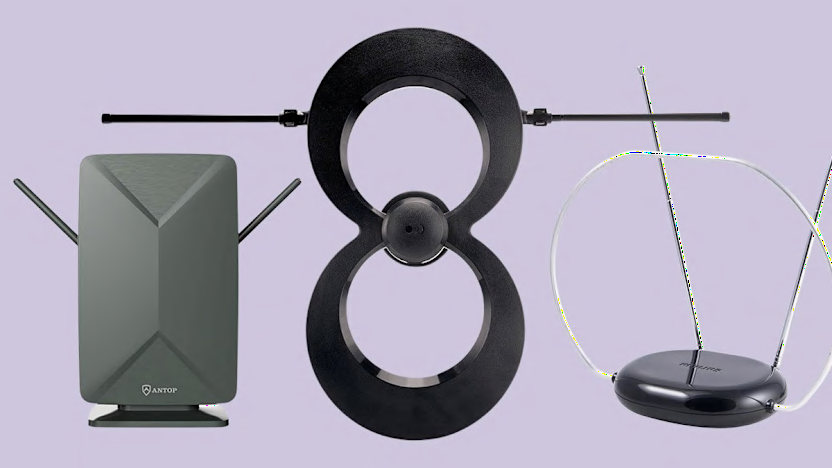
More TVs this year will include tuners that can receive NextGen TV signals, which you can get with an antenna. Technically known as ATSC 3.0, NextGen TV is now available in more than 75 percent of the country. This technology can carry significantly more data than the older ATSC 1.0 standard, enabling broadcasters to offer higher-quality video with HDR—something previously not possible with regular over-the-air broadcasts. So far, we haven’t seen any 4K broadcasts; we are receiving 1080p signals with HDR.
Another advantage is that the new standard is IP (Internet Protocol)-based, so it can carry internet content alongside traditional TV broadcasts. With Next-Gen TV, you may also be able to get TV shows and other content on smartphones, tablets, and even in moving vehicles. Broadcasters are also promising improvements in emergency and weather alert systems.
Many TV brands will include ATSC 3.0 tuners in their sets this year; LG, due to a patent dispute, will not. The big news at CES is an industry-wide push to make lower-cost converter boxes available, allowing consumers with TVs that lack NextGen TV tuners to receive these new signals.
 BEST TIME TO BUY: