5 Best Home Blood Pressure Monitors of 2026, Expert-Tested and Reviewed
In our testing, we’ve evaluated over 20 arm and wrist blood pressure monitors, including models from CVS, Omron, and Walmart


When you shop through retailer links on our site, we may earn affiliate commissions. 100% of the fees we collect are used to support our nonprofit mission. Learn more.

Tracking your blood pressure (BP) at home is, in many cases, a more reliable option for getting an accurate picture of your day-to-day levels than the readings you may get during a visit to the doctor’s office. Research suggests that self-monitoring can even lead to better blood pressure control.
CR tests blood pressure monitors on real people, and we compare the results with those of a mercury sphygmomanometer, the device considered the gold standard in BP testing. Accuracy makes up the bulk of the score for each monitor, but we also evaluate ease of use and comfort.
After all, “you aren’t going to want to use the product if it’s not comfortable,” says Susan Booth, who oversees the testing of home blood pressure monitors at CR.
Monitors with a BP risk category indicator can also help flag high measurements—when a person’s systolic (top) blood pressure measurement is 130 mmHg or higher, and diastolic (bottom) is 80 mmHg or higher. High blood pressure, or hypertension, can increase your risk of a heart attack, a stroke, and a number of other health problems.
In our testing, we’ve evaluated over 20 arm and wrist blood pressure monitors, including models from CVS and Walmart. In general, we’ve found that these don’t perform as well as name-brand monitors, particularly those from Omron.
Whichever monitor you choose, keep in mind that an accurate reading depends on using the right technique. Below, you’ll find our top four arm-cuff blood pressure monitors (in order of Overall Score), plus our top option for people interested in a model with a wrist cuff. Members can access our full blood pressure monitor ratings and reviews. For more helpful information about how to use your monitor and how to buy the best one, check our blood pressure monitor buying guide.
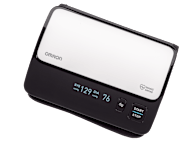
The Omron Evolv BP7000 monitor earns top marks for accuracy, and our testers found it to be very convenient and comfortable. Unlike blood pressure monitors that consist of a cuff attached via a tube to the electronic monitor, this model is all one piece; the monitor is embedded in the cuff, a feature that could be useful for those who need to monitor their blood pressure while traveling. This monitor also has plenty of convenient features, including an irregular heartbeat detector, a data averaging function, and the ability to store data for multiple users. If you sync your data via the Omron Connect app, you’ll also have access to a BP risk indicator. One downside is that, because of the device’s structure, if your arm is outside the 9- to 17-inch circumference range, there’s no option to sub in a different-sized cuff.
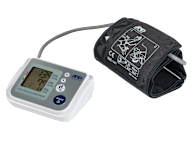
The A&D UA767F monitor earns top marks for accuracy, and our testers found it to be very convenient and comfortable. We did notice that it might be difficult for some users to wrap the cuff around their own arm and align the artery marker, and we also found the fabric fastener somewhat difficult to separate. Still, this monitor offers plenty of features, including an irregular heartbeat detector, a BP risk category indicator, a data averaging function, and the ability to store data for multiple users. The cuff fits arms of 8.6 to 16.5 inches in circumference. A larger cuff for arms 12.2 to 17.7 inches in circumference can be purchased separately.
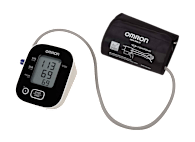
The Omron BP7150 3 Series blood pressure monitor got top marks for accuracy, and testers found it very convenient and comfortable. It’s a simple, less expensive Omron unit. It comes with an irregular heartbeat detector, a BP risk category indicator, and a large-digit display, and can be connected to a companion app. It stores measurements for only one user. The included cuff is designed for arms from 9 to 17 inches in circumference, though you can purchase a separate cuff for smaller arms 7 to 9 inches in circumference.
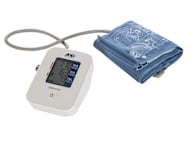
The A&D Medical UA-611 earns very good ratings for accuracy, and our testers found it very comfortable and convenient as well. As with the A&D UA767F, some users may find it difficult to tighten the cuff and align the artery marker. The cuff is not molded, and the Velcro is stiff. With regard to features, this monitor has an irregular heartbeat detector, a blood pressure risk category indicator, and a data averaging function. It can store memory for only one user. The included cuff fits arms 9 to 14.6 inches in circumference, and a larger cuff (up to 17.7 inches) can be purchased separately.
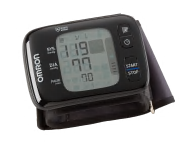
The Omron BP6350 wrist monitor is virtually silent and has a one-size-fits-most (5.3- to 8.5-inch) soft cuff that testers found easy to wrap around their wrists. The Velcro holds tightly but is soft and not difficult to pull apart. When your wrist is in the correct position, a heart symbol on the screen turns blue; when it’s not, little dashes above and below the heart indicate the need to raise or lower your wrist to achieve the correct position. It also has a cuff wrap indicator to tell if the cuff is wrapped too loosely, and it flags high measurements with a special symbol. While arm monitors tend to be more accurate than wrist monitors in general, this one earns a very good rating for accuracy and excellent ratings for comfort and ease of use. It also has an irregular heartbeat detector, can download memory, and has a data averaging function. It can store memory for one user. One downside to keep in mind if you use this monitor: It will start to take a reading even if the wrist is not in the correct position.
How CR Tests Home Blood Pressure Monitors
Accuracy is the most important component, but we also examine ease of use and comfort. To test the accuracy of a blood pressure monitor, we compare its readings with those from a mercury sphygmomanometer, which is considered the gold-standard device for blood pressure measurement.
We note each monitor’s features, such as irregular heartbeat detection and data storage for multiple users. We also ask subjects to rate how comfortable each monitor is.
 BEST TIME TO BUY:


