Menu
Suggested Searches
Recent Searches
Suggested Searches
Product Ratings
Resources
Chat With AskCR
Resources
All Products A-ZThe payment for your account couldn't be processed or you've canceled your account with us.
Re-activateMy account
Sign In
My account
Sign In
Media Room
Release date 12/03/2007
YONKERS, NY – Returning that unwanted gift may be more difficult this season as some store return policies have become stricter. Many retailers have become more persnickety about receipts. Some charge fees for restocking and open boxes or missing packaging. And those addicted to returning, especially without a receipt, may be stuck with their gift. That’s because some retailers including Kmart, Lowe’s, and Wal-Mart, now use computer systems to monitor how often a customer return items without a sales slip and may stop accepting those returns.
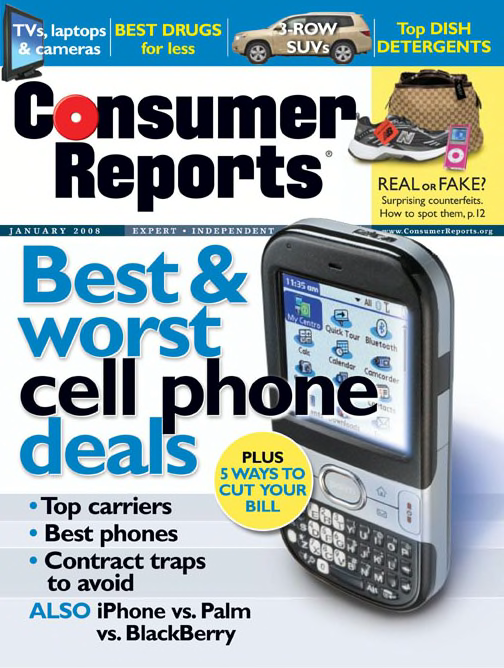
The January issue of Consumer Reports offers the following tips to ensure a happy return this season:
1. Check the policy. Some stores have more generous return policies for goods purchased at holiday time. Checking the store’s Web site, calling its customer service line or visiting the local store directly are the best ways to determine if a gift can be returned or not.
2. Handle with care. Retailers are less likely to take back items that are damaged or have missing tags or packaging. Amazon.com will not accept returns of items that are missing the serial number or UPC square on the box. Best Buy and Circuit City charge a 15 percent restocking fee on some electronic items if the box has been opened; however, consumers should not have to pay that fee if the item was defective when it was unwrapped.
3. Bring the receipt. Having the receipt will likely ensure that a consumer receives credit for the item’s full value. Without a receipt, a retailer may only credit a consumer with the lowest recent price or simply deny the return altogether.
4. Go to the right place. Some stores will take back items that were purchased online or over the phone. Consumers opting to return items via mail should make sure they have the correct address specified by the retailer.
5. Set the record straight. Some retailers monitor returns. If a consumer’s return is inexplicably denied, it may have been incorrectly flagged by a store’s computer as “return fraud.” Consumers might be able to resolve the matter by e-mailing the Return Exchange, a company that monitors returns for retailers, at returnactivityreport@thereturnexchange.com.
The full report is available in the January 2008 issue of Consumer Reports, which is available wherever magazines are sold. Portions of the story are available for free online at https://www.ConsumerReports.org.
Consumer Reports is a nonprofit membership organization that works side by side with consumers to create a fairer, safer, and healthier world. For 80 years, CR has provided evidence-based product testing and ratings, rigorous research, hard-hitting investigative journalism, public education, and steadfast policy action on behalf of consumers’ interests. Unconstrained by advertising or other commercial influences, CR has exposed landmark public health and safety issues and strives to be a catalyst for pro-consumer changes in the marketplace. From championing responsible auto safety standards, to winning food and water protections, to enhancing healthcare quality, to fighting back against predatory lenders in the financial markets, Consumer Reports has always been on the front lines, raising the voices of consumers.
© 2007 Consumer Reports. The material above is intended for legitimate news entities only; it may not be used for advertising or promotional purposes. Consumer Reports® is an expert, independent, nonprofit organization whose mission is to work side by side with consumers to create a fairer, safer, and healthier world. We accept no advertising and pay for all the products we test. We are not beholden to any commercial interest. Our income is derived from the sale of Consumer Reports® magazine, ConsumerReports.org® and our other publications and information products, services, fees, and noncommercial contributions and grants. Our Ratings and reports are intended solely for the use of our readers. Neither the Ratings nor the reports may be used in advertising or for any other commercial purpose without our prior written permission. Consumer Reports will take all steps open to it to prevent unauthorized commercial use of its content and trademarks.
Consumer Reports is a nonprofit membership organization that works side by side with consumers to create a fairer, safer, and healthier world. For 80 years, CR has provided evidence-based product testing and ratings, rigorous research, hard-hitting investigative journalism, public education, and steadfast policy action on behalf of consumers’ interests. Unconstrained by advertising or other commercial influences, CR has exposed landmark public health and safety issues and strives to be a catalyst for pro-consumer changes in the marketplace. From championing responsible auto safety standards, to winning food and water protections, to enhancing healthcare quality, to fighting back against predatory lenders in the financial markets, Consumer Reports has always been on the front lines, raising the voices of consumers.
© 2007 Consumer Reports. The material above is intended for legitimate news entities only; it may not be used for advertising or promotional purposes. Consumer Reports® is an expert, independent, nonprofit organization whose mission is to work side by side with consumers to create a fairer, safer, and healthier world. We accept no advertising and pay for all the products we test. We are not beholden to any commercial interest. Our income is derived from the sale of Consumer Reports® magazine, ConsumerReports.org® and our other publications and information products, services, fees, and noncommercial contributions and grants. Our Ratings and reports are intended solely for the use of our readers. Neither the Ratings nor the reports may be used in advertising or for any other commercial purpose without our prior written permission. Consumer Reports will take all steps open to it to prevent unauthorized commercial use of its content and trademarks.