Menu
Suggested Searches
Recent Searches
Suggested Searches
Product Ratings
Resources
Chat With AskCR
Resources
All Products A-ZThe payment for your account couldn't be processed or you've canceled your account with us.
Re-activateMy account
Sign In
My account
Sign In
Media Room
Release date 02/28/2008
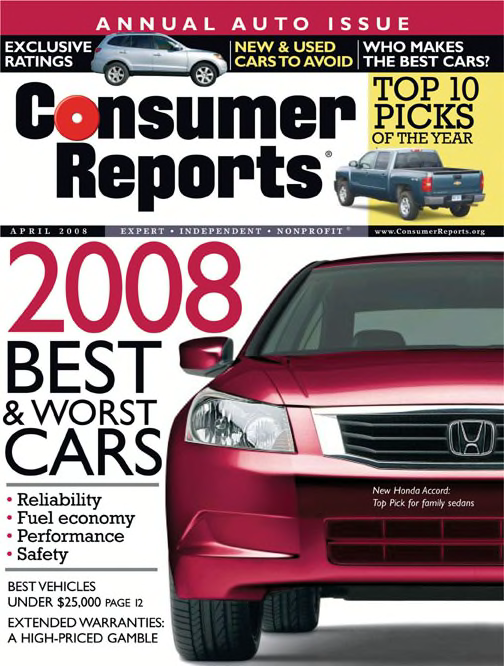
YONKERS, NY — Pricey new-car extended warranties are usually poor deals, according to a recent survey and in-depth report published in Consumer Reports' Annual Auto Issue, on sale March 4.
Sixty-five percent of more than 8,000 Consumer Reports readers surveyed by the Consumer Reports National Research Center in December 2007 said they spent significantly more for a new-car warranty than they got back in repair cost savings.
Respondents cited warranty costs of $1,000 on average that provided benefits of $700; an average $300 loss. Some 42 percent of extended warranties were not used, and only about a third of all respondents used their plan to cover a serious problem. One in five respondents (20%) said they had a net savings. Seventy-five percent did not buy extended warranties at all. Tips on how to minimize risk without buying one are in the magazine and online at www.ConsumerReports.org.
Extended warranties are very lucrative for dealers, who are being squeezed by lower commissions and better pricing information. On average, dealers collected around $800 on each extended warranty they sold.
“Extended warranties sell costly ‘peace of mind’ for repair nightmares that probably won’t occur,” said Rik Paul, automotive editor, Consumer Reports. “Sellers know what tends to break, and in most cases consumers are betting against the house.”
Extended warranties were, however, a better deal for those who bought more troublesome cars scoring lower in Consumer Reports' reliability Ratings, such as those from Mercedes-Benz. Still, only 38 percent of those owners said they saved money. The average loss was $100. Lexus and Toyota owners lost the most money: $600 on average for Lexus and $550 for Toyota. Owners of Pontiacs and Jeeps broke even because on average they had covered repairs that equaled the warranty cost.
Consumer Reports experts suggest, among other things, shoppers put the $1,500 to $2,300 they would spend on an extended warranty into a money market savings account or mutual fund instead, to insure against unlikely significant repair costs.
For consumers who want absolute peace of mind and don’t mind paying for an extended warranty, Consumer Reports offers the following advice:
Don’t feel pressured to buy an extended warranty at the same time of buying a new car. Instead, shop about six months before the vehicle’s factory warranty runs out.
Ask for and have a trusted mechanic review sample contracts before buying.
Bargain hard, sales commissions can be large.
With more than 7,000,000 print and online subscribers, Consumer Reports is one of the most trusted sources for information and advice on consumer products and services. It conducts the most comprehensive auto-test program of any U.S. publication or Website; the magazine’s auto experts have decades of experience in driving, testing, and reporting on cars. To become a subscriber, consumers can call 1-800-234-1645. Information and articles from the magazine can be accessed online at www.ConsumerReports.org.
Consumer Reports is a nonprofit membership organization that works side by side with consumers to create a fairer, safer, and healthier world. For 80 years, CR has provided evidence-based product testing and ratings, rigorous research, hard-hitting investigative journalism, public education, and steadfast policy action on behalf of consumers’ interests. Unconstrained by advertising or other commercial influences, CR has exposed landmark public health and safety issues and strives to be a catalyst for pro-consumer changes in the marketplace. From championing responsible auto safety standards, to winning food and water protections, to enhancing healthcare quality, to fighting back against predatory lenders in the financial markets, Consumer Reports has always been on the front lines, raising the voices of consumers.
© 2008 Consumer Reports. The material above is intended for legitimate news entities only; it may not be used for advertising or promotional purposes. Consumer Reports® is an expert, independent, nonprofit organization whose mission is to work side by side with consumers to create a fairer, safer, and healthier world. We accept no advertising and pay for all the products we test. We are not beholden to any commercial interest. Our income is derived from the sale of Consumer Reports® magazine, ConsumerReports.org® and our other publications and information products, services, fees, and noncommercial contributions and grants. Our Ratings and reports are intended solely for the use of our readers. Neither the Ratings nor the reports may be used in advertising or for any other commercial purpose without our prior written permission. Consumer Reports will take all steps open to it to prevent unauthorized commercial use of its content and trademarks.
Consumer Reports is a nonprofit membership organization that works side by side with consumers to create a fairer, safer, and healthier world. For 80 years, CR has provided evidence-based product testing and ratings, rigorous research, hard-hitting investigative journalism, public education, and steadfast policy action on behalf of consumers’ interests. Unconstrained by advertising or other commercial influences, CR has exposed landmark public health and safety issues and strives to be a catalyst for pro-consumer changes in the marketplace. From championing responsible auto safety standards, to winning food and water protections, to enhancing healthcare quality, to fighting back against predatory lenders in the financial markets, Consumer Reports has always been on the front lines, raising the voices of consumers.
© 2008 Consumer Reports. The material above is intended for legitimate news entities only; it may not be used for advertising or promotional purposes. Consumer Reports® is an expert, independent, nonprofit organization whose mission is to work side by side with consumers to create a fairer, safer, and healthier world. We accept no advertising and pay for all the products we test. We are not beholden to any commercial interest. Our income is derived from the sale of Consumer Reports® magazine, ConsumerReports.org® and our other publications and information products, services, fees, and noncommercial contributions and grants. Our Ratings and reports are intended solely for the use of our readers. Neither the Ratings nor the reports may be used in advertising or for any other commercial purpose without our prior written permission. Consumer Reports will take all steps open to it to prevent unauthorized commercial use of its content and trademarks.