 Media Room
Menu
Suggested Searches
Recent Searches
Suggested Searches
Product Ratings
Resources
Chat With AskCR
Resources
All Products A-ZThe payment for your account couldn't be processed or you've canceled your account with us.
Re-activateMy account
Sign In
My account
Sign In
Media Room
Release date 09/02/2008
Six of the 12 hybrids CR experts looked at — Toyota Prius and hybrid versions of the Chevrolet Malibu, Chevrolet Tahoe, Ford Escape, Saturn Vue, and Toyota Camry — can save consumers about $500 to $4,250 even without tax credits, and pay back their price premium after only one year. For several of these hybrids, owners can save even more by taking advantage of federal tax credits.
CR experts compared the five-year owner costs of 12 hybrids with those of similar conventional vehicles using Consumer Reports’ new-car owner-cost estimates, introduced in the April 2008 issue.
The Toyota Camry hybrid, which gets 34 mpg overall in CR’s tests, saves the most money, about $4,250 over five years compared with a similarly equipped four-cylinder Toyota Camry XLE, which gets 24 mpg.
The Saturn Vue Greenline Hybrid can save about $3,000, while the Toyota Prius and Chevrolet Tahoe save $2,000 and $1,500 respectively, when compared to their non-hybrid counterparts. With tax credits, the Vue and Tahoe come out ahead by about $4,500 and $3,700. Federal tax incentives are no longer available for Toyota and Lexus hybrids.
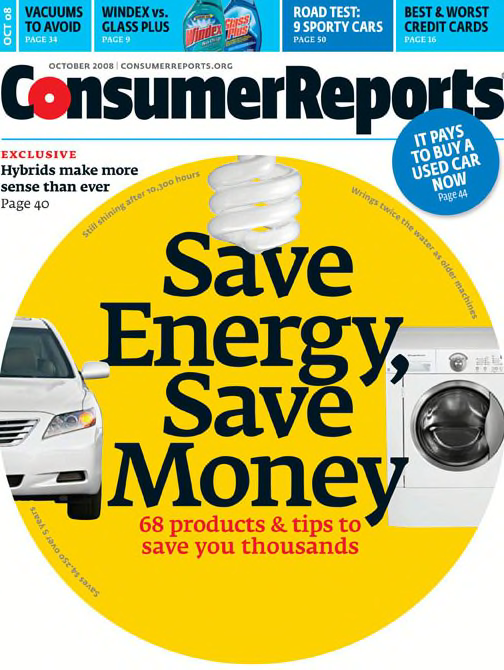
The report, "Which hybrids save you money" is available in the redesigned October issue of Consumer Reports, on sale September 2 on newsstands and online at www.ConsumerReports.org.
The October issue of CR also features an analysis of how drivers can save gas and money by opting for a car with a stick shift. In recent tests, Consumer Reports found that cars with a manual transmission can improve gas mileage by a notable 2 to 5 mpg, compared with an automatic transmission, and can cut a car’s price by $800 to $1,200.
It would take many years for most hybrids to pay back their premium price just on fuel savings alone. But fuel costs are a relatively small part—25 percent—of the overall owner costs in the first five years. Other factors include depreciation, insurance, interest on financing, maintenance and repairs, and sales tax.
Cost estimates were based on driving 12,000 miles per year and paying $4 per gallon for regular gasoline and $4.20 for premium.
“Most of the hybrids tested by CR have done really well, but hybrids have higher initial upfront costs,” said Rik Paul, automotive editor, Consumer Reports. “If you can afford that initial cost, you can be better off buying one, and driving one might make you feel greener.”
The Honda Civic, Nissan Altima, and Saturn Aura hybrids will cost drivers a little more than their conventional counterparts—from $250 to $750 over five years —but some consumers might find it worthwhile to drive a more environmentally friendly car. With federal tax incentives, all three come out ahead after just one year.
Three hybrids—the Lexus GS 450h and RX 400h and the Toyota Highlander Hybrid—cost more than their counterparts in the first five years. They show five year losses ranging from about $1,250 for the Highlander to $5,500 for the GS.
Hybrids vs. Conventional Cars
Interest in hybrids has been on a parallel trajectory with gas prices. Hybrid sales jumped almost 40 percent last year. According to a recent Consumer Reports survey, 32 percent of active car shoppers are considering a hybrid for their next vehicle. And this past summer, automakers had a difficult time keeping up with demand for the most popular models.
In addition to being thrifty with fuel, hybrids emit less pollution, with some models classified as Partial Zero Emission Vehicles by the California Air Resources Board. They also release fewer greenhouse gases because each gallon of gasoline not burned prevents the emission of 19 pounds of carbon dioxide.
The Bottom Line
With higher gas prices, many hybrids now provide a definite benefit in overall owner cost, despite an initial price premium. Still, if saving money right out of the gate is important, some conventional cars provide good fuel economy and cost less than hybrids. Consumer Reports advises people to decide what type of vehicle is right for them and then to choose one that gets good gas mileage for its class and rates highly in CR’s road tests and reliability, safety and ownership-cost ratings.
Consumer Reports is a nonprofit membership organization that works side by side with consumers to create a fairer, safer, and healthier world. For 80 years, CR has provided evidence-based product testing and ratings, rigorous research, hard-hitting investigative journalism, public education, and steadfast policy action on behalf of consumers’ interests. Unconstrained by advertising or other commercial influences, CR has exposed landmark public health and safety issues and strives to be a catalyst for pro-consumer changes in the marketplace. From championing responsible auto safety standards, to winning food and water protections, to enhancing healthcare quality, to fighting back against predatory lenders in the financial markets, Consumer Reports has always been on the front lines, raising the voices of consumers.
© 2008 Consumer Reports. The material above is intended for legitimate news entities only; it may not be used for advertising or promotional purposes. Consumer Reports® is an expert, independent, nonprofit organization whose mission is to work side by side with consumers to create a fairer, safer, and healthier world. We accept no advertising and pay for all the products we test. We are not beholden to any commercial interest. Our income is derived from the sale of Consumer Reports® magazine, ConsumerReports.org® and our other publications and information products, services, fees, and noncommercial contributions and grants. Our Ratings and reports are intended solely for the use of our readers. Neither the Ratings nor the reports may be used in advertising or for any other commercial purpose without our prior written permission. Consumer Reports will take all steps open to it to prevent unauthorized commercial use of its content and trademarks.
Consumer Reports is a nonprofit membership organization that works side by side with consumers to create a fairer, safer, and healthier world. For 80 years, CR has provided evidence-based product testing and ratings, rigorous research, hard-hitting investigative journalism, public education, and steadfast policy action on behalf of consumers’ interests. Unconstrained by advertising or other commercial influences, CR has exposed landmark public health and safety issues and strives to be a catalyst for pro-consumer changes in the marketplace. From championing responsible auto safety standards, to winning food and water protections, to enhancing healthcare quality, to fighting back against predatory lenders in the financial markets, Consumer Reports has always been on the front lines, raising the voices of consumers.
© 2008 Consumer Reports. The material above is intended for legitimate news entities only; it may not be used for advertising or promotional purposes. Consumer Reports® is an expert, independent, nonprofit organization whose mission is to work side by side with consumers to create a fairer, safer, and healthier world. We accept no advertising and pay for all the products we test. We are not beholden to any commercial interest. Our income is derived from the sale of Consumer Reports® magazine, ConsumerReports.org® and our other publications and information products, services, fees, and noncommercial contributions and grants. Our Ratings and reports are intended solely for the use of our readers. Neither the Ratings nor the reports may be used in advertising or for any other commercial purpose without our prior written permission. Consumer Reports will take all steps open to it to prevent unauthorized commercial use of its content and trademarks.