Top Performance Does Not Have to Cost A Bundle; Also More Options
for Digital Picture Frames to Showcase Photos
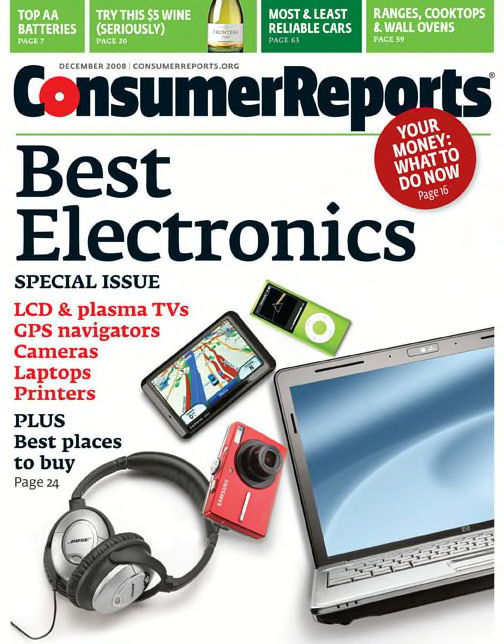
YONKERS, NY —
Consumer Reports tested 77
digital camera models and took 3,080 images to rate the best cameras on the market just in time for the holiday season. No matter what consumers’ needs may be, they will be able to find a good camera at the right price, with subcompact cameras costing less than $250, compacts below $175 and basic SLRs that produced excellent images at $700.
Consumer Reports found that paying more does not guarantee fine performance. The $440 superzoom point-and-shoot Canon PowerShot TX1 fell short in several important areas and ranked dead last among its competitors. Tests also showed the same issue in SLRs with the high-priced basic Sigma SD14, $880 which had the lowest score for image quality.
“Shoppers need to be conscious of what their needs are when shopping for a digital camera, and with so many models available it is a great time to find a good camera at the right price,” said Paul Reynolds, electronics editor at
Consumer Reports. “But be wary of fancy features and high price tags, which don’t always correlate to a better camera.”
Point-and-Shoots Advance
Subcompact and compact cameras continue to improve in many areas. Resolution continues to rise, even though most models already offer more than the 7 megapixels most people need for good resolution. Almost half of the tested point-and-shoots have at least 10. More models have a 3-inch or larger LCD or touch-screen controls, and more superzooms offer zoom capability similar to a pricey SLR.
Consumers who want a pocket-sized camera should go with the Canon PowerShot SD1100 IS ELPH at $200 for its low-light performance, versatility and very short next-shot delay. The Casio Exilim Card EX-S10, $220, is also a good option for its short first-shot delay and manual focus. Another recommendation from
Consumer Reports is the Sony Cyber-shot DSC-T70, $260 which features a 3-inch touch-sensitive LCD, non-telescoping zoom lens and very short next-shot delay.
If shoppers are budget conscious and looking to spend under $200, Consumer Reports suggests the Canon PowerShot A590 IS, $160 because of its manual focus, manual controls, and stabilizer. If cost and size are a concern, the Samsung L210, $150 and the Pentax Optio M50, $170 are both small enough to fit in a pocket.
Digital SLRs Expand
Digital SLRs are adding many new features including the long awaited video recording capability, which arrived this fall in the 12-megapixel Nikon D90, $1,000.
Consumer Reports did find this particular feature lacking and no substitute for a decent HD camcorder. Another new SLR feature is the full-frame sensor, which is the same size as a frame of 35-mm film and can produce better image quality at high ISO settings while offering more options for wide-angle shooting.
One of the most interesting recent innovations is Panasonic’s hybrid point-and-shoot, the Lumix DMC-G1, $800. Like an SLR, it uses a larger image sensor and removable lenses, but this model has the smaller size and weight of a point-and-shoot.
The Pentax K200D, $720, and the Cannon EOS Rebel XSi, $700, are both basic SLRs that stood out in
Consumer Reports’ testing. The Pentax is better designed than other basic SLRs to keep out moisture and dust. It also has an LCD on top that displays exposure and other settings. The Canon is the only basic SLR with excellent image quality and has a 3-inch LCD with live view. For a more advanced SLR,
Consumer Reports’ recommends the Canon EOS-40D Digital, $1,100, for its excellent image quality and dynamic range. It has a live view with autofocus and is very versatile.
Choosing the Right Camera
- Match performance to needs – Image quality is a camera’s most important feature. If action shots are a priority, look for a higher score for first-shot delay and next-shot delay. For landscapes, look for wide-angle capability and excellent or very good dynamic range.
- Decide on needed features – For more control over the image, look for manual controls and RAW-file capability. A glass viewfinder is useful because LCDs typically wash out in bright light. Built-in video, provides the ability to capture an event on the spur of the moment, but it won’t be camcorder quality.
- Size up the design – Most manufacturers offer cameras in a variety of colors and some brands have other, fairly consistent character traits across product lines. Sony excels in sleek, minimalist designs, while Kodak focuses on ease of use.
Digital Picture Frames: Display Photos Continuously
There are more
digital frames on the market now than ever before, but
Consumer Reports recommends resisting the temptation to go small and cheap due to the frames low display resolution. Shoppers should also think twice about the bells and whistles such as a built-in phone or printer, which tend to be unnecessary.
Consumer Reports suggests purchasing the 7- or 8-inch frame that display a 4x6 snapshot and will offer very good performance for a reasonable price. (Check with LH regarding sentence.) One frame stood out in testing, the HP df800, $150, has on-board memory, wall-mountability, and comes with extra, detachable frames for various looks.
What Features Count with Digital Frames
- Shape – Avoid frames with wide-screen length to height ratio of 16:9; they can distort images. For images from a point-and-shoot camera, the ideal ratio is 4:3 and for SLRs are 3:2.
- Resolution – For a 7- or 8-inch frame, resolutions of 720x480 and 800x600 pixels are standard and sufficient.
- Storage and transfer – Most frames work with a memory card filled with shots to display and some models use a USB port to transfer photos directly from a computer or flash drive.
- Controls – Most models have controls on the back, but some include a remote, while others are touch-screen. Some models let consumers adjust color, contrast, or brightness.
- Weigh other features – Many frames automatically rotate images and some can play back video taken on a camera or play MP3 files as the photos cycle through.
 Media Room