 Media Room
Menu
Suggested Searches
Recent Searches
Suggested Searches
Product Ratings
Resources
Chat With AskCR
Resources
All Products A-ZThe payment for your account couldn't be processed or you've canceled your account with us.
Re-activateMy account
Sign In
My account
Sign In
Media Room
Release date 08/03/2009
How to Prepare a Swine Flu Emergency Kit
In case the second wave of swine flu is severe enough to warrant home confinement, consumers should pack an emergency kit in advance. You will need:
For all emergencies, Consumer Reports recommends packing at least three days’ worth of nonperishable food; at least one gallon of water per person, per day; a first-aid kit that includes any prescription or over-the-counter medications your family might need; as well as antihistamines for allergic reactions, pain relievers, stomach and antidiarrhea remedies, and antacids.
The government is currently preparing a vaccine against the swine flu that will likely be recommended for school-age children and other high-risk individuals, such as pregnant women, those with chronic illness, and those who live or work with infants, preschoolers, or older adults. In the meantime, Consumer Reports recommends that everyone—but especially high-risk people—get vaccinated against regular, seasonal flu before December when that infection usually arrives.
“This could be an especially big year for flu, so people need to take every precaution and double their efforts to safeguard their families,” says Joel Keehn, senior editor, Consumer Reports. Even when the vaccine doesn’t prevent seasonal flu, it often lessens its symptoms. In terms of treatments, certain antiviral drugs can not only ease symptoms of seasonal flu but also shorten its duration and possibly prevent complications as well. Some of those drugs probably help against swine flu too. Antivirals work best if taken early on in the illness, so it’s best to take them at the first sign of symptoms.
Brands to Buy and Brands to Skip
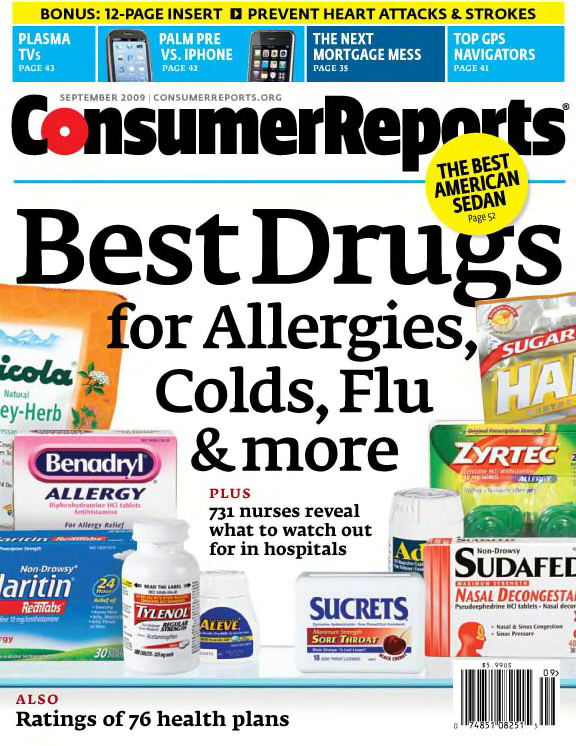
Also in this issue, in a side by side comparison, Consumer Reports identifies the Consumer Reports Best Buy Drug choices to treat eight common conditions, including Attention Deficit/ Hyperactivity Disorder (ADHD), heartburn, and insomnia that can save consumers hundreds or even thousands of dollars a year. For example, consumers who need to lower their LDL (“bad”) cholesterol by less than 30 percent can save nearly $1,000 a year by taking Lovastatin, a generic statin, instead of taking Lipitor, a more expensive brand-name drug. Launched in December 2004, Consumer Reports Best Buy Drugs is a public health initiative that rates more than 200 prescription drugs using comparative effectiveness research. Best Buy Drugs reports are available for free at www.ConsumerReportsHealth.org/BestBuyDrugs. By opting for Best Buy Drug choices, consumers can realize significant monthly savings while receiving the most effective and safest treatments for their condition.
As the new school year approaches and weed pollen allergen levels peak, Consumer Reports also lists other useful information for treating colds and allergies without medication. For colds, the best remedies are the simplest and can often be found in your kitchen, not a drugstore. For example, you can soothe a sore throat with a saltwater gargle, or try honey or nonmedicated lozenges for a cough. Controlling allergies starts by limiting exposure to the triggers, keeping windows shut when outdoor triggers are high, and using an air conditioner or a dehumidifier to reduce humidity. To treat allergy symptoms with over–the-counter drugs, Consumer Reports recommends using generic versions of Claritin and Zyrtec—loratadine or cetirizine.
Avoiding Hidden Drugstore Traps
No matter your ailment, consumers need to watch out for the following traps at the drugstore when shopping for remedies:
Brand-name extensions. Drug manufacturers often use brand names to launch related but different products. There are 34 Vicks products and 14 Sudafed products, and countless store brands and generic versions. With so many products to choose from, people might take medications that are inappropriate or even risky. Recommendation: Choose remedies by active ingredients, not the brand.
Consumer Reports is a nonprofit membership organization that works side by side with consumers to create a fairer, safer, and healthier world. For 80 years, CR has provided evidence-based product testing and ratings, rigorous research, hard-hitting investigative journalism, public education, and steadfast policy action on behalf of consumers’ interests. Unconstrained by advertising or other commercial influences, CR has exposed landmark public health and safety issues and strives to be a catalyst for pro-consumer changes in the marketplace. From championing responsible auto safety standards, to winning food and water protections, to enhancing healthcare quality, to fighting back against predatory lenders in the financial markets, Consumer Reports has always been on the front lines, raising the voices of consumers.
© 2009 Consumer Reports. The material above is intended for legitimate news entities only; it may not be used for advertising or promotional purposes. Consumer Reports® is an expert, independent, nonprofit organization whose mission is to work side by side with consumers to create a fairer, safer, and healthier world. We accept no advertising and pay for all the products we test. We are not beholden to any commercial interest. Our income is derived from the sale of Consumer Reports® magazine, ConsumerReports.org® and our other publications and information products, services, fees, and noncommercial contributions and grants. Our Ratings and reports are intended solely for the use of our readers. Neither the Ratings nor the reports may be used in advertising or for any other commercial purpose without our prior written permission. Consumer Reports will take all steps open to it to prevent unauthorized commercial use of its content and trademarks.
Consumer Reports is a nonprofit membership organization that works side by side with consumers to create a fairer, safer, and healthier world. For 80 years, CR has provided evidence-based product testing and ratings, rigorous research, hard-hitting investigative journalism, public education, and steadfast policy action on behalf of consumers’ interests. Unconstrained by advertising or other commercial influences, CR has exposed landmark public health and safety issues and strives to be a catalyst for pro-consumer changes in the marketplace. From championing responsible auto safety standards, to winning food and water protections, to enhancing healthcare quality, to fighting back against predatory lenders in the financial markets, Consumer Reports has always been on the front lines, raising the voices of consumers.
© 2009 Consumer Reports. The material above is intended for legitimate news entities only; it may not be used for advertising or promotional purposes. Consumer Reports® is an expert, independent, nonprofit organization whose mission is to work side by side with consumers to create a fairer, safer, and healthier world. We accept no advertising and pay for all the products we test. We are not beholden to any commercial interest. Our income is derived from the sale of Consumer Reports® magazine, ConsumerReports.org® and our other publications and information products, services, fees, and noncommercial contributions and grants. Our Ratings and reports are intended solely for the use of our readers. Neither the Ratings nor the reports may be used in advertising or for any other commercial purpose without our prior written permission. Consumer Reports will take all steps open to it to prevent unauthorized commercial use of its content and trademarks.