Menu
Suggested Searches
Recent Searches
Suggested Searches
Product Ratings
Resources
Chat With AskCR
Resources
All Products A-ZThe payment for your account couldn't be processed or you've canceled your account with us.
Re-activateMy account
Sign In
My account
Sign In
Media Room
Release date 08/03/2009
YONKERS, NY ― A car will usually signal that something isn’t right long before it has a major failure, and according to Consumer Reports, that is the time to have it fixed. If early warning signs are ignored, small problems could lead to expensive repairs in the future or even leave you stranded on the side of the road.
As people are keeping their cars longer, maintenance and repairs are becoming a more pressing concern. Nearly half of the respondents to the 2009 Consumer Reports Car Brand Perceptions Survey reported that they have delayed the purchase of a new vehicle.
“Following the recommended maintenance schedule in your vehicle owner’s manual is the best way to avert many large problems,” says David Champion, senior director, Consumer Reports Auto Test Center. “But taking immediate action when you hear a noise or feel something wrong can save you thousands of dollars on avoidable repairs.”
Simply putting off a $30 oil change for 11,000 miles or more can be devastating to your car and your wallet. In some cases sludge buildup can lead to failure of the engine, which can cost as much as $6,000 to replace. Similarly, an oil leak caught early can be an inexpensive fix, but ignoring it can lead to a lack of proper engine lubrication and ultimately engine failure. Timing belt replacement is another routine service that can lead to engine failure. Replacing your car’s timing belt on schedule, usually between 60,000 and 100,000 miles, will cost around $600.
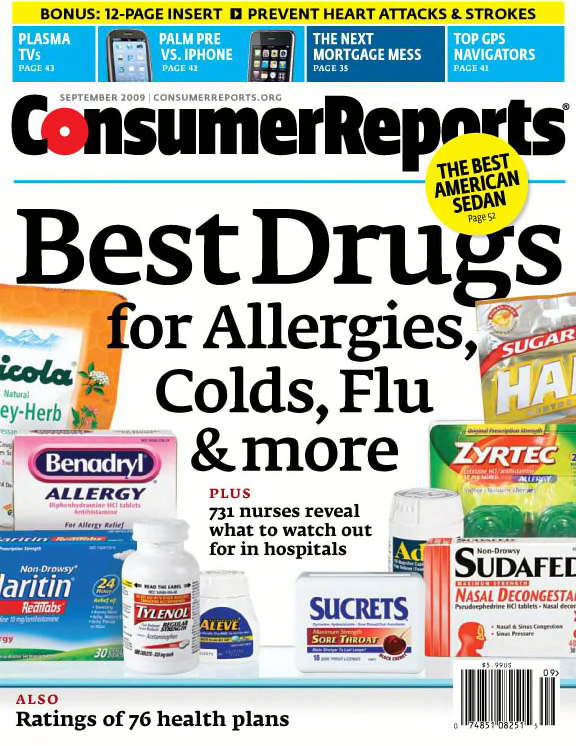
Additional information about early automotive fixes and how to find a great mechanic is available in the September 2009 issue of Consumer Reports and at www.ConsumerReports.org.
Monitoring and repairing other leaks, like transmission fluid, can also save you money. Having your transmission rebuilt can cost $3,000 — as much as ten times more than repairing the initial leak. Other common fixes that can save car owners cash include:
How to find a great mechanic
With hundreds of auto dealerships going out of business, many car owners are facing the challenge of finding a new trustworthy mechanic to do the work, but identifying a mechanic you can trust for your car takes a lot more than letting your fingers do the walking.
According to a survey conducted by Consumer Reports last year of owners of almost 350,000 vehicles, people who used independent mechanics were generally more satisfied than those who had their car serviced at a dealership.
Asking family and friends for recommendations — especially from people who have a vehicle similar to yours — is a good place to start. If you want to do your own research, there are several things you should look for to make sure you’re in good hands.
Combing the internet for information can also help. Several websites, like RepairPal.com and Cartalk.com, offer free information about local mechanics. It’s also a good idea to check with the Better Business Bureau to see which shops you should avoid.
Other things to consider when looking for an independent mechanic include: finding a convenient shop (location and hours), finding a shop that specializes in your vehicle’s make, asking about warranties on work performed at the shop, and making sure the shop is certified by the National Institute for Automotive Service Excellence (ASE).
With more than 7 million print and online subscribers, Consumer Reports is one of the most trusted sources for information and advice on consumer products and services. It conducts the most comprehensive auto-test program of any U.S. publication or Web site; the magazine’s auto experts have decades of experience in driving, testing, and reporting on cars. To become a subscriber, consumers can call 1-800-234-1645. Information and articles from the magazine can be accessed online at www.ConsumerReports.org.
Consumer Reports is a nonprofit membership organization that works side by side with consumers to create a fairer, safer, and healthier world. For 80 years, CR has provided evidence-based product testing and ratings, rigorous research, hard-hitting investigative journalism, public education, and steadfast policy action on behalf of consumers’ interests. Unconstrained by advertising or other commercial influences, CR has exposed landmark public health and safety issues and strives to be a catalyst for pro-consumer changes in the marketplace. From championing responsible auto safety standards, to winning food and water protections, to enhancing healthcare quality, to fighting back against predatory lenders in the financial markets, Consumer Reports has always been on the front lines, raising the voices of consumers.
© 2009 Consumer Reports. The material above is intended for legitimate news entities only; it may not be used for advertising or promotional purposes. Consumer Reports® is an expert, independent, nonprofit organization whose mission is to work side by side with consumers to create a fairer, safer, and healthier world. We accept no advertising and pay for all the products we test. We are not beholden to any commercial interest. Our income is derived from the sale of Consumer Reports® magazine, ConsumerReports.org® and our other publications and information products, services, fees, and noncommercial contributions and grants. Our Ratings and reports are intended solely for the use of our readers. Neither the Ratings nor the reports may be used in advertising or for any other commercial purpose without our prior written permission. Consumer Reports will take all steps open to it to prevent unauthorized commercial use of its content and trademarks.
Consumer Reports is a nonprofit membership organization that works side by side with consumers to create a fairer, safer, and healthier world. For 80 years, CR has provided evidence-based product testing and ratings, rigorous research, hard-hitting investigative journalism, public education, and steadfast policy action on behalf of consumers’ interests. Unconstrained by advertising or other commercial influences, CR has exposed landmark public health and safety issues and strives to be a catalyst for pro-consumer changes in the marketplace. From championing responsible auto safety standards, to winning food and water protections, to enhancing healthcare quality, to fighting back against predatory lenders in the financial markets, Consumer Reports has always been on the front lines, raising the voices of consumers.
© 2009 Consumer Reports. The material above is intended for legitimate news entities only; it may not be used for advertising or promotional purposes. Consumer Reports® is an expert, independent, nonprofit organization whose mission is to work side by side with consumers to create a fairer, safer, and healthier world. We accept no advertising and pay for all the products we test. We are not beholden to any commercial interest. Our income is derived from the sale of Consumer Reports® magazine, ConsumerReports.org® and our other publications and information products, services, fees, and noncommercial contributions and grants. Our Ratings and reports are intended solely for the use of our readers. Neither the Ratings nor the reports may be used in advertising or for any other commercial purpose without our prior written permission. Consumer Reports will take all steps open to it to prevent unauthorized commercial use of its content and trademarks.