Menu
Suggested Searches
Recent Searches
Suggested Searches
Product Ratings
Resources
Chat With AskCR
Resources
All Products A-ZThe payment for your account couldn't be processed or you've canceled your account with us.
Re-activateMy account
Sign In
My account
Sign In
Media Room
Release date 10/05/2009
YONKERS, NY – Consumer Reports latest tests of 25 smoke and carbon-monoxide (CO) alarms found that being safe is much harder than it should be. There is not one device that can sense fast-flaming and smoldering fires and warn consumers about carbon monoxide, forcing consumers to safeguard their homes with some mixing and matching.
Smoke alarms use two technologies: ionization, which detects fast-flaming fires like burning paper but does a lousy job at smoldering fires, and photoelectric, which does just the opposite. There are a few models which use both of these technologies but Consumer Reports notes that the drawback with these is that they do not detect carbon-monoxide leaks. And combined smoke and CO alarms detect only one type of fire depending on the maker.
“We found that keeping your home safe was much more difficult than it should be,” said Celia Kuperszmid Lehrman, home and yard deputy editor of Consumer Reports. “Even trying to get all of a home’s alarms to communicate with one another via an electrical line or wireless signal is a hurdle. However, we found that you can mix-match the alarms in your household and keep it safe.”
Homeowners can rest assured that purchasing any of the alarms tested by Consumer Reports would be better than no detectors at all. For top overall protection, Consumer Reports recommends the Best Buy dual-sensor Kidde PI2000, $30, smoke alarm which connects to home wiring or an existing alarm system and has battery backup for blackouts. When paired with the Kidde Silhouette KN-COPF-1, $60 CO detector they will give the best protection.
The First Alert SA302CN, $25, and the Kidde PI9000, $23 are both recommended as battery-powered smoke detectors and combine both types of smoke sensing in a single battery-powered alarm. For the kitchen and bath, the BRK 7010B, $25, a photoelectric model with battery backup offers excellent protection against smoldering fires without the risk of nuisance alarms. The First Alert SA9120BCN, $15, is recommended where a hardwired ionization sensor is needed to round out an existing alarm system.
As for CO alarms, the First Alert OneLink SCO501CN, $70, a Consumer Reports Best Buy, combines CO and photoelectric smoke detection and can communicate with other wireless First Alert alarms in a large, multi-story home. For a stand-alone model in a small space, Consumer Reports selected the First Alert CO615, $40 as a Best Buy, for its plug-in with battery backup capabilities.
How to Choose
Consumer Reports reminds shoppers that some insurers’ offer a five percent discount if the home has smoke alarms. Consumer Reports recommends that people install both types of smoke sensors and a CO alarm on every level and a smoke alarm in the attic, in all bedrooms and hallways. They also suggest that consumers consider the following when choosing alarms:
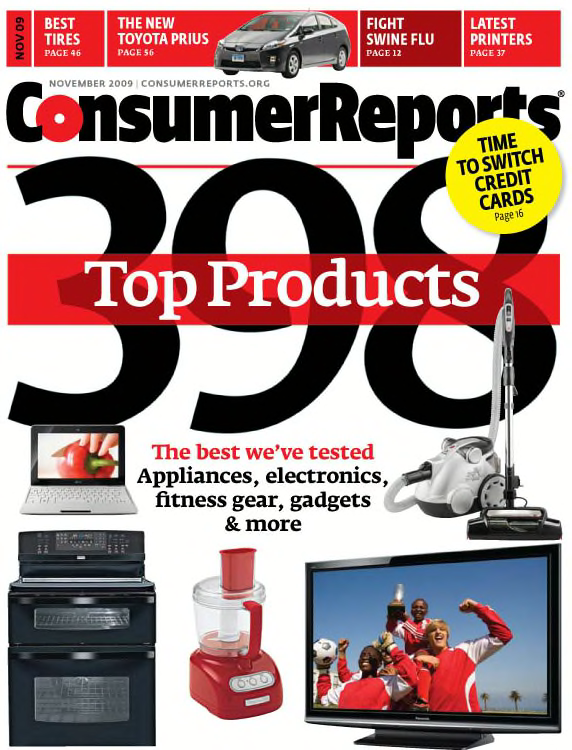
The full report on smoke detectors and carbon-monoxide alarms are available in the November 2009 issue of Consumer Reports, available wherever magazines are sold. It’s also available it online at www.ConsumerReports.org.
Consumer Reports is a nonprofit membership organization that works side by side with consumers to create a fairer, safer, and healthier world. For 80 years, CR has provided evidence-based product testing and ratings, rigorous research, hard-hitting investigative journalism, public education, and steadfast policy action on behalf of consumers’ interests. Unconstrained by advertising or other commercial influences, CR has exposed landmark public health and safety issues and strives to be a catalyst for pro-consumer changes in the marketplace. From championing responsible auto safety standards, to winning food and water protections, to enhancing healthcare quality, to fighting back against predatory lenders in the financial markets, Consumer Reports has always been on the front lines, raising the voices of consumers.
© 2009 Consumer Reports. The material above is intended for legitimate news entities only; it may not be used for advertising or promotional purposes. Consumer Reports® is an expert, independent, nonprofit organization whose mission is to work side by side with consumers to create a fairer, safer, and healthier world. We accept no advertising and pay for all the products we test. We are not beholden to any commercial interest. Our income is derived from the sale of Consumer Reports® magazine, ConsumerReports.org® and our other publications and information products, services, fees, and noncommercial contributions and grants. Our Ratings and reports are intended solely for the use of our readers. Neither the Ratings nor the reports may be used in advertising or for any other commercial purpose without our prior written permission. Consumer Reports will take all steps open to it to prevent unauthorized commercial use of its content and trademarks.
Consumer Reports is a nonprofit membership organization that works side by side with consumers to create a fairer, safer, and healthier world. For 80 years, CR has provided evidence-based product testing and ratings, rigorous research, hard-hitting investigative journalism, public education, and steadfast policy action on behalf of consumers’ interests. Unconstrained by advertising or other commercial influences, CR has exposed landmark public health and safety issues and strives to be a catalyst for pro-consumer changes in the marketplace. From championing responsible auto safety standards, to winning food and water protections, to enhancing healthcare quality, to fighting back against predatory lenders in the financial markets, Consumer Reports has always been on the front lines, raising the voices of consumers.
© 2009 Consumer Reports. The material above is intended for legitimate news entities only; it may not be used for advertising or promotional purposes. Consumer Reports® is an expert, independent, nonprofit organization whose mission is to work side by side with consumers to create a fairer, safer, and healthier world. We accept no advertising and pay for all the products we test. We are not beholden to any commercial interest. Our income is derived from the sale of Consumer Reports® magazine, ConsumerReports.org® and our other publications and information products, services, fees, and noncommercial contributions and grants. Our Ratings and reports are intended solely for the use of our readers. Neither the Ratings nor the reports may be used in advertising or for any other commercial purpose without our prior written permission. Consumer Reports will take all steps open to it to prevent unauthorized commercial use of its content and trademarks.