Menu
Suggested Searches
Recent Searches
Suggested Searches
Product Ratings
Resources
Chat With AskCR
Resources
All Products A-ZThe payment for your account couldn't be processed or you've canceled your account with us.
Re-activateMy account
Sign In
My account
Sign In
Media Room
Release date 09/07/2010
YONKERS, NY — Store brand products can compete with their name-brand counterparts and save shoppers more than a thousand dollars a year on grocery bills, according to a new study from Consumer Reports. In 21 head-to-head taste matchups, national brands won seven times, the store brand came out on top in three instances, and the remainder resulted in ties.
“The study reaffirms that store brands are worth a try,” said Tod Marks, senior projects editor for Consumer Reports. “For a family that spends $100 a week on groceries, the savings could add up to more than $1,500 a year.”
Consumer Reports’ price study evaluated five supermarket chains and compared store-and name-brand prices for 30 everyday items at five chains, collecting a total of 283 price quotes. Consumer Reports found the average savings with store brands was 30 percent, but shoppers saved as much as 52 percent on some items.
Store-brand stigma
Although the savings are significant, some shoppers are still reluctant to try store-brand products, according to a Consumer Reports nationally-represented survey. The top reasons for those who don’t buy store brands are: “I prefer name brands,” “The name brand tastes better,” and “I don’t know if store brands are as high in quality.” Respondents 18 to 39 years old were particularly likely to question the quality of store brands.
Still, 84 percent of Americans purchased store brands in the past year, and 93 percent of store-brand shoppers said they would keep buying as many store brands after the economy recovers. Nationwide, store brands accounted for almost one of four products sold in supermarkets and a record $55.5 billion in sales last year.
Consumer Reports found nutrition similar for most of the tested products, despite the perception among 17 percent of survey respondents who said that “name-brand foods are more nutritious.” The most notable differences: Mott’s applesauce has more sugar than Publix, Ore-Ida fries have more sodium than Jewel, and Kellogg’s Froot Loops have 3 grams of fiber vs. 1 gram in Stop & Shop Fruit Swirls.
Shoppers are devoted to certain categories as well. Though they’ll purchase store-brand paper goods and plastics, at least half of respondents rarely or never buy store-brand wine, pet food, soda, or soup. But Consumer Reports trained testers found that when it came to products like soup, the name brand didn’t always reign:
Name brands did win in seven of the categories, including mayonnaise, mozzarella cheese, and frozen French fries, but the majority of the matchups found that the store brand and name brand were of similar quality. A tie doesn’t mean the taste was identical. Two products may be equally fresh and flavorful, with ingredients of similar quality, but taste dissimilar because the recipe or seasonings differ. Some products that tied include:
Significant Savings
National brands are generally pricier than store brands, not so much because of what’s in the package but because of the cost of developing the product and turning it into a household name.
There’s no reason store brands shouldn’t hold their own, since some companies manufacture both, including Sara Lee, Reynolds, 4C, McCormick, Feit, Manischewitz, Joy Cone, Stonewall Kitchen, and Royal Oak. Plus, most grocers offer a money-back guarantee if their products can’t meet the consumer’s expectations. (National brands stand behind their products too, of course).
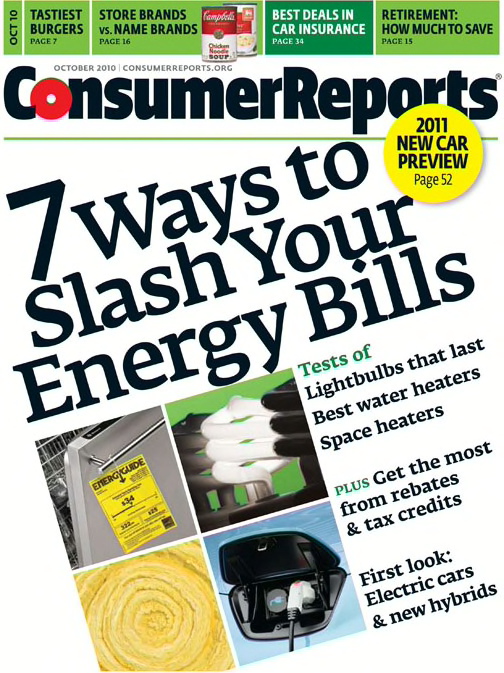
Despite the savings, the price advantage may be narrowing. In recent years, some national-brand makers have lowered prices and stepped up promotional activities. The full results on how all the brands stacked up, Consumer Reports’ study, are available in the October issue on newsstands September 7 and online at www.ConsumerReports.org.
Consumer Reports is a nonprofit membership organization that works side by side with consumers to create a fairer, safer, and healthier world. For 80 years, CR has provided evidence-based product testing and ratings, rigorous research, hard-hitting investigative journalism, public education, and steadfast policy action on behalf of consumers’ interests. Unconstrained by advertising or other commercial influences, CR has exposed landmark public health and safety issues and strives to be a catalyst for pro-consumer changes in the marketplace. From championing responsible auto safety standards, to winning food and water protections, to enhancing healthcare quality, to fighting back against predatory lenders in the financial markets, Consumer Reports has always been on the front lines, raising the voices of consumers.
© 2010 Consumer Reports. The material above is intended for legitimate news entities only; it may not be used for advertising or promotional purposes. Consumer Reports® is an expert, independent, nonprofit organization whose mission is to work side by side with consumers to create a fairer, safer, and healthier world. We accept no advertising and pay for all the products we test. We are not beholden to any commercial interest. Our income is derived from the sale of Consumer Reports® magazine, ConsumerReports.org® and our other publications and information products, services, fees, and noncommercial contributions and grants. Our Ratings and reports are intended solely for the use of our readers. Neither the Ratings nor the reports may be used in advertising or for any other commercial purpose without our prior written permission. Consumer Reports will take all steps open to it to prevent unauthorized commercial use of its content and trademarks.
Consumer Reports is a nonprofit membership organization that works side by side with consumers to create a fairer, safer, and healthier world. For 80 years, CR has provided evidence-based product testing and ratings, rigorous research, hard-hitting investigative journalism, public education, and steadfast policy action on behalf of consumers’ interests. Unconstrained by advertising or other commercial influences, CR has exposed landmark public health and safety issues and strives to be a catalyst for pro-consumer changes in the marketplace. From championing responsible auto safety standards, to winning food and water protections, to enhancing healthcare quality, to fighting back against predatory lenders in the financial markets, Consumer Reports has always been on the front lines, raising the voices of consumers.
© 2010 Consumer Reports. The material above is intended for legitimate news entities only; it may not be used for advertising or promotional purposes. Consumer Reports® is an expert, independent, nonprofit organization whose mission is to work side by side with consumers to create a fairer, safer, and healthier world. We accept no advertising and pay for all the products we test. We are not beholden to any commercial interest. Our income is derived from the sale of Consumer Reports® magazine, ConsumerReports.org® and our other publications and information products, services, fees, and noncommercial contributions and grants. Our Ratings and reports are intended solely for the use of our readers. Neither the Ratings nor the reports may be used in advertising or for any other commercial purpose without our prior written permission. Consumer Reports will take all steps open to it to prevent unauthorized commercial use of its content and trademarks.