 Media Room
Media Room
Media Room
Release date 10/04/2011
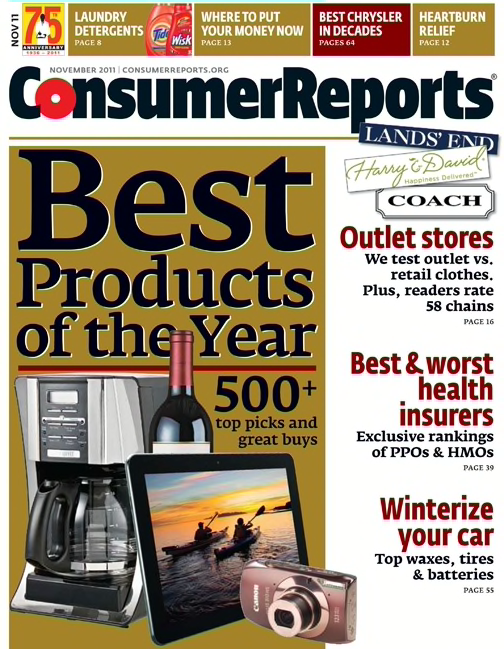
The rankings are from the nonprofit National Committee for Quality Assurance (NCQA), a respected nonprofit quality-measurement and accreditation group. The rankings are based on voluntary disclosure by 912 participating health insurance plans that measure their quality using rigorous, standardized techniques.
“All the health plans in these rankings are exemplary,” said NCQA President Margaret E. O’Kane. “First, they measure their quality in painstaking ways that help them improve and that make comparing plans possible. Then they take the extra step of revealing their results for the world to see—a true public service.”
O’Kane continued, “Groups like NCQA that track quality know these insurers offer superior service compared to the many other plans that avoid measurement or keep their results secret. Being evaluated in public is a huge motivator to improve and a major reason health care gets better.”
This is the second year that Consumer Reports is publishing NCQA’s rankings and the first time that Preferred Provider Organizations (PPOs) are being ranked. PPOs, which in general have less restrictive rules on access to doctors than Health Maintenance Organizations (HMOs), enroll about a third (34 percent) of the U.S. population.
Insurance plans in all 50 states and Washington, D.C. are ranked, including 540 HMOs, 285 PPOs, and five HMOs and PPOs whose owners operate them separately but combine their results. They include plans for Medicare and Medicaid beneficiaries as well as private plans serving employers and individuals. Together, these plans enroll an estimated 127 million Americans.
“American consumers who assume that ‘bigger is better’ and that doctor choice equates with quality might be surprised when they see how insurance plans stack up in the rankings. We were struck by the strong performance among HMOs in general, and by some of the smaller, community-based plans,” says Nancy Metcalf, senior program editor, Consumer Reports.
Private plans with the top score of 5 for consumer satisfaction include:
Some highlights from Consumer Reports’ analysis:
Kaiser plans excel. Almost all of Kaiser Permanente’s private and Medicare HMOs scored better than average for treatment and prevention and were among the highest ranked nationally.
Biggest doesn’t equal best. The largest insurers—Aetna, Cigna, Humana, Kaiser Permanente, and UnitedHealthcare—together with the 60 mostly state-based Blue Cross Blue Shield Plans account for 75 percent of the 390 ranked private plans, but only 36 percent of the top 50.
Small can be good. Some of the top-ranked insurers are smaller, community-based, and mostly nonprofit. Capital Health Plan, a Blue Cross Blue Shield HMO in Tallahassee, Fla., that has just 113,300 enrollees, ranks third in the nation among private plans. The magazine cites several other examples including Tufts Associated HMO and Tufts Health Plan (a PPO), which have enrollees in Massachusetts, New Hampshire, and Rhode Island, and Group Health Cooperative of South Central Wisconsin.
New England shines. Eighteen of the 50 top-ranked private plans are in this compact six-state region. And Aetna and the “Blues” had New England plans ranked in the top 100, while many of the same insurers’ plans in the southern and western states ranked near the bottom of the list.
The type of health insurance one has can affect out-of-pocket costs, provider choice, and potentially the quality of care. Consumers should pick their plans carefully, using the Rankings as a guide and bearing in mind that, while some general difference between plan types exist, employers and insurers have the flexibility to set up plans any way they choose. Consumers should look carefully at the actual terms of a given plan they’re considering.
Consumer Reports suggests the following tips for choosing among an HMO, PPO, or high-deductible plan:
Consumer Reports is the world’s largest independent product-testing organization. Using its more than 50 labs, auto test center, and survey research center, the nonprofit rates thousands of products and services annually. Founded in 1936, Consumer Reports has over 8 million subscribers to its magazine, website, and other publications. Its advocacy division, Consumers Union, works for health reform, food and product safety, financial reform, and other consumer issues in Washington, D.C., the states, and in the marketplace.