Media Room
Menu
Suggested Searches
Recent Searches
Suggested Searches
Product Ratings
Resources
Chat With AskCR
Resources
All Products A-ZThe payment for your account couldn't be processed or you've canceled your account with us.
Re-activateMy account
Sign In
My account
Sign In
Media Room
Release date 08/21/2014

Two federal agencies recently recommended that because fish is a good source of omega-3 fatty acids and other nutrients, women of child-bearing age and young children should eat more lower-mercury fish. While Consumer Reports (CR) agrees that eating fish can be healthy, it analyzed Food and Drug Administration (FDA) data to determine its own recommendations for lower-mercury options. Getting too much mercury can damage the brain and nervous system.
“We’re particularly concerned about canned tuna, which is second only to shrimp as the most commonly eaten seafood in the United States. We encourage pregnant women to avoid all tuna,” said Jean Halloran, director of food policy initiatives for Consumers Union, the advocacy arm of Consumer Reports.
Last June, for the first time, the FDA and the Environmental Protection Agency (EPA) set a firm minimum level for weekly fish consumption, including shellfish. The federal proposal encourages women who are pregnant, breast-feeding or trying to become pregnant to eat between 8 and 12 ounces of fish per week, and for children, it suggests a minimum weekly quota dependent on their age and nutritional needs.
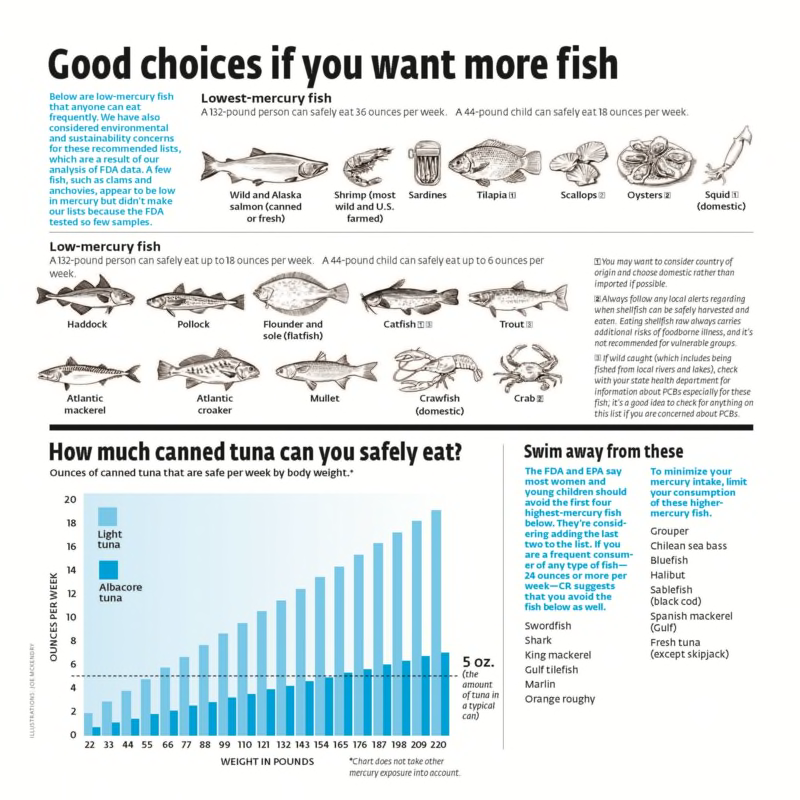
Consumer Reports analyzed the FDA’s own data that measures mercury levels in various types of seafood and found almost 20 seafood choices that can be eaten several times per week, even by pregnant women and young children, without worrying about mercury exposure. In fact, for women who are pregnant or nursing, fish can also contain an important fuel for a baby’s brain development. Fish with the lowest mercury levels includes salmon (Alaskan or other wild), scallops, shrimp (most wild and U.S. farmed), tilapia and more; low-mercury options include catfish, crab, flounder and sole (flatfish), and trout.
The full report, “The Great Fish Debate” is featured in the October 2014 issue of Consumer Reports magazine and is available at www.ConsumerReports.org.
What Consumers Can Do
Other than the new advice on the minimum weekly fish consumption, most of the other federal recommendations are essentially the same ones given in 2004. The agencies advise that young children and women of child-bearing age avoid four fish with the highest mercury levels: swordfish, shark, king mackerel, and tilefish from the Gulf of Mexico. They are also considering adding marlin and orange roughy to that list.
While Consumer Reports agrees that those groups should avoid high-mercury seafood, the organization disagrees with the latest recommendations from the FDA and EPA on how much tuna women and children may eat—and believes pregnant women should avoid eating any tuna.
Even adults can experience the toxic effects of mercury if they consume too much high-mercury fish. Therefore, Consumer Reports also suggests that anyone who eats 24 ounces (1.5 pounds) or more of fish per week, should also steer clear of high-mercury choices, which includes sushi made with tuna.
Consumer Reports has put together the following chart that identifies good low-mercury fish choices.
For more information on Consumer Reports good fish choices and call for action from the FDA and EPA, check out the October 2014 issue of Consumer Reports, on newsstands on Tuesday, September 2nd or online at www.ConsumerReports.org.
Consumer Reports is a nonprofit membership organization that works side by side with consumers to create a fairer, safer, and healthier world. For 80 years, CR has provided evidence-based product testing and ratings, rigorous research, hard-hitting investigative journalism, public education, and steadfast policy action on behalf of consumers’ interests. Unconstrained by advertising or other commercial influences, CR has exposed landmark public health and safety issues and strives to be a catalyst for pro-consumer changes in the marketplace. From championing responsible auto safety standards, to winning food and water protections, to enhancing healthcare quality, to fighting back against predatory lenders in the financial markets, Consumer Reports has always been on the front lines, raising the voices of consumers.
© 2014 Consumer Reports. The material above is intended for legitimate news entities only; it may not be used for advertising or promotional purposes. Consumer Reports® is an expert, independent, nonprofit organization whose mission is to work side by side with consumers to create a fairer, safer, and healthier world. We accept no advertising and pay for all the products we test. We are not beholden to any commercial interest. Our income is derived from the sale of Consumer Reports® magazine, ConsumerReports.org® and our other publications and information products, services, fees, and noncommercial contributions and grants. Our Ratings and reports are intended solely for the use of our readers. Neither the Ratings nor the reports may be used in advertising or for any other commercial purpose without our prior written permission. Consumer Reports will take all steps open to it to prevent unauthorized commercial use of its content and trademarks.
Consumer Reports is a nonprofit membership organization that works side by side with consumers to create a fairer, safer, and healthier world. For 80 years, CR has provided evidence-based product testing and ratings, rigorous research, hard-hitting investigative journalism, public education, and steadfast policy action on behalf of consumers’ interests. Unconstrained by advertising or other commercial influences, CR has exposed landmark public health and safety issues and strives to be a catalyst for pro-consumer changes in the marketplace. From championing responsible auto safety standards, to winning food and water protections, to enhancing healthcare quality, to fighting back against predatory lenders in the financial markets, Consumer Reports has always been on the front lines, raising the voices of consumers.
© 2014 Consumer Reports. The material above is intended for legitimate news entities only; it may not be used for advertising or promotional purposes. Consumer Reports® is an expert, independent, nonprofit organization whose mission is to work side by side with consumers to create a fairer, safer, and healthier world. We accept no advertising and pay for all the products we test. We are not beholden to any commercial interest. Our income is derived from the sale of Consumer Reports® magazine, ConsumerReports.org® and our other publications and information products, services, fees, and noncommercial contributions and grants. Our Ratings and reports are intended solely for the use of our readers. Neither the Ratings nor the reports may be used in advertising or for any other commercial purpose without our prior written permission. Consumer Reports will take all steps open to it to prevent unauthorized commercial use of its content and trademarks.