 Media Room
Media Room
Media Room
Release date 06/11/2020
YONKERS, NY — Three quarters of adults are “very” or “somewhat” concerned about the continued transmission of COVID-19 virus into their communities, according to a new nationally-representative survey from Consumer Reports, the nonprofit consumer research, testing, and advocacy organization. The findings are similar to last month when 76 percent of Americans in a CR survey said they were “extremely” or “very” concerned about the widespread transmission of coronavirus in the US.
The CR American Experiences Survey, fielded from May 8 to 18, included questions on the pandemic’s impact on consumers’ attitudes, behavior, and finances. Like the previous survey completed in April, it found that black and Hispanic adults are much more likely to be concerned about the virus. When asked, “How concerned or not concerned are you about COVID-19 continuing to spread in your local area over the next month,” 41 percent of all adults said they are “very concerned.” That figure is much higher among black (55 percent) and Hispanic (48 percent) adults than among white (34%) adults. Hispanic and black communities have been especially hard hit by the pandemic, experiencing higher numbers of cases and deaths in certain areas of the U.S.
The survey fielded just prior to widespread protests in response to the killing of George Floyd, notes Kristen Purcell, Chief Research Officer at Consumer Reports. “At that time COVID spread was foremost in most Americans’ minds as many states were reopening, with data clearly showing the pandemic was taking the greatest financial and public health toll on black and Hispanic Americans.”
In addition to racial and ethnic differences, divides over concern about the spread of COVID-19 are seen across socio-economic and generational lines. Adults earning under $30,000 annually are the most likely to express high levels of concern about the continuing spread, with 48 percent saying they are very concerned. The level of concern for other income groups range from a low of 35 percent who are very concerned among those who earn between $30,000 and $59,999 annually, to 40 percent among those earning more than $100,000 annually. Looking at age cohorts, Americans ages 60 and older are the most likely to say they are very concerned about continued spread (48 percent), while those ages 18 to 44 are least likely (35 percent).
Only 16 Percent Expect to Go Back to Living Life as They Did Before
CR’s May American Experiences Survey shows that most Americans do not expect to return to their previous lifestyles in the wake of the COVID outbreak and subsequent shutdowns across the nation. About six in ten (58 percent) report that they would try to keep "some” of the changes they made during the outbreak, and another 26 percent say they expect to keep “most” or “all” of the changes they made. Just 16 percent say they expect to go back to living the way they did before, with no real changes.
Responses to this question vary across gender, age, income and race/ethnicity groups. Women are more likely than men (30 percent vs. 22 percent) to say they expect to live very differently than they did before the outbreak by keeping most of the changes they’ve made, as are 45 to 59-year-olds (32 percent) and adults 60 and older (29 percent), when compared with 18 to 29 year-olds (18 percent). Among racial groups, black respondents lead in the sentiment that they expect to live their lives very differently after COVID at 43 percent followed by Hispanic respondents (32 percent), and white adults (22 percent).
 |
Consumers Reluctant to Return to “Everyday” Activities
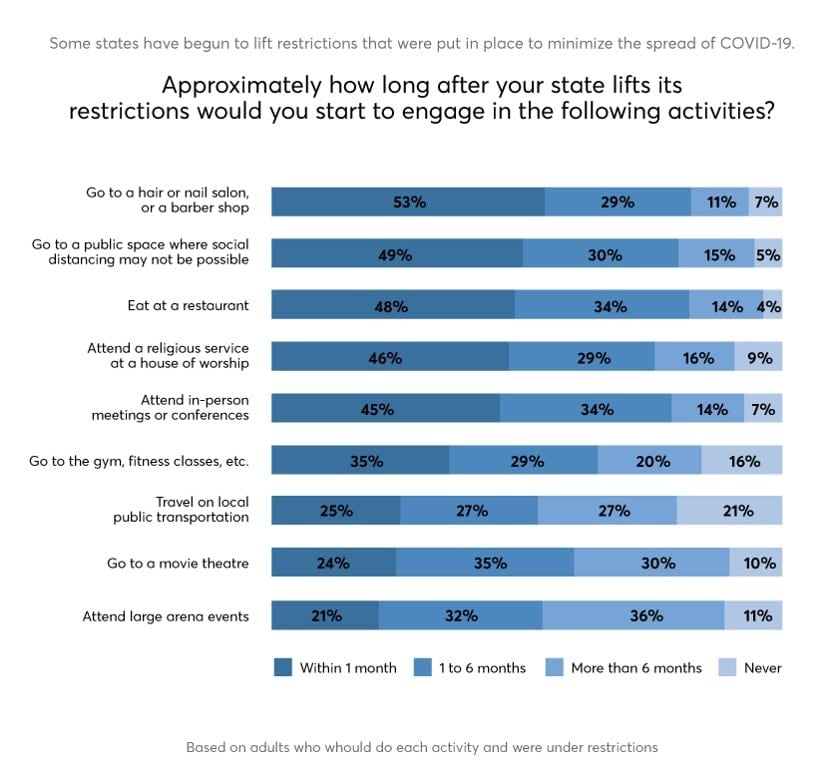
Asked how quickly they will return to their everyday activities after restrictions lift, about half say they will return in the first month to such activities as:
Comfort in returning to certain activities including using public transportation, attending large arena events and going to the gym or fitness classes may take longer. Some adults, who would normally engage in each of these activities, state that they will “never” return to them, and sizable percentages say they will wait more than six months.
As Dr. Purcell explains, “It’s hard to know if people who say now that they will never return to an activity will continue to feel that way in the coming months, but it reflects the current level of anxiety many Americans feel about returning to what were once everyday activities. While some are eager to get back to normal activities, many others plan to take a wait and see approach.”
Two-thirds Likely to Get COVID-19 Vaccine‒if One Becomes Available
Asked if they would get a COVID-19 vaccine if one becomes available, about two-thirds of adults say they are likely to do so‒40 percent are very likely and 25 percent somewhat likely. Men are more likely than women (44 percent vs. 35 percent) to say they are very likely to get a vaccine, as are adults age 60 and older (49 percent), when compared with all other age groups. Sixty percent of adults living in households with incomes of $100,000 or more say they are very likely to get a COVID vaccine, a much higher portion than among other income groups.
Among the 34 percent of adults who are not too likely or not at all likely to get a COVID-19 vaccine, 45 percent cite safety concerns over a COVID-19 vaccine as their main reason. Another 15 percent cite a belief that all vaccines are unsafe, and 14 percent say the threat from COVID has been exaggerated.
About Consumer Reports American Experiences Survey
Consumer Reports’ American Experiences Survey (AES) is conducted monthly to track consumer attitudes and behaviors over time. It was fielded by NORC at the University of Chicago to a nationally representative sample of 2,085 US adults. The margin of error for the sample of 2,085 is +/- 2.91 percentage points at the 95% confidence level. The survey was conducted from May 8-18, 2020.