 Media Room
Media Room
Media Room
Release date 04/07/2021
YONKERS, NY — More than a year since the Coronavirus reshaped people’s lives in the US and worldwide, a new, nationally representative survey from Consumer Reports (CR), the nonprofit consumer research, testing, and advocacy organization, finds that a majority of Americans (64 percent) remain concerned about the continued spread and effects of COVID in their local area over the next month.
For certain communities, the effects of the pandemic and concern about the immediate future are still felt very much.
While overall levels of concern are down slightly from prior surveys, Black, English-speaking Asian, and Hispanic adults are all still significantly more likely than white adults to say they are “very concerned” that COVID will continue to spread in their communities. The survey also shows that women are slightly more likely than men to say they are “very concerned” (35 percent versus 25 percent), a trend that has remained fairly constant in recent months.
“For certain communities, the effects of the pandemic and concern about the immediate future are still felt very much,” notes Kristen Purcell, Chief Research Officer at Consumer Reports. ”In addition, our latest survey paints an image of two disparate groups of Americans--one that is weathering the pandemic with little if any personal financial impact and another that continues to struggle. From the very beginning it has been the most vulnerable who foresaw the toll this pandemic would have on their lives.”
Consumer Reports has been tracking consumer sentiment on the pandemic since March 2020, completing more than 25,000 surveys with US adults. CR also conducted online qualitative interviews about the impacts of the COVID pandemic over six months with a panel of 235 Americans, tracking the economic impact on an individual and family level.
Personal and Financial Impact
Reports of the negative financial impact of COVID have been widespread, yet for some the pandemic has been a boon. For those with the ability to work from home, the pandemic has also meant the ability to save on things like commuting costs, child care, eating out. For others, the pandemic has hit harder. Of those Americans who were employed pre-pandemic, the majority of them (62 percent) reported a job change or change to their working situation, including a shift to remote work, since the start of the COVID-19 outbreak. Fourteen percent said they started a new job. Many reported loss of work (26 percent stopped working a job). And a third started working remotely.
Those most likely to have reported job changes included younger individuals and lower income individuals (half of those aged 18 to 29 and half of those with household incomes under $30,000 who are typically employed say they stopped working or started a new job during the pandemic).
Hispanics were more likely to say they stopped or started a new job during the pandemic compared to non-Hispanics (42 percent versus 33 percent, of those who are typically employed).
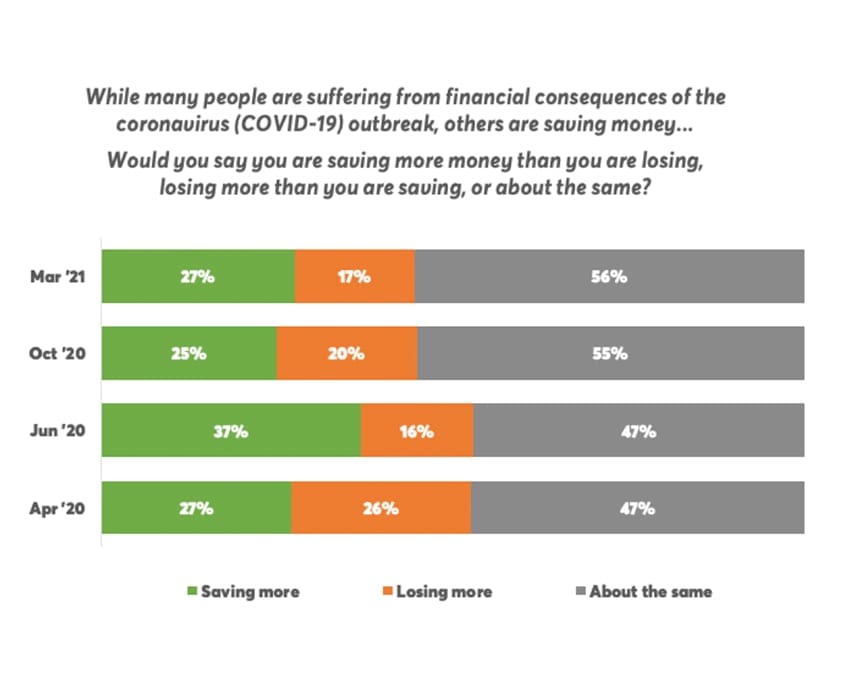
Despite those individuals suffering negative financial impacts from job and income loss, there is a sizable portion of Americans who are coming out ahead financially during the outbreak, thanks to trends such as reduced commuting costs, using fewer services, and engaging in fewer activities. Slightly over a quarter (27 percent) said they are saving more money now than they are losing, and a majority of Americans (56 percent) said they are netting about the same when it comes to saving versus losing money.
Access to Medical Care
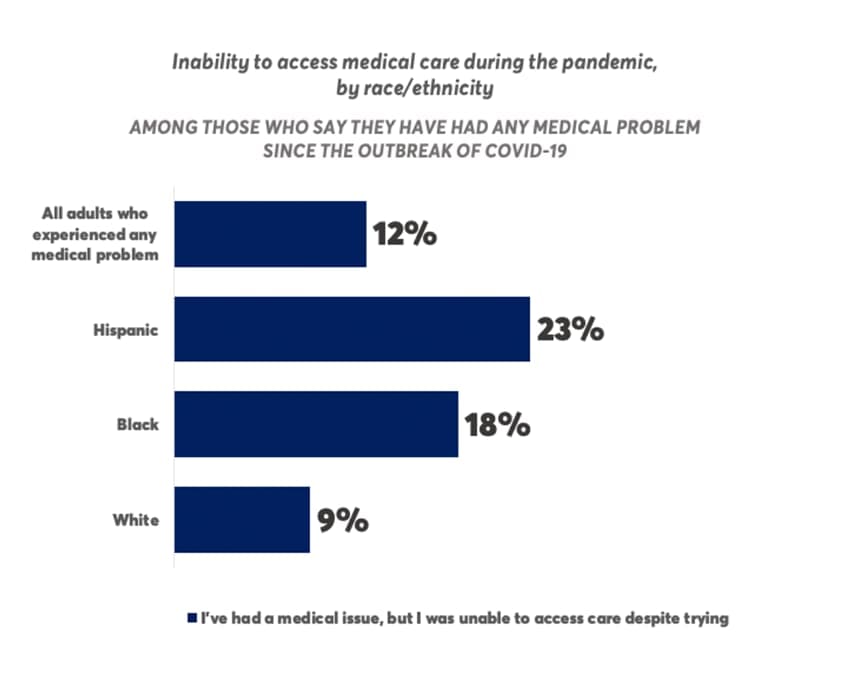
About half of Americans have experienced some kind of a medical problem during the coronavirus outbreak (including issues both related to and unrelated to COVID-19). Among those who have had medical problems during the past year, over a third (39 percent) said they did not seek out medical care, and 12 percent say they were unable to access care despite trying.
White adults are the least likely to experience difficulty accessing medical care when they have a health issue, compared to Black and Hispanic adults. Among those who reported experiencing any medical problem in the past year, 23 percent of Hispanics and 18 percent of Blacks said they were unable to access care despite trying (versus 9 percent of white adults who had a medical issue that say so).
Mental Health
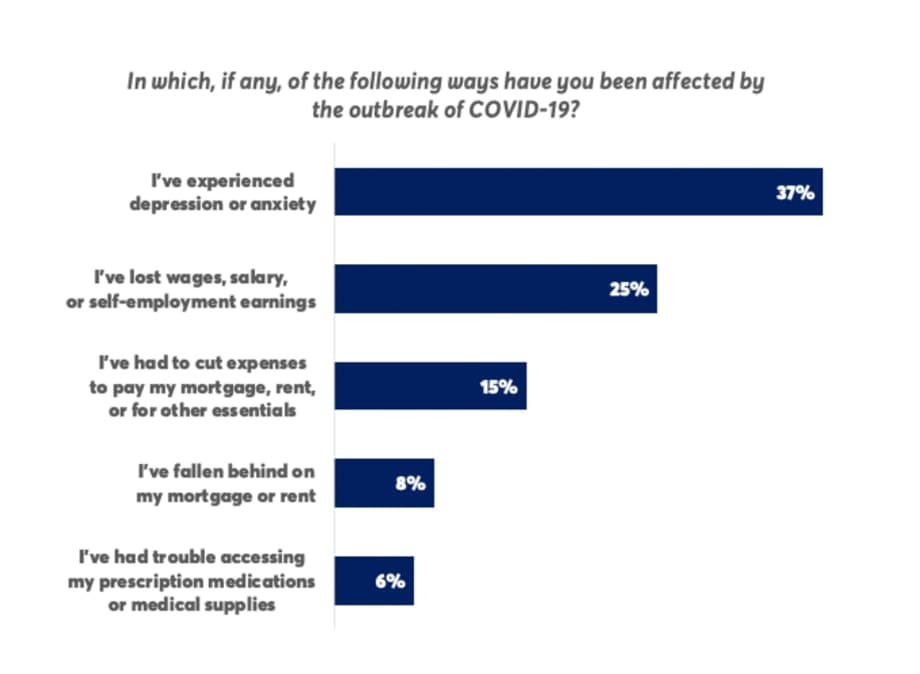
The pandemic continues to take a toll on mental health. Overall, 37 percent of Americans said they had experienced depression or anxiety due to the pandemic; that’s compared to 40 percent in December.
What the Future Might Look Like
About a quarter of Americans (24 percent) said they expect to go back to living the way they did before COVID, with no real changes. Instead, most (55 percent) expect to try to keep some of the changes they made during the outbreak and 20 percent expect to live very differently by keeping most or all of the changes they have made in their lives.
Black adults are most likely to say they plan to live very differently and keep most or all of the changes they made during the outbreak (38 percent, compared to 28 percent of Hispanics, 22 percent of English-speaking Asians, and 15 percent of whites).
About Consumer Reports American Experiences Survey
Consumer Reports’ American Experiences Survey (AES) is conducted monthly to track consumer attitudes and behaviors over time. It was fielded by NORC at the University of Chicago to a nationally representative sample of 2,144 US adults. The survey was conducted from March 4-15, 2021. Interviews were conducted in English and in Spanish, and were administered both online and by phone.