PICTURE QUALITY. It did a very good job displaying fine detail. There was some slight loss of fine texture likely due to noise reduction processing. Color accuracy was very good, with images generally looking natural. Contrast—the difference between the darkest blacks and brightest whites—was good, so images had depth and dimension, typical of most models we test. The brightness level was good, making it a suitable choice for most rooms. The model had deep black levels, just shy of the best models. In scenes with subtly shaded light-to-dark areas, such as a sky during sunset, the model did a very good job producing a smooth transition without distinct, coarse bands.
VIEWING ANGLE. This Insignia has a moderate viewing angle overall, decent, but not quite as good as the better-performing TVs we've tested. The optimal seating position for best picture quality is directly in front of this model. When we viewed the TV from the sides, image quality got worse. The picture showed a moderate loss of color, so flesh tones looked a bit washed out, along with a moderate color shift. Black levels visibly brightened, reducing contrast especially on dark scenes. When viewing the image from above or below eye level to the screen, the vertical viewing angle was very good. The picture showed minimal change in color, contrast, and black level.
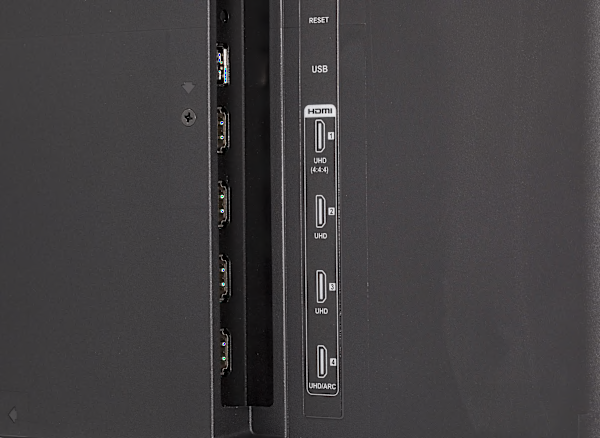
ULTRA HD PERFORMANCE. Overall, falls short. All native 4K content we played on this model, including movies and test videos, showed very good detail when played back via the TV's HDMI input. However, when viewed from up close, some of the fine image detail showed slight coarseness along the edges of objects in the scene. Even on our test patterns, very fine black and white line patterns had somewhat of a "checkerboard" appearance. While UHD's extended detail was apparent, the clarity of the finest details fell short of the better UHD TVs we've tested. This TV supports video streaming of 4K programs via both Netflix, and YouTube. Image quality was similar to what we saw via HDMI, but here we also detected a touch of possible noise reduction processing, which affected the clarity of fine texture. We also checked 4K video and photo playback via a flash drive plugged into the TV's USB port. We were able to play 4K videos in the HEVC and VP9 formats, but not the MP4 file formats. Play back of high resolution photos and 4K test patterns were displayed in full 4K detail but a moderate level of over-sharpening was applied to the image, which may bother picky viewers. When playing 1080p movie content from a Blu-ray disc, we found the TV's HD-to-UHD up-conversion processing fell short of the best we've seen, with edges along diagonals of image content showing more jaggies than we expect. All four of the TV's HDMI inputs comply with the latest HDMI 2.0/HDCP 2.2 specification, a requirement for compatibility with 4K movie play back devices such as a 4K Blu ray player.
MOTION BLUR. This Insignia TV has good motion performance, with some blurring on our motion tests. This is better than average for LCD displays with the basic 60Hz frame rate. This model does not include a blur reduction feature.
SCREEN REFLECTIVITY. Though not as mirror-like as on some models, this screen surface is glossy and therefore susceptible to reflections from a nearby lamp or window. The screen is dark so it does a good job reducing glare from ambient light and maintains contrast even in a bright room.
SOUND QUALITY. This model has fair sound quality with below average performance. It's acceptable for typical programming, but shortcomings become obvious with movie soundtracks and music. With movies, dialog was generally clear and natural sounding, though a bit muffled, and background music and other sounds were slightly recessed. Bass was lacking and treble lacked detail, while the overall sound was somewhat closed in. The speakers produced a good volume—so this model should play sufficiently loud in typical room environments and without obvious distortion—a plus if you'll be using this model in a large room or noisy environment. Also, at higher volume, dynamic compression kept the sound from distorting, but also limited the clarity of peaks in loudness, which was a bit distracting on some audio content. If sound quality matters to you, you might want to add a soundbar or other external speaker system.
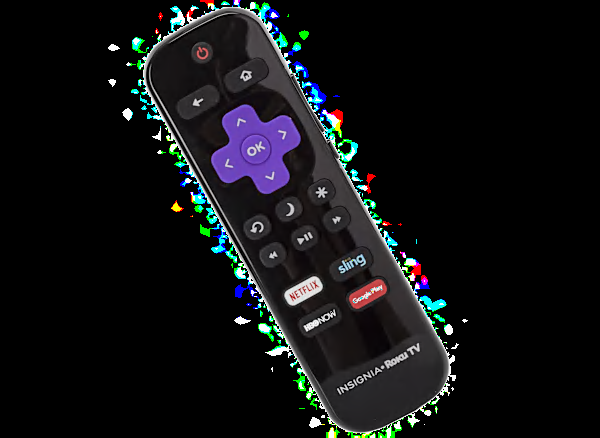
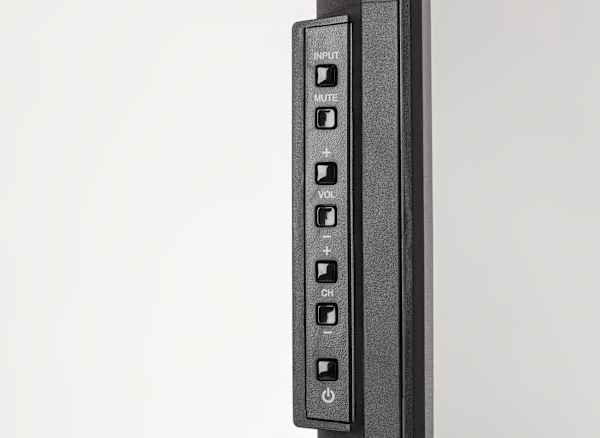
EASE OF USE. Overall, it was fairly easy to setup and fairly easy to do routine things. On first power up there is an on-screen guide that helps you through setting up the TV. The remote's buttons are labeled with non-standard icons, which can be confusing. The remote's major function buttons were sufficiently large and have high-contrast labeling, making them easier to see and navigate.
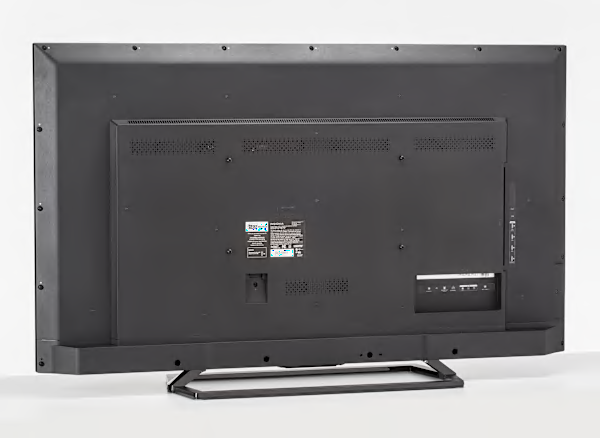
STAND ASSEMBLY. The TV's base does not come pre-attached, so some assembly is required. Mounting the support stand to the TV is straightforward, though the stand requires the assembly of one part before mounting.
INTERNET FEATURES. This TV provides advanced Internet capabilities via its "Roku TV" portal with access to a library of applications. Movie streaming services include: Netflix, Amazon, Hulu Plus, Vudu, YouTube, HBO Go.
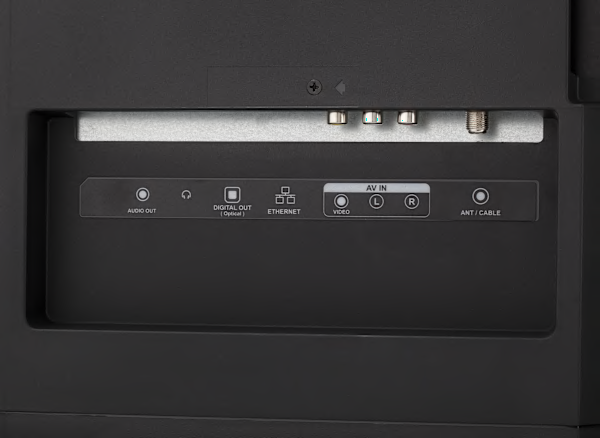
CONNECTIONS. This model has four HDMI inputs—one supports MHL (Mobile High-definition Link), and one composite input. It also has one USB port, an optical digital audio out, a headphone out, an Ethernet port. Wireless connectivity is built-in. DLNA: accesses files within your home network. Casting: control the TV from a smartphone that has the suitable app installed. Screen mirroring: the image on your smartphone or other compatible device can also appear on the TV. The cable connections on the rear panel are recessed with side or bottom-facing ports, so wires don't protrude beyond the display's depth.
INCLUDED IN THE BOX. A quick start guide. A remote control with batteries. A detachable power cord. No printed manual is included.