Sign In


Not long ago I was talking with a recently retired friend, a former stockbroker who probably planned for retirement as well as anybody. I asked him how he was faring in the current economy, expecting to hear his take on the volatile stock market or the negligible yields on bonds and CDs. But what he said surprised me.
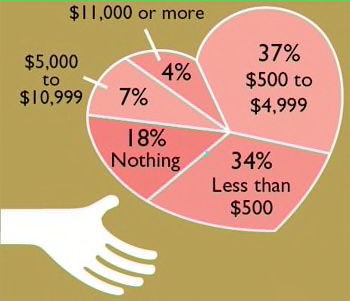
"We're doing OK," he said. "It's not being able to help our kids as much as we hoped to that pains us."
I was reminded of my friend the other day when I interviewed Susan MacMichael John, a fee-only financial planner in Wolfeboro, N.H., for this column. She's seeing much the same reaction among her retired clients. "Retirees aren't panicking," she said. "It's what's happening with their kids that's freaking them out. They've lost their jobs. They're losing their homes."
Of course, both my friend and John's clients are luckier than most. Many Americans are having a tough time supporting themselves in retirement, let alone doing anything for their children. And you don't even have to have kids to find yourself in this situation. A parent, sibling, niece, nephew—you name it—who's down on his or her luck can pose the same sort of dilemma.
So before I depress all of us out of our wits, here are some possible solutions.
When to help, when not to
A good first step, when you're asked to help, is to assess how serious and how urgent the problem really is, John suggests. "Sometimes kids jump the gun in panic," she adds, but "sometimes they wait too long, until it may be too late." If a grown child can't make his mortgage payments and is facing foreclosure, that's a serious problem, and you might want to intervene, assuming you're in a position to. On the other hand, if your child didn't get an expected bonus at work and can't take his kids skiing over spring break, that's more of a judgment call.
A perfectly good reason not to help is if you simply can't afford to. Or if doing so will jeopardize your retirement. For example, contributing to a child's or grandchild's college fund is a nice thing to do, but your retirement should come first, most financial planners will tell you. Ditto for lavish weddings, first-home down payments, and any other big-ticket obligations you might be expected to foot the bill for. Tell your child how much (if anything) you can afford to contribute. If that's not enough, she can come up with the rest, or else scale back in the spirit of these frugal times.
I would avoid withdrawing or even borrowing from a 401(k) plan, unless it's for something like a life-or-death medical treatment. For a raft of reasons we've covered in the past, tax-deferred accounts are best left untouched until you begin withdrawals for your own retirement.
All of this might seem harsh and selfish, but there's a good argument to be made that it's as much for the child's sake as your own. The last thing you want, if you have any choice in the matter, is to deplete your retirement savings and end up financially dependent on your kids. They probably don't want that either.
Gifts vs. loans
One age-old question in these situations is whether to consider any financial help you provide to be a loan or a gift. People on the gift side of the debate say your child might never be able to repay you anyway, so just calling the money a gift lessens the likelihood of future ill feeling. Bear in mind that if your gift exceeds $13,000 a year, or $26,000 in the case of couples, you could be subject to gift taxes. Publication 950 on the IRS website has the details.
Loan advocates, meanwhile, will tell you that a loan encourages responsibility on the part of the child, plus you stand a chance of getting some money back eventually. You can plow those funds into your retirement fund or keep it in reserve for the next family emergency.
Personally, I think a lot depends on the particular child as well as the amount of money involved. I do know that if you decide to go the loan route, you'll be wise to get the terms in writing to avoid any misunderstandings.
Julian Block, a tax attorney and author in Larchmont, N.Y., says a loan agreement should include a reasonable interest rate and a well-defined repayment schedule. If your child is unable to repay you, you might be able to deduct the loan as a nonbusiness bad debt, which goes on Schedule D of your tax return, under short-term capital losses. Let's hope it never comes to that, but should you ever need the details, they're in Publication 17 on the IRS site.

 WASHING MACHINE REVIEWS
 GENERATOR REVIEWS
 Build & Buy Car Buying Service
Save thousands off MSRP with upfront dealer pricing information and a transparent car buying experience.
 Get Ratings on the go and compare
while you shop