Sign In


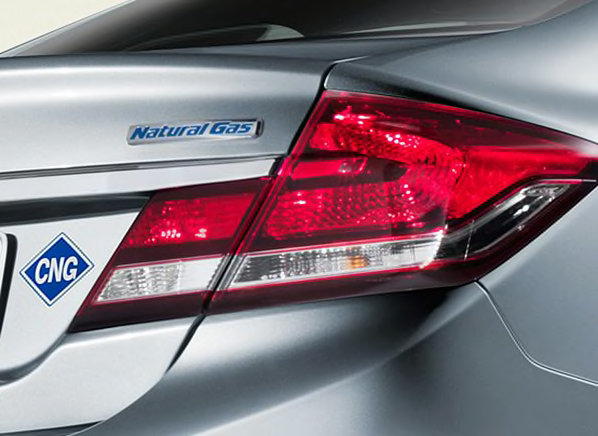
The buzz on alternatives to gasoline usually focuses on electrics, hybrids, or ethanol. But Honda is quietly pushing another alternative: a Civic that runs on compressed natural gas (CNG). The natural gas Civic has been offered in fleet sales since 1998, and customers in California and certain other states since 2005. Honda rolled its latest CNG sedan out nationwide for 2012, based on the current Civic.
Like other alternative fuels, CNG has its advantages and disadvantages. Compared with gasoline, it has much cleaner emissions while providing similar fuel economy, performance, and drivability. Its relative energy cost can be about half that of gasoline, and it's mostly a domestically produced energy source, thus contributing to reducing the reliance on foreign oil. (More than 85 percent of the CNG consumed in the U.S. is produced here.) On the other hand, the Civic Natural Gas is priced thousands of dollars higher than a similar gasoline-powered version, refueling stations are sparse, and CNG is not available at all‑even for home‑fueling in some areas.
Natural gas has been used as a motor vehicle fuel since the 1930s. But with the increased focus on electricity, ethanol and other alternative fuels, fewer and fewer CNG-powered passenger vehicles have been offered in recent years. Shoppers were left to choose only from Honda and a handful of aftermarket conversion companies, along with used fleet cars. Now General Motors, Ford, and Chrysler have come back into the game with heavy duty pickups converted to run on natural gas. All three are available from dealers. While they're primarily designed for fleets, consumers can also order them.
Honda used to sell a home refueling device called Phill, now sold by an Italian company called BRC FuelMaker. The device can refuel a vehicle overnight when connected to a gas line from a home served by natural gas. But at this time, Honda does not recommended home refueling "because of moisture and other contaminants inherent in some natural gas supplies." This is a shame, as the ability to refuel overnight could help address the limitations with fuel pump availability.
Natural gas refueling, however, is still problematic. A few states, such as California and New York have an infrastructure in place to deliver natural gas, but other areas have very limited access to the fuel. Since CNG is generally transported by pipeline, rather than by truck or rail, the distribution infrastructure plays a key role in the fuel's availability.
To help understand the value of CNG, we broke down the notable benefits and the compromises involved. Like all alternatives, CNG will not be for everyone. But if it is available in your area, and you do a fair bit of commuting in a region with a ready supply, it might be worth a look.
Cost
The cost of CNG can be as little as half that of a gallon of gas if you use a home refueling device. And at commercial stations, the cost is still significantly less than gasoline. Some research pegs the fuel savings at about 30 percent less than gasoline on average, although as of this writing the savings are nearly 40 percent.
The driving experience
Drivers will be hard-pressed to notice a significant difference in performance between a CNG-powered vehicle and one fueled by gasoline. Though acceleration is typically slower, the car starts and drives normally. As a bonus, in some states, drivers of CNG vehicles can use the HOV lane. A study of New York City taxis running on natural gas concluded that maintenance costs were also reduced.
Air quality
CNG burns much cleaner than gasoline. According to the Environmental Protection Agency, CNG can reduce carbon-monoxide emissions by 90 to 97 percent and nitrogen-oxide emissions by 35 to 60 percent when compared with gasoline. CNG can also potentially reduce non-methane hydrocarbon emissions by 50 to 75 percent, while producing fewer carcinogenic pollutants and little or no particulate matter.
Reducing reliance on foreign oil. Using domestically sourced natural gas reduces reliance on imported oil, as does driving on electric power.
Purchase cost
CNG-powered vehicles have generally cost more to purchase new than comparable gasoline models. Suggested retail for the Civic Natural Gas is $26,155 plus $770 for destination charges. A comparably equipped, gasoline-powered Civic LX lists for $18,242. A home refueling unit, plus installation, can cost upwards of $5,000, making the premium to drive a CNG Civic can top $10,000, before incentives.
Availability
CNG stations are not available in some areas. Check the U.S. Department of Energy Web site for availability in your region.
Honey, they shrunk the trunk
Even though a CNG tank is larger than a gasoline tank, you get fewer miles per tank. With the Civic Natural Gas, roughly half the trunk capacity is given over to the tank, with 6 cubic feet left for your luggage. The range between fill-ups also shrinks. Honda claims a 220 to 250 mile range from the Civic Natural Gas. But when we tested a 2008 model, we couldn't get more than about 130 before the low-fuel indicator came on.
Range anxiety. With a claimed usable range of 160-180 miles in the updated Civic Natural Gas, you're going to feel range anxiety as soon as the low fuel light comes on. Given the scarcity of public access CNG filling stations, that's a big concern.
Gassing up with CNG
Even if you have access to natural gas, refueling can be a hassle. There are a limited number of refueling stations in the United States, and many are operated by fleets and not open to the public.
In addition, the pressurized CNG pumps take some getting used to. They use a special fitting to seal to the vehicle, something most motorists might not recognize. A Honda representative suggested a 15-minute training session before using the pumps. Many pumps also work on a card-reader system specific to the fuel supplier. Users are billed monthly, which may be less convenient than handing over cash.
And the pumps take about twice as long to fill the car as a regular gas pump.
If you choose to fill up with a home system
An advantage of refueling stations over a home unit is that the gas is already pressurized, so the tank can be filled in a matter of minutes. Gas fed to the home is under very low pressure. The home refill device acts as both a pump and a compressor, which is why it takes overnight to fill the tank. But refueling at home can cost much less than a refueling station, so it can be worth the wait, especially if the refueling is done overnight. Of course, it would take time for the payback of the initial unit cost and installation. Also, installation is likely to require a building permit.
Safety
The Department of Energy says vehicles powered by natural gas are as safe as conventional gasoline or diesel vehicles, and their pressurized tanks have been designed to withstand severe impact, temperature, and environmental exposure. CNG is lighter than air, so if fuel were to escape in a crash, it would evaporate rather than create a puddle under the car. While the gas is escaping the storage tank, it is highly volatile. But once the gas has evaporated, the fire danger is diminished. In contrast, a gasoline spill remains a danger until the pooled liquid is removed.
As for the potentially scary business of home refueling, BRC FuelMaker Corp. of Italy, says that the unit will not operate if it is not connected properly and that a built-in sensor shuts it down if the system senses a methane leak or any other malfunction. The manufacturer also says the device is considered a home appliance by municipalities, like a hot-water heater or gas dryer. Still, it would be wise to check with local authorities before making the investment.
Features
Alternative fuel cars aren't just for misers anymore. Honda has added content to the Civic Natural Gas for 2014, including its touch-screen radio, navigation, and optional leather seats.
Don't want a Honda?
There are companies that specialize in converting other models to run on CNG. The Department of Energy says you can expect to pay between $2,000 and $4,000 for such specialty conversions. Chrysler, Ford, and General Motors offer heavy-duty CNG pickups for special-order from dealerships. All are available in a wide variety of body and drive configurations.
No promises of cheap fuel
Natural-gas prices have been volatile, and today's good deal might not look so good tomorrow. As anyone who has bought gasoline in the last few years knows, fuel prices can change quickly.

 WASHING MACHINE REVIEWS
 GENERATOR REVIEWS
 Build & Buy Car Buying Service
Save thousands off MSRP with upfront dealer pricing information and a transparent car buying experience.
 Get Ratings on the go and compare
while you shop