Mole check

How to spot a suspicious spot

Last updated: July 2011

The key to effectively examining your body for skin cancer is to familiarize yourself with your own skin. "What you are looking for are changes, something that wasn't there before or a mole that appears to be growing or changing color," advises Allan Halpern, M.D., chief of the dermatology service at the Memorial Sloan-Kettering Cancer Center in New York. Here's what to look for when doing a mole check:
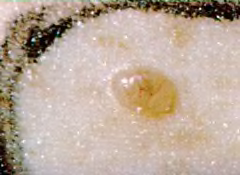
Basal cell carcinoma (BCC)

BCCs can develop anywhere but most often form on sun-exposed areas—the face, scalp, neck, hands, and arms. They are typically slow-growing and might look like any of the following:
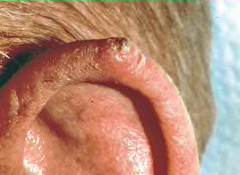
  • A persistent reddish patch of dry skin.
  • A pearl-shaped lump that's skin-colored, pink, red, or brown, often with a depression in the center.
  • A pimple that won't clear.
  • A sore that bleeds, heals, and returns.
  • A scar that feels waxy and might be skin-colored, white, or yellow.
  • A group of shiny pink or red growths that are often scaly and bleed easily.
  • A hard, flat, or sunken growth that might be white or yellow.

Squamous cell carcinoma (SCC)

SCCs often appear on sun-exposed skin but can occur elsewhere—inside the mouth, on lips, or genitals. They often look like:
  • A hard, scaly, or crusty reddish bump, patch, or pearl-shaped growth.
  • An open sore that itches and bleeds, and might heal and return.
  • A scaly patch on the lip that can thicken.

Melanoma

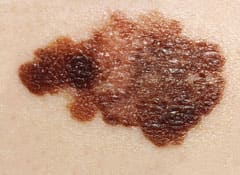
Healthy moles are typically small, one color, circular or oval, and have a well-defined border. Suspicious moles usually have one or more of the distinctive A, B, C, D, E characteristics summarized below. Some melanomas can also appear as a brown or black streak under the fingernails or look like a bruise that won't heal. A melanoma will sometimes itch, bleed, or feel painful.

  • Asymmetry: One half is unlike the other.
  • Border: An irregular or poorly defined border.
  • Color: Varies from one area to another, often in shades of tan, black, and brown. Is sometimes white, red, or blue.
  • Diameter: Typically greater than the size of a pencil eraser, but they can be smaller.
  • Evolving: A mole or lesion that looks unlike others or is changing in color, shape, or size.
   

E-mail Newsletters

FREE e-mail Newsletters!
Choose from safety, health, cars, and more!
Already signed-up?
Manage your newsletters here too.

Health News

Federal limits on arsenic in food and beverages still not in place

How much progress have federal officials made in taking steps to reduce Americans' exposure to arsenic in everyday foods such as rice and apple juice? Not as much as we'd hope to see. While there...

Pollen panic? Best allergy treatment is a drugstore brand

We're barely a week into Spring and already pollen counts in some parts of the U.S. are on the rise, causing sheer misery in the form of runny noses, itchy, watery eyes, and sneezing for nearly 6...

Do kids need vitamin D supplements?

Some do. Because most breast milk does not contain much vitamin D, the American Academy of Pediatrics says breast-fed infants should get 400 IU daily from supplement drops. Our new Ratings of vit...

LifeScan recalls OneTouch VerioIQ blood glucose meters

Over 90,000 OneTouch VerioIQ blood glucose meters are being recalled by its maker LifeScan, Inc. According to the company, a unit of Johnson & Johnson, the meters can inadvertently shut off if re...

Americans are still clueless about health reform three years later

You have to hand it to the foes of the Affordable Care Act. They've been hugely successful at "educating" the public on all the unpopular parts, including some that don't even exist. Meanwhile, p...

Connect

and safety with
subscribers and fans

Follow us on:

Mobile

Mobile Get Ratings on the go and compare
while you shop

Learn more