Sign In

Menu
Suggested Searches
Recent Searches
Suggested Searches
Product Ratings
Resources
Chat With AskCR
Resources
All Products A-ZThe payment for your account couldn't be processed or you've canceled your account with us.
Re-activateMy account
Sign In
My account
Sign In
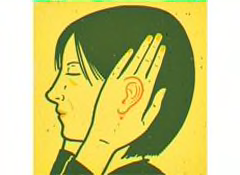
It took almost two days to air out the examining room from its most recent occupant, the 78-year-old mother of a colleague who came to see me at the urging of her grandchildren. They had been refusing to visit her for the past month because of a terrible odor in her apartment. It wasn't long before they realized that the source was Grandma herself.
I recognized the odor as soon as I entered the examining room. It had the distinct smell of skin infected with the bacterium pseudomonas, common in people with cancerous growths that have pushed through the skin. When I examined her I discovered a large, open wound on her left breast, beneath which was a rock-hard, golf-ball-sized mass.
She had known about the lump for about three months. The skin breakthrough and infection had been present for a month. It had crossed her mind that it might be cancer—but she had also hoped it would go away on its own. And when the infection developed, she said, she began to feel guilty about not seeking help in the first place; she tried her best to cover it up with various creams and the lavish use of perfume. Grandma was practicing denial, an innate, adaptive trick of the human mind that often erupts in an attempt to diffuse the punishing effects of bad news.
Sigmund Freud defined the state of being "in denial" as a strong basic mechanism, often unconscious, for coping with unpleasant news in an attempt to protect one's ego. In real life, denial can range from that subconscious refusal to see the truth to any behavior that seeks to avoid blame for an antisocial act. It explains, for example, how the 6-year-old, caught in the act of stealing from the cookie jar, can say, straight-faced, "I didn't do it."
In the medical world, denial can serve a useful function in some circumstances. A 2010 study from the Netherlands of almost 200 patients with recently diagnosed lung cancer found that those who displayed only low to moderate awareness of the seriousness of their condition reported feeling and functioning better physically compared with those who acknowledged how dire things were. And in an article published in 2006, University of Vermont researchers found that indulging in a "denial phase" helped people newly diagnosed with cancer to cope with each stage of the illness at a manageable rate. In neither of those cases did denial improve the course of a potentially fatal disease. But it probably made life more tolerable for the patients.
Of course, denial by either the patient or the physician is never useful if it interferes with the diagnosis and treatment of serious disease. For example, it's almost universally accepted among physicians that alcoholism is a major cause of sickness and death, but due to the stigma attached to being labeled an alcoholic—and the secrecy and evasion that often accompany alcoholism—it remains woefully underdiagnosed. And a diagnosis of diabetes, especially in teenagers and middle-agers, often evokes a "Why me?" response and an overly casual approach to a serious disorder that can have dire complications.
Fortunately, few cases of denial are as flagrant as that of my colleague's mother. After receiving a diagnosis of widespread metastatic breast cancer, she declined chemotherapy and died eight months later.


 WASHING MACHINE REVIEWS
 GENERATOR REVIEWS
 Build & Buy Car Buying Service
Save thousands off MSRP with upfront dealer pricing information and a transparent car buying experience.
 Get Ratings on the go and compare
while you shop