Sign In


One in five Americans—almost 60 million—are enrolled in Medicaid, the government's health insurance program for low-income people. Enrollment has increased since 2008 as people have lost jobs and health insurance. And that occurred as state budgets got crunched in the recession. As a result, some states are cutting back on Medicaid benefits.
In 2011, seven states passed laws to limit benefits or increase cost sharing, such as co-payments for some children enrolled in the Children's Health Insurance Program (CHIP), according to a study by the National Association of Children's Hospitals.
California, for example, instituted enrollee co-pays ranging from $5 for an office visit to $200 for a hospitalization. Most Medicaid enrollees are limited to seven office visits per year.
Medicaid HMOs are included in our rankings of health-insurance plans.
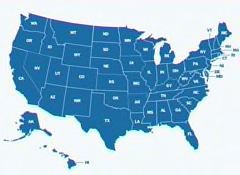
Click on the image at right for NCQA's rankings of health insurance plans nationwide. Use the tool to:
How can I find out whether I am eligible?
Eligibility depends on where you live. While the federal government sets minimum eligibility levels and standards and provides more than half of the funding, each state partially funds and runs its own program and can expand eligibility if it chooses.
HealthCare.gov can provide guidance on your health-insurance options, including Medicaid eligibility. Or you can type Medicaid and your state's name in the search box of an Internet search engine. Just make sure to go to your state's official site.
If you're enrolled in Medicare, you might also be able to get Medicaid. About one in six low-income Medicare beneficiaries were covered by Medicaid in 2005. Those seniors are known as "dual eligibles." Medicaid helps them with Medicare premiums and cost-sharing and covers important services that Medicare limits or does not cover.
Can Medicaid be used to help pay for nursing-home costs?
Yes. In fact, 70 percent of all nursing-home residents are enrolled in Medicaid. Here, too, eligibility can differ by state, and seniors must often "spend down" their own savings on nursing-home costs before they are eligible for the program.
What about children and pregnant women?
Again, rules vary from state to state. But in general, Medicaid is a backup insurer for millions of pregnant women who have no other insurance. Many states cover women with income about twice the poverty level. Medicaid pays for four of every 10 births in the U.S. and is the largest source of public funding for family planning.
The Children's Health Insurance Program (CHIP) provides free or low-cost insurance for children in low-income working families who do not qualify for Medicaid. In many states, families can have higher incomes and their children can still qualify. Get more information on CHIP in your state.
Which people with disabilities are covered?
This, too, varies by state. Medicaid covers some 8 million non-elderly people with disabilities and is an essential adjunct to Medicare for the 9 million or so low-income elderly and disabled Medicare beneficiaries who depend on Medicaid to help with premiums, gaps in benefits, and long-term care.
Does the health reform law change Medicaid?
Yes. Starting in 2014, Medicaid eligibility for people younger than 65 will be based primarily on income and not categorical criteria such as whether you have children or are disabled. Everyone younger than 65 with a household income up to 133 percent of the poverty level (in 2013, $14,856 for an individual and about $30,656 for a family of four) will qualify. That change was intended to expand Medicaid eligibility to about 15 million more people than are enrolled today, according to some estimates. However, in June, 2012, the U.S. Supreme Court said that states could opt out of this Medicaid expansion if they wanted to, and several governors have said they plan to do so.
In those states, households with incomes below the federal poverty level ($11,170 for one person; up to $23,050 for four people) will not qualify for Medicaid unless they fall into existing eligibility categories, such as pregnant women or certain parents of minor children. And they also won't be eligible for subsidies on their state's exchange, because when the law was written they were intended to have coverage under an expanded Medicaid program. (States can opt into the expansion at a later date if they choose.) Read more about health care reform.
Below is a chart showing what incomes households must have in order to be eligible for Medicaid (in states that have chosen to expand it) or for subsidies to purchase coverage on their state's exchange.
Family size |
Eligible for Medicaid (annual income) | Eligible for a subsidy (annual income) |
1 |
Up to $14,856
|
$11,170 to $44,680
|
2 |
Up to $20,123
|
$15,130 to $60,520
|
3 |
Up to $25,390
|
$19,090 to $76,360
|
4 |
Up to $30,657
|
$23,050 to $92,200
|

 WASHING MACHINE REVIEWS
 GENERATOR REVIEWS
 Build & Buy Car Buying Service
Save thousands off MSRP with upfront dealer pricing information and a transparent car buying experience.
 Get Ratings on the go and compare
while you shop