Sign In


Our rankings of private, Medicare, and Medicaid health insurance plans are based on data and calculations from the National Committee for Quality Assurance (NCQA), a nonprofit group that develops quality measures and accredits health insurance plans, doctors, and other organizations.
This year, NCQA ranked a record 1,051 plans on their quality of care, customer satisfaction, and commitment to improvement and disclosure of information. There were 507 plans for people who get insurance through their employer, 408 for people with Medicare, and 136 for those covered by Medicaid.
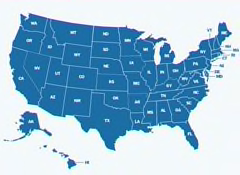
Click on the image at right for rankings of health insurance plans nationwide. Use the tool to:
The plans are ranked in three categories:
There are three reasons you might not see your health insurance plan. First, not all plans submit data to NCQA. Second, some that do submit data choose not to make their results public. Third, some plans don't have enough available data to make valid statistical comparisons. If your plan isn't listed in these rankings, ask a plan representative for an explanation.
The plans listed in your state's marketplace and in these rankings are not identical. That's because plans in the marketplace are still new, so NCQA does not yet have data for them. But these rankings can help by showing you the track record of similar plans in your state in previous years. So go to Healthcare.gov to find the marketplace for your state. Then check the rankings of private plans in the rankings low to see if any of the plans are similar to those offered through your state's marketplace. A plan's record in your state provides an indication of how well the new marketplace plan may perform. (For more on the Affordable Care Act, use our Health Law Helper tool.)
There are several possible reasons. A plan might not offer a particular benefit or service or it might have too few enrollees using them. Or the plan might not submit data for a particular measure, or choose not to make some results public. NCQA differentiates between no reported data at all ("Data Not Reported") and those that a plan can't report because it doesn't offer the benefit or has too few members affected ("Not Applicable").
Each health plan received an overall score between 1 and 100 based on how it compared with other plans in its category (private, Medicare, or Medicaid) on consumer satisfaction, prevention, treatment, and accreditation. Accreditation is an independent review of how well a plan does at working with doctors and patients to provide high quality health care and at providing important consumer protections. Plans that are not accredited, including those that are in the NCQA-accreditation process or scheduled to go through it, get zero points for this category.
Prevention and treatment account for 60 percent of the score for all plans; consumer satisfaction, 25 percent; and NCQA accreditation, 15 percent. Plans are ranked according to their overall scores.
The overall score is based in part on performance measures from the Healthcare Effectiveness Data and Information Set, or HEDIS®. Plans submit HEDIS data from billing and medical records as well as patient medical charts. Consumer satisfaction is based on two surveys: the Consumer Assessment of Health Providers and Systems survey, or CAHPS®; and the Health Outcome Survey (HOS).
All the data we report this year, except the CAHPS assessments for Medicare plans, comes from HEDIS and CAHPS assessments for the 2012 plan year; the Medicare CAHPS data are for 2011.
For prevention and treatment measures in 2014, NCQA used measures in different areas of care, such as asthma-medication use and controlling high blood pressure. In general, private plans, Medicare plans, and Medicaid plans are graded on the same measures, but some are unique to each. For example, glaucoma screening and osteoporosis management were taken into account when evaluating Medicare plans.
NCQA summarizes the scores for dozens of individual measures in several ways. First, it scores plans on composites of related measures. When assessing diabetes treatment, for example, it considers blood-pressure control, retinal eye exams, glucose testing and control, LDL cholesterol screening and control, and monitoring kidney disease. Those composite scores are further summarized into scores for the three components of care: consumer satisfaction, prevention, and treatment.
NCQA scores all those measures on a scale of 1 to 5, from worst to best. Those that get a 5 are in the top 10 percent compared with other plans in their category, those that get a 4 are above average, those that get a 3 are average, those that get a 2 are below average, and those that get a 1 are in the bottom 10 percent.
During the NCQA accreditation process, evaluations by physicians and managed-care experts make sure not only that the plan has the right policies and procedures but also that the plan is following them. Do the plans provide accurate marketing material? Do they give clear information to members on coverage and denial decisions? Do the providers in their networks have proper credentials?
Accredited plans also commit to being held accountable for their performance by reporting data on it. Experience has shown that when plans do that, the performance usually improves. In fact, the health care reform law will require that any plan sold through exchanges in 2014 and beyond must be accredited.
Unaccredited plans lose ground in the NCQA rankings because accreditation counts for up to 15 points out of a possible 100. There are a number of reasons a plan might skip NCQA accreditation, including the expense—plans pay a fee to the NCQA for it. Plans might be accredited by another organization, again for a fee. Many more Medicare and Medicaid plans than private plans are not accredited.
All unaccredited ranked plans do submit some quality and consumer satisfaction data. So you can compare unaccredited and accredited plans in your area, based on performance in treatment, prevention, and satisfaction, and decide whether the components that are most important to you make up for the lack of accreditation and its associated commitment to reporting and external review. But before choosing an unaccredited plan, we recommend that you ask a plan representative why it isn't accredited and carefully review its consumer protection policies.
That makes it easier for you to find the plans you're interested in. Many consumers, for instance, want the option of going to a non-network doctor or hospital, in which case they'll consider only PPOs. Families with young children may prefer HMOs because they tend to have low or no deductibles. But the standards used for evaluation are the same for both types of plans, so they are ranked on a single scale.
You can use them to look closely at a single plan or compare up to five plans. In either case, focus on three things. First look at a plan's 1 to 100 overall score; then see how it ranks in your state and nationally; and then look at its scores for prevention, treatment, and customer satisfaction. For even more detail, click on the plan's name and see how it did in dozens of measures, such as how well it cared for people with diabetes.
Don't focus too much on minor differences in overall scores or rank, such as between plans with scores from, say, 82 to 86 or ones ranked 70th and 80th nationally. Instead, pay attention to larger differences in overall score and rank and on the 1-to-5 scale for prevention, treatment, and customer satisfaction.
And remember that nonaccredited plans generally have lower scores than accredited plans because accreditation can add as much as 15 points to a plan's overall score.
Health insurance plans that people buy on their own aren't represented as often in the NCQA rankings as plans offered through an employer, Medicare, or Medicaid. And the private-plan rankings primarily reflect private employer-based coverage that companies buy for their workers, not coverage that companies "self-insure," meaning they assume the insurance risk themselves and contract with insurers to manage health-insurance benefits.
Even so, many insurers sell the same plans to self-insured companies and to individuals. But the name of the insurance product or plan and the exact benefit package might be quite different. For more details on plans offered to individuals, go to Healthcare.gov.
Each of these health plans may offer several policies with different premium and coverage levels that affect the price. The price of any single insurance policy is also influenced by other factors such as your age, your health status, and whether you are buying for your family or just yourself. If you are buying through your employer, it can be even more difficult to estimate the price. Most employers cover a portion of the premium, and the price you pay depends on what your portion is. If you are buying insurance for yourself on the individual market, you can look up the price of the base premium using the plan-finder feature at the federal government's consumer health website, Healthcare.gov. That price may be higher, though, if you have additional risk factors, and it doesn't include the costs you'd pay for care out of pocket. Some plans listed in a particular state may be available for sale only to employer groups, not to individuals.
Consumer Reports has alsop evaluated private plans in a category called Avoiding Overuse. To earn Consumer Reports' Avoiding Overuse designation (indicated by a checkmark), plans must have sufficient data, score higher in overall quality, and do better in at least three of the following areas: avoiding inappropriate use of antibiotics, limiting imaging tests for lower-back pain, reducing hospital readmissions, avoiding overuse of emergency rooms, and reducing overuse of invasive heart procedures. Download a PDF showing how private plans fared in Avoiding Overuse. And For more details about the Avoiding Overuse measure, see our technical report.
Go to NCQA's Health Insurance Plan Rankings 2014—Methodology Overview.
Note: HEDIS® is a registered trademark of the National Committee for Quality Assurance. Medicare data used in NCQA's rankings of health-insurance plans depends on annual approval from the federal government's Centers for Medicare and Medicaid Services. CAHPS® is a registered trademark of the Agency for Healthcare Research and Quality.

 WASHING MACHINE REVIEWS
 GENERATOR REVIEWS
 Build & Buy Car Buying Service
Save thousands off MSRP with upfront dealer pricing information and a transparent car buying experience.
 Get Ratings on the go and compare
while you shop