Sign In

I'm often surprised to hear my patients say that they got their tattoos while they were intoxicated. These confessions usually pour out spontaneously, prompted by anxiety, as I prepare to insert a needle for medical reasons. Getting a tattoo may be exciting, but you shouldn't get drunk and cloud your judgment before you get one.
Permanent tattoos have been growing in popularity (pop star Justin Bieber's tattoos even have their own fan website). Twenty-one percent of all U.S. adults admit to having at least one tattoo, according to a Harris Interactive poll taken this year, up from the 14 percent of Americans who said so in 2008. Adults age 30 to 39 are most likely to have a tattoo (38 percent), and women are slightly more likely than men to have tattoos (23 percent vs. 19 percent).
No longer just the stigmata of sailors, prison inmates, and bikers, tattoos have gone mainstream, prompted in part by celebrity body art. Pop star Rihanna, who reportedly has 17, admits she gets "tattoo fever" when the impulse strikes. Singers Miley Cyrus and Selena Gomez, actors Johnny Depp, Colin Farrell, Angelina Jolie, and Brad Pitt, along with quite a few athletes have also flaunted their tattoos.
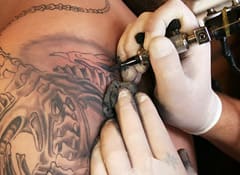
But as tattooing has spread, so have the associated health risks—skin infections, allergic reactions, and blood-borne diseases. Recently in Rochester, N.Y., 19 patrons of a tattoo parlor were infected with the organism Mycobacterium chelonae, which causes a rash and bumps on the skin; left untreated, the bacteria can spread to the lungs. The tattooing was performed using premixed gray ink, manufactured in Arizona, that had been contaminated before distribution, according to a New England Journal of Medicine report. And outbreaks of MRSA (Methicillin-resistant staphylococcus aureus) skin infections from commercially acquired tattoos have also been reported.
State and local authorities oversee tattoo practices, which vary considerably across the country. There is no standard regulation for training or licensing, and virtually no requirements for inspection, record-keeping, or informed consent. Although most states have laws prohibiting minors from getting tattoos, many teens nonetheless find them easy to get.
And almost anyone can put up a tattoo shingle. For example, in New York City, where tattoo parlors are not licensed, a tattooist can get a practitioner's license after simply paying some fees and passing a three-hour infection control course.
In New York's Westchester and Putnam counties, where I practice, tattoo shops are unregulated. leaving multiple opportunities for health dangers. Because the skin itself is teeming with organisms, if rigorous infection control practices are not used, it can become easily infected when pierced. If equipment or surfaces are improperly sterilized, or if needles are reused, it's possible for viruses such as hepatitis to be transmitted from people who were tattooed earlier.
In addition, blood splatter can contaminate tattoo inks, which are often sold in more economical bulk containers. Sterile, single-use inks are available, but they are more expensive and rarely offered. Tattoo inks, which may be chemically complex and contain metals and solvents, are not regulated by the Food and Drug Administration. These inks may consist of azo pigments that not only contain multiple impurities, but are also used in car paint. Many of these pigments are illegal to use in cosmetics in Europe because they can break down into cancer-causing compounds, which may be absorbed into the skin.
If your mind is still set on a new tattoo, be sure to take these precautions.


 WASHING MACHINE REVIEWS
 GENERATOR REVIEWS
 Build & Buy Car Buying Service
Save thousands off MSRP with upfront dealer pricing information and a transparent car buying experience.
 Get Ratings on the go and compare
while you shop