Sign In

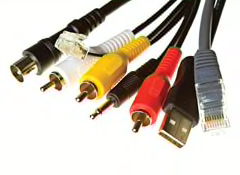
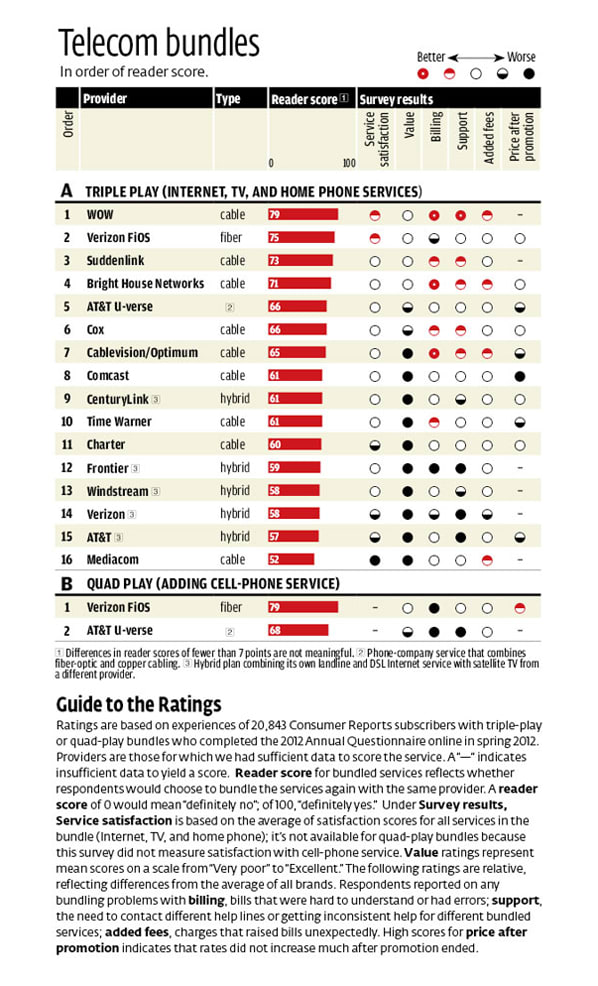
Many of us are one-stop shoppers when it comes to home telecom, opting for a "triple play," the industry term for a discounted bundle of TV, Internet, and phone service. The majority of Consumer Reports readers who bundled are happy with that arrangement, a new Consumer Reports National Research Center survey suggests. Among the more than 20,800 readers who told us about their triple- or quad-play package, three in four said they would definitely or probably buy that bundle of services again.
Deep discounting helps explain the bullishness about bundling. You can get big savings by bundling three services with one provider. "Friends who went with a bundle were saving a good deal of money, so I decided to do it as well," says Mary Kelly of Chico, Calif., whose Comcast bill dropped by more than $50 a month.
You can get more discounts by adding cell-phone service to a triple play. Verizon and AT&T offer such "quad plays." Comcast, Cox, and Time Warner offer them (with Verizon Wireless phones) in some locations.
Such breaks are welcome relief from the upward climb of telecommunications rates. Many big providers boosted monthly bills for one or another of their telecom services by $5 or so this year, driven in part by the rising costs of TV programming. Industry analysts forecast continuing hikes over the next few years. "I expect to see TV rates continue to climb about 4 to 5 percent a year," says Arthur Gruen, president of Wilkofsky Gruen Associates, a telecom consulting firm in New York.
The more services in your bundle, of course, the more services you have to switch when changing providers and the tighter the grip your current company has on you. This report should embolden you to tackle your telecom costs head-on.
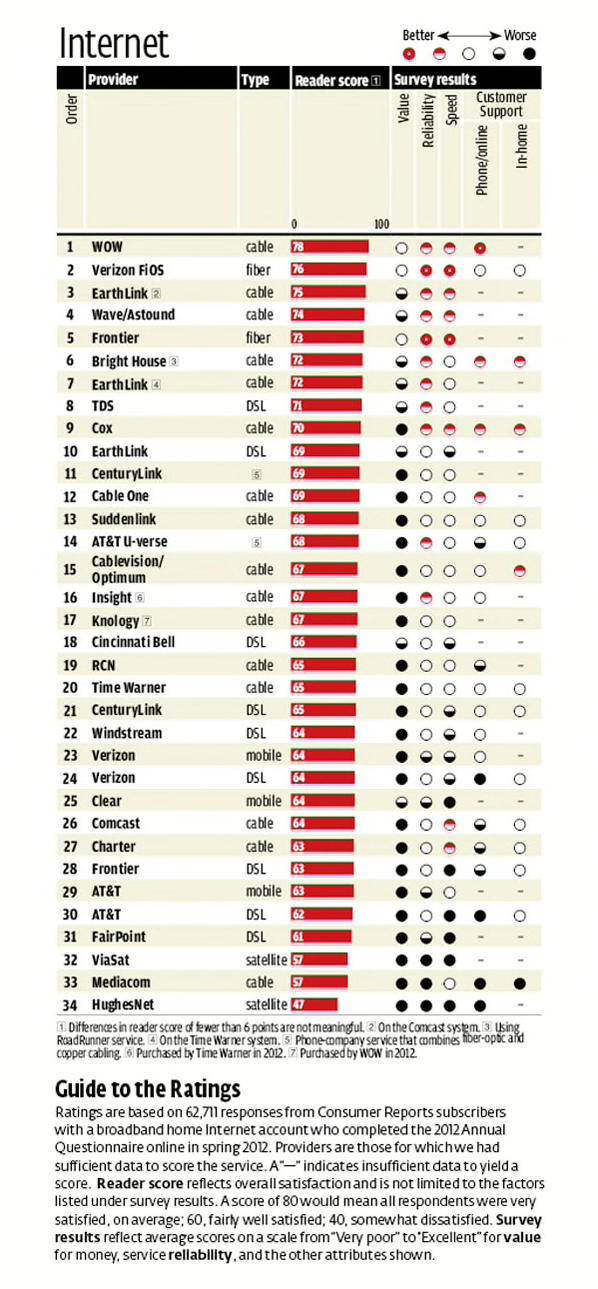
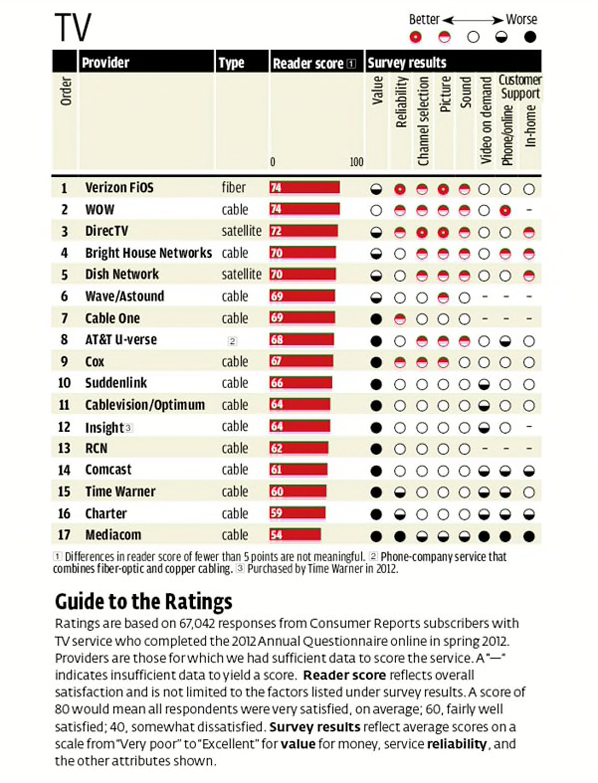
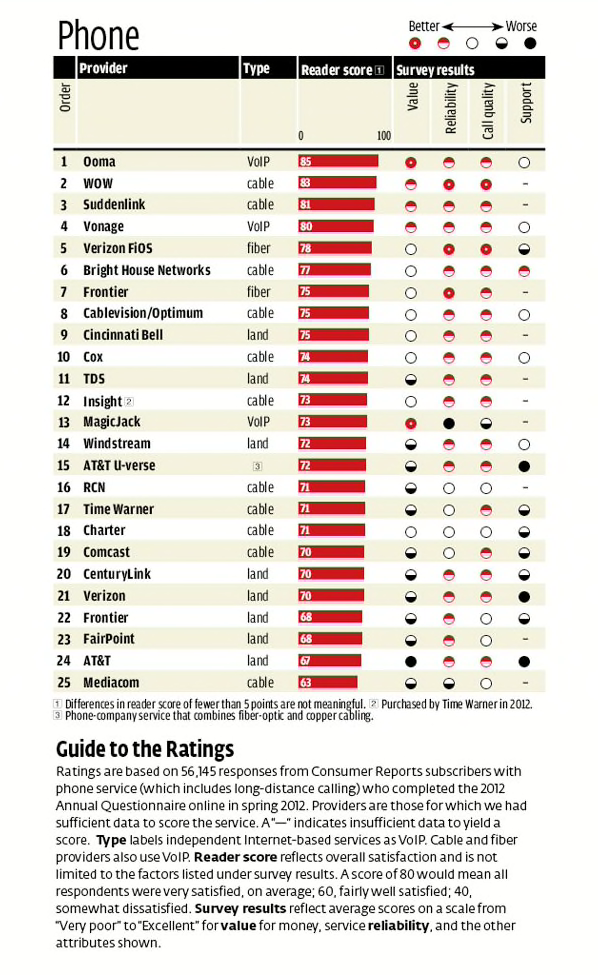
Our Ratings—of bundles from 14 companies, along with individual phone, TV, and Internet services from many more—show that most people have at least one decent choice in telecom. And our reporting and exclusive survey results reveal ways to slim down service—maybe because you're using cell phones more or streaming more online video—or at least to negotiate a price break or some freebies to soothe the sting of that higher bill.
Here are key findings from our survey, along with advice on how to use the info to get better or cheaper telecom service:
Verizon's fiber service satisfies. Among major carriers, the highest proportion of subscribers who said they'd "triple play" again had bundles with FiOS, Verizon's fiber-optic-based TV, digital-landline phone, and high-speed Internet service. "Quad play" customers who added Verizon cell-phone service to the bundle were even more enthusiastic. FiOS received standout scores for its broadband speed and reliability, TV picture and reliability, and even phone call quality and reliability. But respondents with FiOS bundles were more likely than most other providers' customers to say bills were hard to read or error-prone.
Verizon FiOS is available to about 18 million homes in 12 states (mostly on the East Coast and in parts of California, Florida, and Texas) and Washington, D.C. If your neighborhood is wired for FiOS, you'll probably know it. Consumers in those areas (including our own staffers) report a flood of direct-mail promos and door-to-door calls pitching the service.
Areas that aren't wired for FiOS probably can't expect to get the service anytime soon, even if FiOS is available nearby. Verizon says it's focused more on signing up customers in areas it already serves than in expanding coverage.
Ooma is a top phone option. Ooma, which provides VoIP service (the same technology used by cable and fiber companies), was one of the top-rated phone services of any type in our survey. It requires a $180 device (often discounted to $150) that connects to your broadband service and a regular phone. There's no charge for unlimited local calls and 5,000 minutes a month of domestic long distance (though you have to pay a few dollars a month in taxes), and international rates are very low. Watch our video review of Ooma VoIP service.
Before you drop your bundled phone service to go cell-only, make sure your cell phone works well throughout your home. And if you're considering Ooma or another VoIP service, keep in mind that it might not work with a home-security system. (Don't think you need to keep a landline for emergency calls, though. A past Consumer Reports survey found cell phones reliable enough for calling 911.)
Also, dropping phone service from a triple play might save you as little as $5 or so a month. That's because the discount on buying a bundle of two services is usually not as big as when you buy three. That's the reason 34 percent of survey respondents who thought about switching phone services decided to stick with their bundle provider after all. Comcast, Cox, and Time Warner were among the companies whose subscribers were markedly less satisfied with value from double plays than triples.
But that's not always the case. Our survey found that customers of Verizon FiOS, AT&T, and some small providers were equally satisfied with the value they got from double bundles as they were with the value from triple plays.
Verizon and satellite are TV standouts. Verizon FiOS TV and DirecTV's satellite service had higher ratings than most other providers for picture and sound quality, channel selection, and reliability. Satellite rival Dish Network also fared well with survey respondents, as did a few (mostly smaller) cable companies.
If you're a TV aficionado who owns an especially large set, you might want television service from one of the standout providers, if any are available to you. (Satellite TV requires you to mount a pizza-sized dish antenna with a clear view of the southern horizon.)
At the other extreme, perhaps you're relatively unattached to your TV service and want to cut back on it—or even eliminate it altogether. Around one in 10 survey respondents make do without any pay-TV service.
See whether your provider offers a low-priced basic package that would satisfy your viewing needs. Or cut the cord and use an antenna to get free over-the-air digital signals, including HD, from broadcast networks such as ABC, CBS, NBC, and PBS. That might be enough TV for you, especially if combined with a streaming-video subscription.
Try to bundle your cell phone, too. Bringing your cell phone into your telecom bundle, if it's an option, is as close to a no-brainer as you can get in the complex world of telecom savings.
AT&T gives you $5 a month off your wireless bill for two years if you sign up for U-verse services for one year and will discount U-verse services as well. AT&T's U-verse Choice bundles offer savings to new customers who sign up for any combination of wireless, TV, landline, and Internet.
At press time, Verizon was offering a $10-a-month break for combining Verizon Wireless with a FiOS triple-play bundle on one bill. In areas where Verizon FiOS is not available, Comcast, Cox, and Time Warner cable subscribers can add Verizon Wireless cell phone service to a double- or triple-play bundle. With a two-year contract, they'll receive a $50 to $400 prepaid Visa card. This isn't a one-bill deal, though; Verizon Wireless and the cable company send separate monthly bills for this type of hybrid package.
AT&T and Verizon subscribers reported worse problems with billing, such as errors, with quad-play packages than triple plays—and neither carrier handled triple-play bills very well.
These recommendations focus on widely available providers that readers judged best for bundles of TV, phone, and Internet—and for two providers, those that add cell phone. Most readers who bundled would do so again.
Superior scores make Verizon FiOS worth serious consideration for any and all services if the provider is available to you. (The same applies to high-ranked WOW cable service if you live in Detroit, Michigan; Columbus, Ohio; or the handful of other Midwestern and Southeastern cities where it's available.) FiOS was rated higher than most major cable companies for TV picture, sound, channel selection, and reliability; it also received our highest mark for Internet speed. But Verizon users had more complaints than most about bills for triple play, and quad-play customers had even more gripes.
If you can't get FiOS, you're probably best off bundling with AT&T U-verse or your local cable company (unless that provider is bottom-ranked Mediacom). Those choices are likely to be more satisfying for triple-play service than a hybrid bundle of satellite TV and landline phone and DSL Internet.
Have a big TV, a big viewing appetite, and a discerning eye for picture quality? Hybrid bundles that combine satellite TV with landline phone and Internet from other providers were only middling, but DirecTV was a standout for TV service. It had the highest mark for channel selection of all providers and a picture rating that only Verizon FiOS could match.
These alternative VoIP (voice over IP) services were among the most satisfying overall and among the better-rated for value. Though you have to buy equipment up front for both, monthly costs are very low. But keep in mind that buying Internet and TV service from another provider might cost almost as much as buying a triple-play bundle that includes phone service.

The experiences of our survey respondents should empower you to bargain for lower rates. "If you're persistent enough, you can get just about anything," says Faye Burchard of Burke, Va., who subscribes to Cox. By quoting specific offers from competitors, she won savings of more than $50 a month.
Only one in three survey respondents with a triple or quad play negotiated with their carrier, and many of them got a reduction in their monthly bill, fees waived, or an upgrade in service. About 44 percent of bargainers reported savings of up to $50 a month, and 7 percent chopped more than $50 off their monthly bill.
If you're lucky enough to have two competitors offering triple-play packages in your neighborhood, you can play them off against each other, as Burchard and other survey respondents found. Among readers who had changed TV providers in the previous six months, 18 percent were offered new savings of $20 or more a month by their old provider if they didn't switch to a new company or if they had switched but were open to coming back.
You might not even need to bargain to enjoy a price break when TV service from Verizon or AT&T is available. As Joey Schultz, AT&T's vice president of wire-line consumer marketing, observed, "When we come to town, the cable companies get more aggressive with pricing."
If you strike out on negotiations with the regular customer-service rep, ask for the customer-retention department. Its mandate to hang onto existing subscribers gives reps more latitude to negotiate. But be ready for the carrier to refuse to budge till the last possible moment. A survey respondent who was switching from cable to FiOS got a great offer the day he called to have his cable service turned off. "They reduced my monthly bill by $45 and gave me three premium channels free for a year," says Brian Flaherty of Woodland Park, N.J., who canceled the Verizon installation he had scheduled for the next day and stayed with Optimum.
Breaks such as those are usually good for a limited time, but you can always ask for another deal. Carolyn Aloisi of North Springfield, Vt., did just that when her two-year triple-play contract with Comcast was up. "I told them I wanted the lowest special being offered to new customers and no contract," she says, "or I would go back to DirecTV, which I had before." Comcast agreed, keeping her as a customer.
Other respondents had similar success. Among the 62 percent of customers whose initial promo period had expired, 40 percent said they were able to negotiate a new discounted rate. You can also ask for more channels: 33 percent of the negotiators got additional premium TV channels, and 10 percent got more regular channels.
Another possible cost cutter: See whether you can get a whole-home DVR instead of paying for multiple units. Philip Roberts of San Rafael, Calif., trimmed his bill substantially by switching to a Comcast AnyRoom networkable DVR, which lets him watch recordings on multiple TVs.
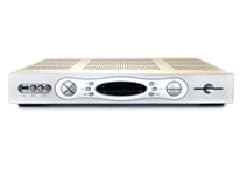
When you're paying $100 or more a month for your TV, phone, and Internet service, equipment-rental charges are irksome, to say the least. It's even more annoying when new charges start showing up on your bill, as they might this year.
Last fall, the Federal Communications Commission agreed to allow cable companies to encrypt, or scramble, even basic-tier digital cable service. That includes local broadcast stations as well as government and educational channels. (Cablevision and other carriers got that permission sooner.) So the TV in your bedroom that you once connected directly to a cable may now require a digital cable box to get any programming at all.
Cable companies must give customers advance notice and provide free converter boxes (or CableCards) for one or two years, depending on the service subscribers have. At the end of the free period, the cable company must notify the subscribers that they'll be charged for the equipment.
Most cable companies charge $5 to $10 a month for each box and remote. Comcast offers a simpler terminal for secondary sets that costs $2 a month, but you get only the most basic channels and only in standard definition. (An HD terminal was in the works at press time.)
Broadband customers might also be billed for a modem. Time Warner Cable recently joined Bright House, Comcast, and Cox in charging a monthly fee—in Time Warner's case, $4—for a modem that it used to provide at no charge. (Those other carriers charge $3.50 to $7 a month.) Time Warner subscribers have to pay the modem leasing fee for Internet access unless they buy their own modem (most sell for $80 and up). There is no charge for the modem required for phone service.
A version of this article appeared in the May 2013 issue of Consumer Reports magazine with the headline "Bundle for Savings."


 Build & Buy Car Buying Service
Save thousands off MSRP with upfront dealer pricing information and a transparent car buying experience.
 Get Ratings on the go and compare
while you shop