Sign In

How important are our smart phones? Just consider how much we're spending on them. The average American household shelled out more than $1,500 on phones and phone service in 2012, and the biggest spenders easily blew through twice that amount. Overall, spending on wireless services was up by 7 percent over 2011, even though many households cut just about every other expenditure they could.
Part of that spending spree came as owners of basic cell phones continued to trade up to their first smart phones, those Web-connected combinations of phone, mini-computer, and micro-compact camera. About 70 percent of Consumer Reports readers who responded to our annual survey on cell-phone service now own a smart phone, up from about 50 percent only two years ago.
Upgrading from a plain cell phone at a major carrier isn't cheap. You have to buy the smart phone itself (usually $100 to $400 when signing a two-year contract) and fork over $70 to $110 a month for a plan with data service. That's a lot more than a basic phone plan, which generally costs $40 to $70 a month.
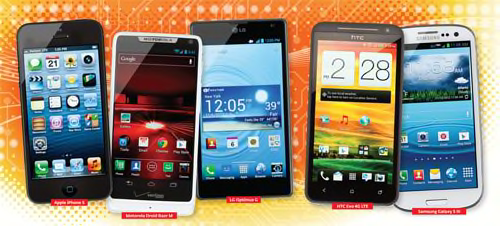
Even if you already own a smart phone, you might be tempted by the charms of a later model. The best of the new phones—including the Apple iPhone 5, Samsung Galaxy S III, and Samsung Galaxy Note II—offer better cameras, bigger and more responsive screens, and faster processors for speedier Web access and app performance.
Cell-phone service remains among the lowest-rated of those evaluated by the Consumer Reports National Research Center. Yet the experiences of the 63,000 respondents to this year's survey offer glimmers of improvement.
As in years past, giant Verizon and smaller Consumer Cellular and U.S. Cellular stood out from the pack for satisfying customers with standard service. But there was also good news for subscribers to the other major carriers—AT&T, Sprint, and T-Mobile. Customers of all three who owned phones that connect to faster 4G networks (as does almost every phone they now sell under contract) were consistently more satisfied than subscribers with 3G who remain in the cellular slow lane.
Even the long-suffering patrons of lower-rated AT&T had something positive to report: They had the fewest problems—interrupted, downgraded, slow, or no service—with 4G service of any carrier.
Plans cost the same for 4G-capable and 3G-capable phones, but faster phones and faster connections can lead to higher bills. The two biggest carriers, AT&T and Verizon, have dropped their unlimited data plans for new customers, just as more people are buying smart phones and 4G networks allow you to tear through the megabytes.
For example, in a 2011 study of 185,000 phone lines by Validas, a company that tracks cell usage and recommends plan savings, owners of the HTC Thunderbolt, an older 4G smart phone, used an average of 1GB of data per month. That's almost double the 565MB average usage by owners of iPhones, all of which accessed only 3G networks at the time of the study.
Many smart-phone owners may be unaware of all the ways their usage patterns can run up data consumption. And it's not only data charges driving up costs. Carriers continue to swell bills with pesky charges such as a new-phone upgrade fee of $30 at Verizon; AT&T has pushed its own upgrade fee from $18 to $36.
It's little wonder that for the first half of 2012, AT&T and Verizon were crowing to investors about profit margins of 41 and 50 percent, respectively. The latter isn't just a Verizon record. "It's one of the highest ever recorded for wireless carriers around the world," says Phil Cusick, the telecom stock analyst for J.P.Morgan.
There are few signs that consumers won't pay for better phones and better service, but we offer ways to save—and be more satisfied, too—no matter what phone and plan you choose. We also show you how to avoid data-hogging phone habits and protect the data on your phone.
How well did your carrier do in our nationwide survey? Check our U.S. cell phone carriers Ratings and cell phone carriers by city Ratings to find out. And find out the best place to buy cell phones in our Ratings of cell phone stores.
Although they've achieved a high standard, smart phones vary in performance and price, even among the recommended models in our smart phone Ratings.
Displays get better and bigger. Within the past year, more phones have sharper displays, with 720p resolution and higher pixel counts per inch. They're also more accurate with colors and easier to read in bright light. And typical screen size is edging up, with a norm of at least 4.3 inches for our recommended models.
Two new phones exemplify how manufacturers are making the extra real estate of the biggest screens work better for the user: the Samsung Galaxy Note II, whose 5.5-inch display is the new size champion among phones, and the LG Intuition, a 5-incher. Both let you write with a finger or stylus on top of photos, calendar appointments, e-mail messages, or other displayed content and share the content and note as an image via e-mail, messaging, or social networks. In portrait mode, phones also allow you to shrink the keyboard and slide it to either side of the screen to help smaller thumbs reach the farthest keys.
Cameras improve. Despite having much tinier lenses and image sensors, the best smart-phone cameras challenge subcompact cameras and compact camcorders in image quality. That said, smart-phone cameras have limits.
Their performance in low light is generally worse than that of stand-alone cameras, and they have a slower maximum frame rate than camcorders (30 frames per second versus 60 fps), resulting in less fluidity in video images. And so far no smart phone offers optical zoom-lens capability, although rising resolution (8 megapixels or more on many phones) should limit the degradation in quality as images are enlarged.
More smart phones, fewer exclusives. The basic cell phone isn't dead, but its smart sibling is edging it out. The major carriers now offer only a handful of basic phones, most of them sold by their prepaid subsidiaries or partners. And many basic models sold with contracts cost almost as much as an entry-level smart phone. Six of 10 basic phones from Verizon, for example, cost $80 or more with a two-year contract.
Even many cell phones from prepaid carriers such as Virgin Mobile and Tracfone are now less basic, adding features such as Web browsers and app stores that require data service. And the simple smart phones that prepaid carriers mostly offer are increasingly supplemented by some marquee models.
There's also less exclusivity. Carriers still have some phones that are theirs alone—Motorola's top-of-the-line Droid Razrs are sold only by Verizon, for example—but fewer than in the past.
The days when iPhones, for example, were available only from AT&T are long gone. The iPhone 5 is now available from three of the four major carriers as well as prepaid carrier Cricket. The highly rated Samsung Galaxy S III is offered with a contract by the big four carriers as well as Credo Mobile and U.S. Cellular, smaller carriers that got high marks in our Ratings. You can also get it prepaid from MetroPCS.
Satisfaction scores with cell-phone service may be unchanged overall, but the following developments are addressing some old gripes while creating a few new ones.
Data plans get metered. The shift to selling data in measured tiers may actually have benefited some smart-phone owners. Among respondents to our survey who switched to a metered data plan, 21 percent saved up to $20 a month and 16 percent said they saved more than $20. Those savings may result from subscribers fine-tuning their purchases by buying as little as 300MB for their smart phone for $20 a month at AT&T, for example, rather than the previous $30 charge for overbuying unlimited data.
On the downside, 10 percent of respondents who switched said they paid up to $20 more per month on a metered plan, and 9 percent saw their bill rise by more than $20 a month. At Verizon, for example, the price of 1GB of data a month, the minimum required by most smart-phone customers, has shot up to $50. Previously, Verizon charged $30 for 2GB and before that $30 for an unlimited 3G data plan.
You might still see so-called unlimited plans advertised, but of the four major carriers, only Sprint offers truly unlimited data plans. AT&T, T-Mobile, and Verizon all reduce the download speed under certain circumstances on grandfathered and new "unlimited" plans—when you reach a data cap, for instance, or when the network is busy—a practice known as throttling. It's usually allowed by the fine print in your service contract.
Data becomes shareable. Because they've all but ended truly unlimited data service, AT&T and Verizon now let customers share "buckets" of metered data among multiple family members and devices. They've also moved more toward making voice and messaging unlimited, and seemingly free, in those shared data plans.
In reality, though, you pay for both through a per-device access fee of $40 (Verizon) or $30 to $45 (AT&T) per smart phone per month. You can add devices other than phones to the plans, at access fees of $20 per laptop and $10 per tablet.
Overage alerts are now in place. When users exceed their data, voice, or texting limits, carriers impose overage charges that can result in shockingly high cellular bills. This year, after prodding by the Federal Communications Commission and Consumers Union, the advocacy arm of Consumer Reports, CTIA-The Wireless Association agreed that its member carriers will warn customers via e-mail and text before and after they hit their limits.
But you should still be mindful of your limits and react by reducing usage or switching to a higher monthly bucket of voice minutes, data, or messages. Thirteen percent of our readers surveyed last September who switched from unlimited to limited data plans said they were hit with overage fees at least once. Our 2010 survey found that more than half of those who went over their voice, text, or data limits incurred penalties of at least $50.
Have you been bill-shocked? Find out how to avoid bill shock on your monthly wireless plan.
The plan you pick and the cell-phone retailer you choose are likely to affect your cost of owning a particular phone far more than the price of the phone itself.
Haggle for the phone. Most shoppers don't think to negotiate for a lower cell-phone price, but 17 percent of our cell-phone-buying survey respondents took a shot. Of that group, more than one in four succeeded. The median discount won was $54, but a handful of hagglers knocked $100 or more off the price.
Consider a prepaid phone plan. A no-contract plan is now worth serious consideration. Phones are better, reader satisfaction with prepaid service is relatively high, and service costs are lower.
You can pay $250 more to buy the same phone from a no-contract carrier versus a major provider, because the no-contract carrier can't be assured of recovering some of the phone's subsidized discount price through a two-year contract term.
But monthly bills are usually lower for prepaid service, especially from prepaid specialists such as MetroPCS, which offers low-cost unlimited-everything plans. Prefer a big national carrier? AT&T, T-Mobile, and Verizon also offer prepaid service. Sprint does so through its Boost and Virgin brands.
Two-thirds of our survey respondents who switched to prepaid knocked more than $20 a month off their bill by switching to prepaid, and 17 percent saved up to $20 a month. Over two years, you can recoup the extra cost of the phone and more. Here's a tip: If you're coming off contract with a phone you like, you can often transfer that phone to a prepaid plan with your current carrier or a new one and pay less for service comparable to what you had on contract.
Be careful when upgrading early. Unless you're totally fed up with your current phone, try to stick with it until the contract runs out. If you upgrade early, you'll be hit with penalties and surcharges, including paying full price for the new phone.
Think twice about insurance or an extended warranty. It can easily cost $500 to $600 to replace a popular smart phone in midcontract, as salespeople pushing protection plans will remind you. But in our survey of cell-phone buyers, we found that only 15 percent polled bought a new phone because the old one broke, and only 2 percent bought one because their phone was lost or stolen.
Based on that, the value of insurance or an extended warranty seems questionable. That's especially true when you consider what a plan costs and what you get for the money. Phone replacement coverage can cost $5 to $9 a month and can come with a $50 to $150 deductible. Yet you might be entitled only to a repaired, refurbished phone rather than a new one.
Even so, close to one in three survey respondents purchased additional protection against loss or damage to their phone. Many said they felt it necessary to protect their investment in the phone.
But here's a better idea: Keep your old phone until the new handset's contract ends. If you lose or break the new phone, reactivate the old one by contacting the carrier and then syncing to your accounts to download contacts and more to the device. Then use the old model until you qualify for a free or discounted new phone.

It's easy to burn through the 2-gigabyte (that's 2,000 megabytes) monthly allowance of typical data plans, especially if you overdo any of the activities below when connected to the carrier's network. Use Wi-Fi instead of the data network when possible and limit these activities:
Watching video streams. A high-quality video stream consumes almost 6MB per minute with a 4G connection. Streaming a video once a day from YouTube for a month, or a single HD movie, could eat up 700MB of data—or more than a third of that 2GB budget. Use the phone's settings to reduce the resolution of videos you watch or upload.
Making video calls. Face-to-face video calls, using the front-mounted camera found on most new smart phones, eat up a hefty 2.5MB to 3MB a minute. Chat for 20 minutes once a week with your daughter at college and you would use up at least 200MB of data per month.
Uploading video. Can't wait until a Wi-Fi network is accessible to upload that high-def video from your phone to Facebook? Think twice: Unless it's compressed, a 3-minute video clip in HD (1080p) can be about 300MB.
Streaming music. Streaming your favorite sounds to your phone from a subscription music service, a collection stored in the cloud, or an Internet radio station eats up a megabyte of data per minute. Listen for a half-hour of commuting on weekdays and during a few 20-minute workouts per week, and you've consumed more than 700MB of data in a month. Consider reducing the bit rate of streams (via settings) and storing music on the device rather than streaming.
Playing connected games online. Shooting it out with other players in high-octane online games is way cool—and way costly. With every minute of play requiring a megabyte of data, a half-hour of play three times a week will easily burn through 360MB of data per month.
On the plus side, at least three activities you might think are data hogs usually use less than a megabyte of data per minute: surfing the Web, using maps and navigation, and sending e-mail (at least without attachments). If your phone has a data usage monitor, check it periodically to make sure you don't overdo it.
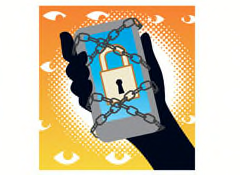
In a recent survey, half of Consumer Reports readers who own a cell phone told us they use their phones in ways that put their passwords, account numbers, and other sensitive information at risk. Yet one out of three of them didn't take any steps to protect themselves. If they were to lose their phone, strangers could pore through their data, send malicious texts or e-mail that seem to be from them, and order merchandise from accounts they've set up. Here's how to minimize your risk:
Lock your phone. Consider using a personal identification number or password on your phone so that others won't be able to browse your life history or embark on an online spending spree. That tactic requires you to balance security and convenience, because you'll have to enter a code every time your phone screen locks. To minimize the hassle, you could set a fairly long interval before your phone times out, say, 30 minutes.
Install an app that can locate a phone and remotely lock it or even erase its data. Options include Find My iPhone (free on iTunes) and Lookout for Android-based phones (free at Google Play). The Lookout app can back up your data. Other free backup services are the iCloud for iPhones and, for Android phones, Google Cloud Storage, Verizon's Backup Assistant, and AT&T's Mobile Backup. For Windows Phone devices, use SkyDrive.
Keep apps in check. Many consumers realize there are at least some inherent risks in downloading apps to a phone but don't understand the extent to which they compromise privacy, according to a nationally representative survey conducted recently by the Consumer Reports National Research Center.
Eighty-one percent of respondents recognized that apps—even from reputable, well-known companies—can access personal information stored on a phone and share it with others. But almost 60 percent of those surveyed believed sharing data was illegal unless the phone's owner explicitly agreed to that. And 53 percent thought it was illegal for an app maker with a privacy policy to share the user's personal information with other companies. In fact, there are no legal protections against sharing this information. But three-quarters of survey respondents did realize that app markets, including Apple's App Store and Google Play, don't prevent app developers from sharing their information.
With smart-phone apps from any source, see what permissions you've granted installed apps (under Settings/Apps for Android phones and Settings/Privacy for iPhones). Also, uninstall any that are too nosy. And before downloading an app, scrutinize the permissions it requests. Reject any that want to do something suspicious, such as tracking your location if that seems unnecessary.
Don't get personal. When going online, be careful about disclosing personal information. Before selling or discarding a phone, wipe out your data by resetting the phone to the factory default. And remove SIM cards and memory cards, if applicable.
A version of this article appeared in the January 2013 issue of Consumer Reports magazine with the headline "Smart Phones, Smart Savings."

 WASHING MACHINE REVIEWS
 GENERATOR REVIEWS
 Build & Buy Car Buying Service
Save thousands off MSRP with upfront dealer pricing information and a transparent car buying experience.
 Get Ratings on the go and compare
while you shop