Mattresses

Mattress buying guide

Last updated: July 2012

Getting started

You should think about buying a new mattress if you wake up tired or achy, you tend to sleep better at hotels than at home, your mattress looks saggy or lumpy, you're over 40, or your mattress is five to seven years old. Use this mattress guide to help with your purchase.

Choose a size

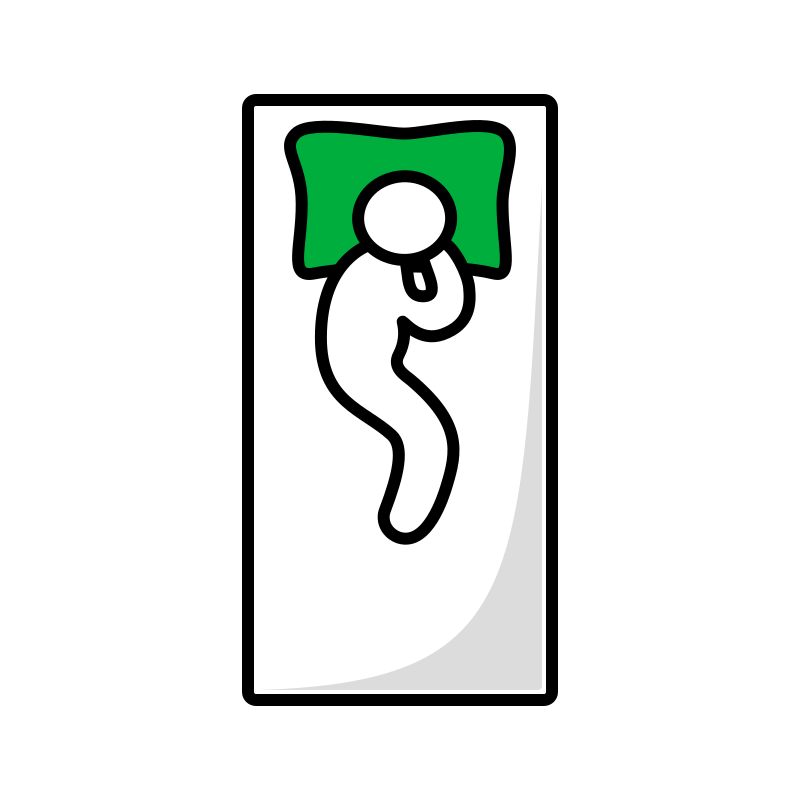
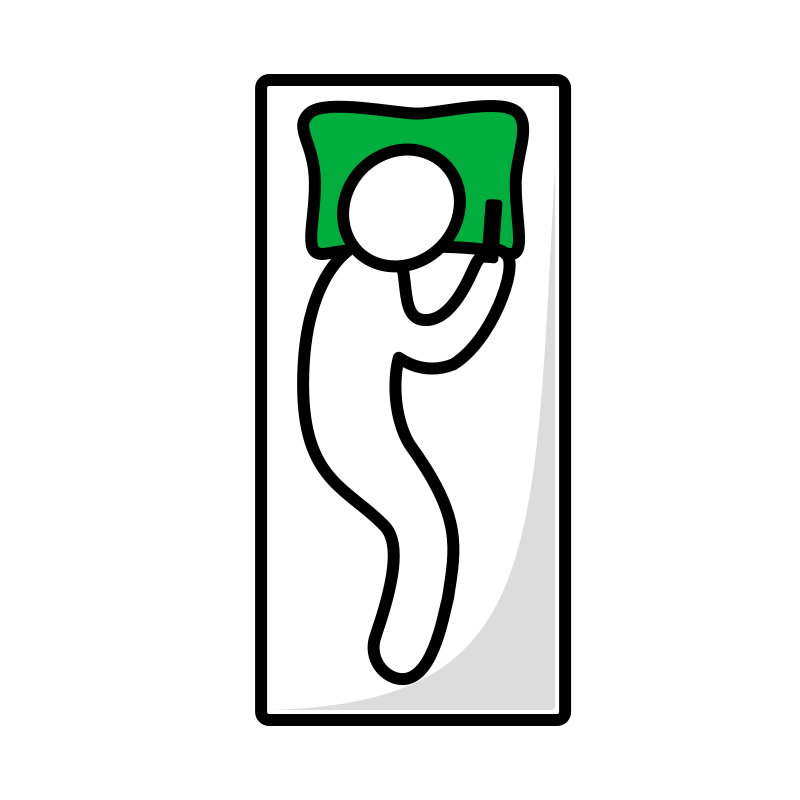
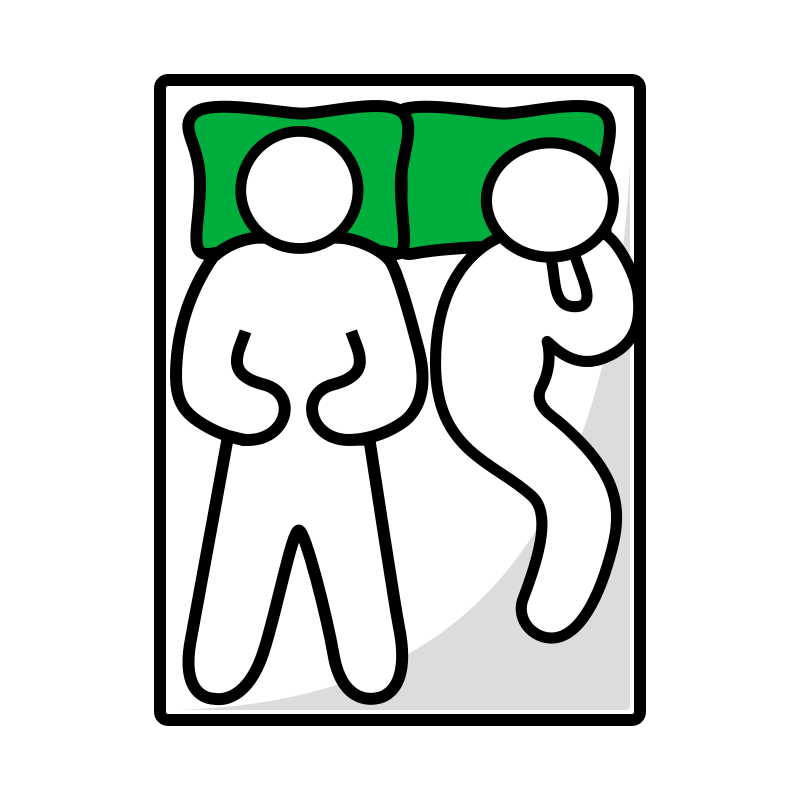
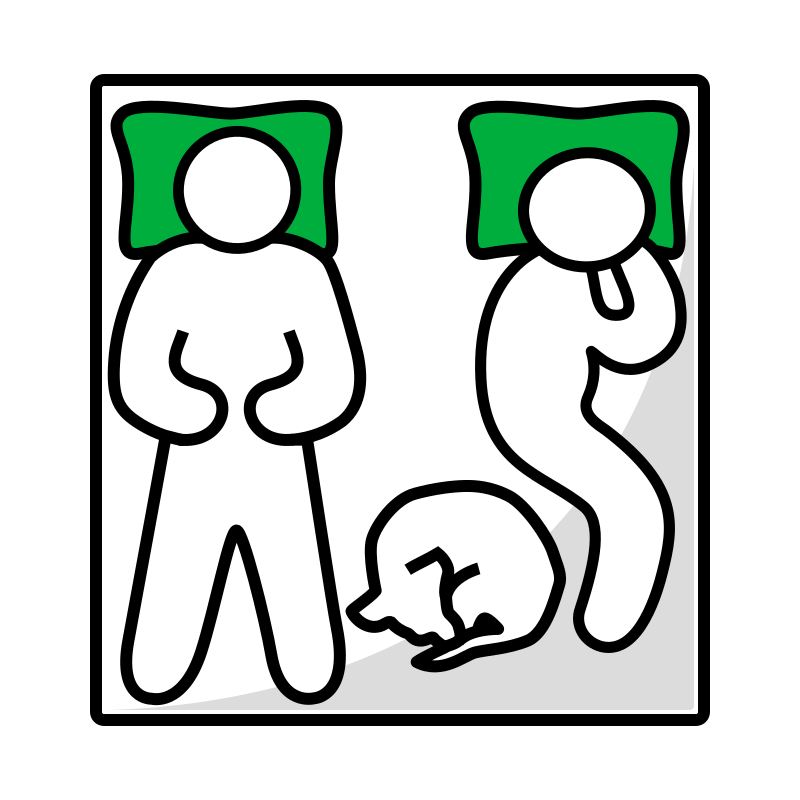
Most sleepers shift positions during the night, and cramped quarters can keep them from moving freely. Standard mattress dimensions are king, 76x80 inches; California king, 72x84 inches; queen, 60x80 inches; full, or double, 53x75 inches, and twin, 38x75 inches.

Consider an innerspring first

A conventional innerspring mattress is the most common choice and often the least expensive. Memory foam, which was developed to protect astronauts against g-forces, is heat-sensitive and conforms to your body. Tempur-Pedic is the big name, but there are other brands. Not all memory foam feels the same, and it can take time to get used to. Another option is an inflatable mattress; with this kind you can choose a different firmness for each half of the bed. Select Comfort is the major brand.

Decide where to shop

Buy at a store, not online or over the phone, unless you've already tried the identical mattress in a store. A product manager for Tempur-Pedic told us that more online customers return their mattresses than shoppers who buy in a store.

Department stores have frequent sales and lots of brands, but can be crowded, cluttered, and short on sales help. Bedding stores such as Sleepy's and 1-800-Mattress, and some furniture stores, offer plenty of variety and are often less crowded. We found the salespeople at these stores more attentive and sometimes more willing to bargain. Start out with the least expensive bed from a few top brands, and work your way up in cost. Hint: Stores keep the priciest models up front.

Company stores selling only Duxiana or Select Comfort provided especially good service, because employees can afford to take time with customers. Queen-size sets cost about $4,000 to $7,000 at Duxiana (there's no bargaining) and about $900 to $3,800 at Select Comfort (there are occasional sales). One specialty bed we tested, Tempur-Pedic, is sold at a variety of stores, but we found that discounts have historically been few and far between.

Understand the name game

Manufacturers usually modify innerspring mattresses for different sellers, changing the color, padding, quilting pattern, and so forth. Then each seller can call the mattress by a different name. Consumers are the losers. Because such mattresses are at least somewhat different, and the names vary, you can't comparison-shop. (A big chain such as Sears or Bloomingdale's has the same model names for the same beds at all of its stores, usually at the same price.)

Some mattress makers provide helpful information on their websites. Go to www.simmons.com, for example, and you'll find basic information about the company's flagship Beautyrest lines, including TruEnergy, ComforPedic, Natural Care, and BeautySleep. You'll see those names wherever you find Beautyrest, and all beds in each line share attributes.

Choose the right firmness

Don't rely on names. One company's ultraplush might be another's supersoft. Orthopedists once recommended sleeping on an extremely firm mattress, but there's little evidence to support that view. The best surface is purely subjective, says a spokesman for the Stanford University Center for Human Sleep Research.

A study published in 2003 in the British medical journal Lancet suggested that people who suffer from lower back pain would benefit from a medium-firm mattress. That made sense to several experts we interviewed. If a mattress is too firm, it won't support the body evenly and may cause discomfort at the heaviest points (hips and shoulders). If it's too soft, a sleeper could sink into the surface and have a hard time moving, which could cause tingling, numbness, or aches.

Alan Hedge, Ph.D., professor of ergonomics at Cornell University, noted that the best mattress supports the spine at all points while allowing it to maintain its natural curve. By age 40, Hedge said, skin loses elasticity and becomes more sensitive to pressure points, so a softer, more cushiony surface is more comfortable. "Slightly softer works better because there's less compression on the skin," he said.

Do the 15-minute, in-store test

Don't be embarrassed to lie down on lots of mattresses in the store. Salespeople expect it. Wear loose clothes and shoes that you can slip off. Spend at least five minutes on each side and on your back (your stomach, too, if that's a preferred sleeping position). Panelists who took beds home for a month-long trial rarely changed the opinion they formed after the first night. On the whole, their opinions were the same as those of our in-store testers, about 75 percent of whom told us, in a recent subscriber survey, that trying out the mattress beforehand helped them sleep better.

Do you need a new box spring?

Foundations can sell for as much as the mattress, even though they're generally just a wood frame enclosing stiff wire and covered with fabric to match the mattress.

We found that companies frequently pair the same foundation with mattresses in different price ranges. You can save by buying a higher-priced mattress and a lower-priced foundation. Once the bed is made, no one will know. If the old box has bouncy springs instead of stiff wire, it should be replaced.

If your current foundation is only a few years old, with no rips, warps, creaks, or "give," consider using it with a new mattress. Though most respondents to our recent subscriber survey replaced their foundation with their mattress, roughly 80 percent of those who kept their old one reported that they were sleeping better after replacing just the mattress. So if your box spring isn't broken and is still structurally sound, consider keeping it and saving several hundred dollars.

If your new mattress is ultrathick, consider pairing it with a "low profile" foundation, 4 to 6 inches thick, to reduce height.

Be wary of 'comparables'

If you like a mattress at one store and ask elsewhere for something similar, you're likely to be steered toward a same-brand mattress that's supposed to have the same construction, components, and firmness. It's unlikely. Mattress makers offer some lines nationally, but when those brands are sold through major chains such as Macy's, Sears, and Sleepy's, they're for lines exclusive to those chains. And manufacturers don't publish a directory of comparables. Retailers that claim to sell them, insiders say, generally snoop in competing stores and compile a list of beds that appear equivalent. But when we went to three bedding chains and asked for mattresses similar to those we'd bought at three department stores, five of the six mattresses were way off the mark. A two-sided mattress, for example, was said to be comparable to a one-sided bed. Ultimately, there's no way for you to know which mattress is actually the same as or comparable to one in another store.

Look for a comfort guarantee

Some retailers give you two weeks to several months to return or exchange a mattress or box spring you don't like. Everyone plays by different rules, and a return usually costs you. At Bloomingdale's, you're encouraged to keep a bed for 30 days; then you have seven days to return or exchange it, but you'll pay for delivery plus 10 percent of the price up to $250. Sears doesn't charge for returns or exchanges within 90 days.

Don't count on warranties

They cover defects in materials and workmanship, not comfort or normal wear. They're usually in effect for 10 years. The warranties for Duxiana, Select Comfort, and Tempur-Pedic are in effect for 20 years. Some mattress warranties don't cover full replacement value; instead an annual usage charge is deducted from the current retail price.

When you make a claim, the store or manufacturer sends an inspector to your house. You'll need to show a receipt. If you say the mattress has sagged, the inspector checks whether the dip is below the allowable limit, 1 1/2 inches. A company will void a warranty if you remove the "do not remove" tag, if the mattress is soiled, or if it has uneven support from a box spring or frame--a common reason for sagging, says a Simmons spokesman.

Wait for a sale, and bargain

Specialty mattresses usually have a set price, but you can save at least 50 percent off list price for an innerspring. Ads for "blowout" sales make such events seem rare. They aren't. If the price is good, buy; if not, wait. Our shopper spent $1,300 more for a Serta Perfect Sleeper set at one Sears store than for the same set at another Sears a week later.

An advertised "bargain" may not be all it seems, so read the fine print. A flyer from one store we saw touted 75 percent savings on mattresses, but a footnote revealed that the list price from which the discount was calculated "may not be based on actual sales."

Have options at several stores

If you're ready to shop elsewhere, you may be able to get a discount. When our reporter asked a salesman at a 1-800-Mattress showroom whether there was a better deal at the company's website, the salesman said he'd double the value of a $100 Internet coupon if the bed was bought at the store.

Seal the deal

Ask about trial periods, return policies, and restocking and pickup fees before buying--especially at warehouse clubs such as Costco or Sam's Club, where you can't try out mattresses. Also ask about disposal of your old mattress (some deliverers will take it to the curb, others charge to cart it away). Insist on a no-substitutions clause in the sales agreement, in case the bed you ordered is out of stock. When it's delivered, check for stains and other damage. Insist on a replacement if you're not happy.

Leave the tag on

In case you have to file a warranty claim, you'll need that do-not-remove-under-penalty-of-law label that's sewn onto the mattress. (If the tag isn't there, don't buy the mattress.) While the stern warning is aimed at retailers and manufacturers, not consumers, removing the tag could come back to haunt you if you can't resolve a warranty problem with the retailer and you need to plead your case to the manufacturer. The tags are important because they contain identifying information, a description of the filling (for example, polyester, goose down, feathers, or cotton) and the percentage of each, whether--and how much of--the materials are new or used, and details about flame retardancy. Other labeling requirements include country of origin (for example, "Made in the U.S.A. of imported materials" or "Shell made in China, filled and finished in the U.S.A."), and the name of the manufacturer, importer, distributor, or vendor. We checked the policies of three of the largest mattress makers, Sealy, Serta, and Simmons, and all agreed that you must have the tag in order to have your claim processed. What's not 100-percent clear is whether the tag must be permanently attached to the mattress or whether it's adequate simply to possess a tag that's been cut off. We suggest you play it safe and leave the tag alone.

Types

The good news: Our years of testing have shown that, whatever the type of mattress, all but the cheapest are apt to be sturdy. Here are the mattress types to consider.

Innerspring mattress

This traditional type is still the most widely sold. Sealy, Serta, Simmons, and Spring Air are the top sellers.

Pros:

It's often the least expensive.

Cons:

In our online poll of more than 12,000 subscribers who'd recently bought a mattress, 73 percent of those who'd bought an inner-spring were highly satisfied with it compared to 83 to 85 percent of buyers of the memory-foam or adjustable-air variety.

Specialty mattresses

Highly hyped alternatives to conventional versions include air-filled, with separate adjustments for firmness on each side (Select Comfort is the major brand); polyurethane memory foam, which conforms to your body and can help isolate you from movement on the other side of the bed (Tempur-Pedic and others), and models with an extravagance of springs mounted in two layers (Duxiana).

Pros:

According to our recent survey, subscribers who bought memory foam and inflatable air beds were more likely to tell us they were sleeping better than those who purchased traditional innersprings. Tempur-Pedic memory foam and Sleep Number air beds were most cited as improving sleep.

Cons:

Despite the gushing ads and lavish testimonials, spending more for a specialty mattress doesn't guarantee you'll be a happy sleeper.

Features

Ticking  |  Top padding  |  Coils  |  Box spring  |  Topper

The construction of a mattress determines the way it feels. Most stores have a cutaway or cross-section display of at least some mattresses. Despite the claims, there is no best bed for everyone. Spend time finding the mattress that's most comfortable for you and supports you best. Here are the mattress features to consider.

Ticking

This is the outermost layer, usually polyester or cotton-polyester. Fancier mattresses may have damask, jersey knit, microsuede, wool, cashmere, or silk. More than the material, ticking is an important contributor to sleeping comfort. What really counts is the stitching that binds the ticking to the top padding, which affects how the mattress feels. A large quilt pattern provides a deep, cushioned sensation. A smaller pattern tends to feel firmer.

Top padding

This is usually polyurethane foam, with or without polyester batting. Polyester batting provides a soft feel and helps to dissipate perspiration. "Egg crate" foam feels softer than a solid slab.

Coils

They provide the main support in a conventional innerspring mattress. Heavier-gauge coils provide a stiffer suspension, and lighter-gauge coils feel springier. But despite the hype, all types of coils--hourglass, continuous wire, or individually pocketed--are up to the task. Some manufacturers beef up the edges of the mattress with more closely spaced coils, slabs of stiff foam, or thicker wire. Stiffer edges keep you from feeling as though you'll roll off, and they provide a solid place to sit and tie your shoelaces.

Box spring

It may sell for as much as the mattress, though it's generally just a wood frame enclosing stiff wire. Companies often pair the same box spring, or foundation, with mattresses in various price ranges, so you may save by buying a higher-priced mattress with a lower-priced foundation. If you buy an extra-thick mattress, consider pairing it with a low-profile box spring to reduce height. There's nothing springy about box springs. They simply support the mattress.

Topper

Foam- and feather-filled toppers are sold separately and are designed to go on top of the mattress. A topper may soften a bed that's too hard, but price is no guarantee of a good night's sleep. A $890 topper made one of our testers feel as though he were sinking in quicksand. Even the higher-priced, feather-filled ones might shift overnight and become lumpy. You won't need a topper if you pick the right mattress.

Brands

Sealy  |  Select Comfort  |  Serta  |  Simmons  |  Tempur-Pedic

You'll probably recognize some of these brands of mattresses, but because model names differ from store to store, it is difficult to compare mattresses by brand. But here are the big names in the business.

Sealy

Sealy leads the pack with over $1 billion in sales from its Sealy, Stearns & Foster, and Bassett brands of mattresses. Sealy has effectively marketed itself as maker of orthopedic, back-friendly mattresses with its Posturepedic line. The national brand is available in mass-market chains like Sears, sleep specialty stores, and furniture retailers. Sealy makes models at a wide range of prices, from $500 for a queen to more than $4,000 for a foam mattress. A plush pillow-top (queen mattress only) can range from $800 to $3,000. Sealy has recently expanded its offerings, and now makes latex (SpringFree by Sealy Posturepedic) and foam (TrueForm by Sealy Posturepedic) mattresses.

Select Comfort

Select Comfort, a specialty sleep brand, has grown significantly over the last few years and has moved into the top five. Select Comfort is most known for its Sleep Number beds, endorsed by the Bionic Woman, Lindsay Wagner. It claims the Sleep Number system allows the user to set the degree of firmness on each side of the bed. Select Comfort’s prices range from $1,000 for an entry-level 3000 queen set to $4,700 for the 9000 model which has memory foam and a digital remote. The brand is sold nationally in 450 Select Comfort retail stores and at the company’s Web site.

Serta

Serta is the No. 3 brand of mattresses, and its slogan is “We Make the World’s Best Mattress.” Serta relies on the very recognizable “counting sheep” ads to convey its comfort message to consumers. Serta is a national brand available at mass market chains like Sears, sleep specialty chains, and furniture stores. Prices range from $200 for an entry-level, firm queen mattress (only) to $3,000 for a KoolComfort memory-foam model. Serta has joined forces with designer Vera Wang to create the Signature Bridal Bed (queen set, $1,600), which was featured in an episode of “The Celebrity Apprentice” with Donald Trump.

Simmons

Simmons is No. 2 in the market, and is best known for its bowling-ball ads showcasing its “unsurpassed motion separation”— which means your partner won’t wake you up when he or she rolls over. Simmons’ Beautyrest line ranges in price from $500 for a basic queen mattress to $6,000 for a latex plush super pillow-top queen mattress. Simmons is available nationwide through mass-market chains like Sears, sleep specialty chains, and furniture stores. Like the other brand leaders, Simmons has its own line of latex and advanced memory-foam mattresses. Simmons also makes the Heavenly Bed used by the Westin hotel chain and the W Bed at W hotels. Consumers can purchase these mattress sets at each hotel’s shop-at-home Web site; each sells for around $1,600.

Tempur-Pedic

Tempur-Pedic revolutionized the bedding market with its introduction of memory foam a decade ago. Tempur-Pedic is the top specialty sleep brand and ranks No. 4 among the market leaders. Its expensive line of proprietary foam bedding ranges in price from $1,200 for the OriginalBed (queen) to $6,000 for the GrandBed. Tempur-pedic’s popularity has generated a loyal following as well as a number of knockoffs from the mattress brand leaders. Tempur-Pedic is a national brand available at sleep specialty stores and at its own Web site.


Find Ratings blob logo

Mattresses Ratings

Subscribers can view and compare all Mattresses Ratings.

E-mail Newsletters

FREE e-mail Newsletters!
Choose from safety, health, cars, and more!
Already signed-up?
Manage your newsletters here too.

Home & Garden News

'30 Rock' ends with a big idea: Transparent dishwashers

At the end of last night's "30 Rock" finale, ex-network exec Jack Donaghy is about to set sail around the world when he has a brainstorm: "Clear dishwashers! You can see what's going on inside! I...

A top-notch blender could be your Super Bowl party MVP

Scrambling to plan the menu for a last-minute Super Bowl party? A blender could handle a lot of the meal prep, from pre-game pass-arounds to the post-game desserts. But it has to be the right mac...

Food safety tips to prevent sidelining your Super Bowl guests

No matter what team you're cheering for, the Super Bowl is a long game, typically four hours not counting the pre- and post-portions. That's twice as long as it takes for bacteria to start multip...

Ad watchdog asks Lemi Shine to clean up its claims

Envirocon Technologies says its Lemi Shine dishwasher detergent additive is "the only thing that works" at removing hard water spots and film from dishes. Not so fast, says the National Advertisi...

Don't let grilling fumbles ruin your Super Bowl party

Super Bowl Sunday always has some drama—sibling rivalries, halftime wardrobe malfunctions, a nail biting finish—and then there's the food. Feeding a crowd takes some planning, and gri...

Connect

and safety with
subscribers and fans

Follow us on:

Mobile

Mobile Get Ratings on the go and compare
while you shop

Learn more
left arrow right arrow
See also:
4 Tested down arrow
20 Tested down arrow
18 Tested down arrow
25 Tested down arrow
26 Tested down arrow
20 Tested down arrow