Safest Car Brands Ranked by Consumer Reports' Safety Verdict
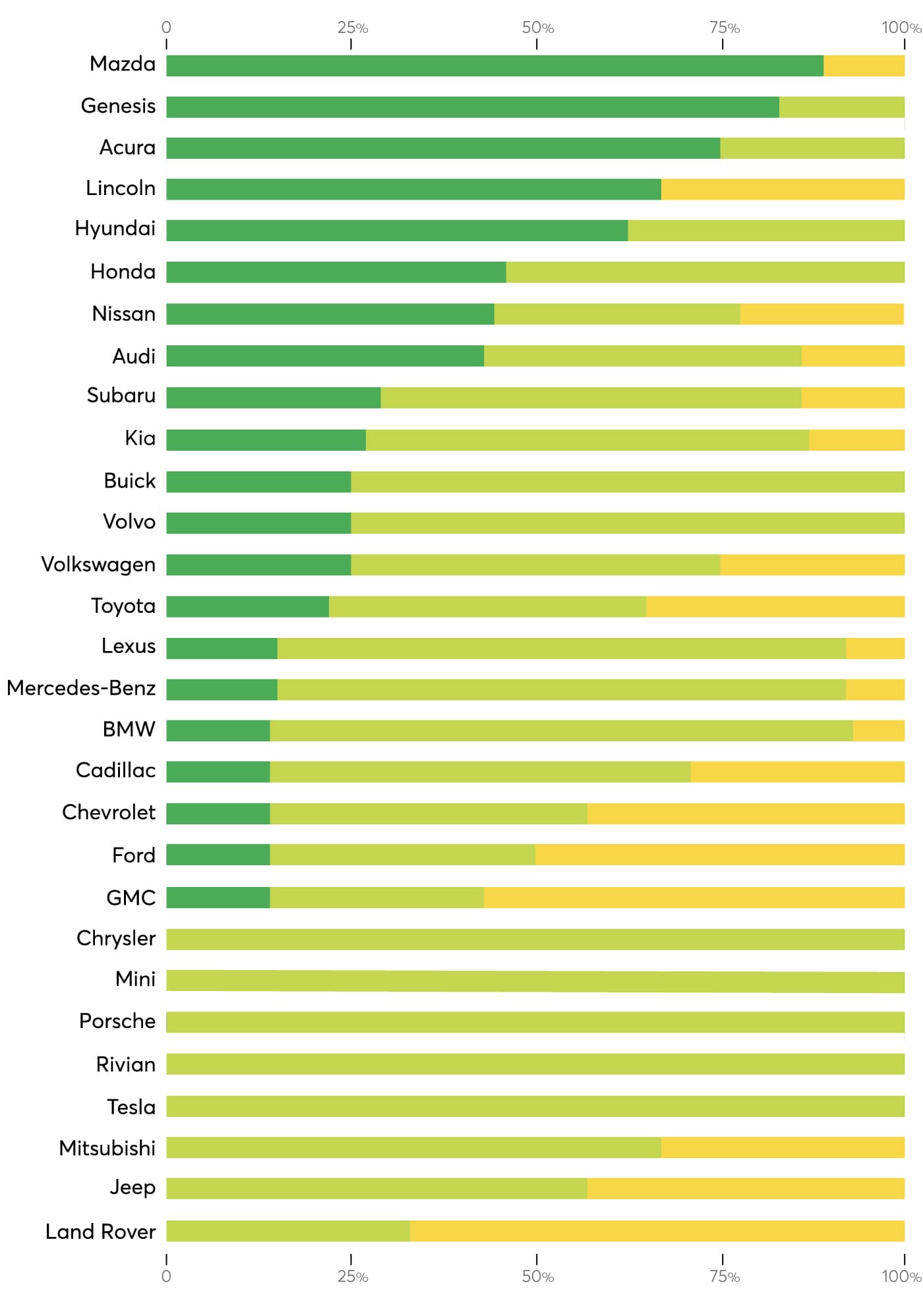
According to our analysis of crash tests, braking, handling, and crash-avoidance technology, Mazda, Genesis, and Acura have the safest new cars.


Consumer Reports’ new safety verdict is a comprehensive, easy-to-understand score that helps you identify which new cars do the best job of preventing a crash or protecting you if one occurs, and which cars lag behind.
Consumer Reports Car Safety Guide
Below, we’ve broken down what percentage of each major automaker’s lineup scores in each category. We’ve also shared the exact requirements for achieving Basic, Better, and Best.
See the complete safety verdict for every new car on the model pages, found via the pull-down menus at CR.org/cars or through the A-Z interactive ratings chart.
Safety Verdict: How the Brands Rank
• Automatic emergency braking (AEB) that can detect pedestrians, standard across all trim levels.
• A curb weight above 2,500 pounds, because a lightweight car is at a disadvantage in a crash with a heavier car.
• Front-wheel or all-wheel drive (standard or optional) for effective handling in ice, snow, and rain.
• If tested, a Good or Acceptable rating in the IIHS small-overlap front crash test, which simulates hitting a pole or tree, and in the safety organization’s evaluation of front crash prevention technology.
• If tested, at least an Acceptable rating in the IIHS side-crash test.
• All trims must have standard highway-speed AEB, blind spot warning (BSW), and rear cross traffic warning (RCTW)—three proven technologies that prevent crashes and injuries.
• A Good rating (the highest one) in the IIHS side-crash test.
• At least an Acceptable rating in the IIHS moderate-overlap front crash test, which simulates a partial head-on crash with another vehicle that crosses a center yellow line.
Why Some Brands Rank Higher Than Others
You might be wondering why some brands—including those well-known for safety—have a low percentage of Best-scoring vehicles.
For example, although Volvo was one of the first automakers to introduce safety innovations such as the three-point seat belt and side airbags, you won’t find Volvo ranked among the top brands. That’s because many of the company’s modern vehicles, such as the EX30, earn CR’s lowest usability score. “If controlling climate or audio functions distracts you from the task of driving, that’s a strike against safety,” says Jake Fisher, senior director of auto testing at CR.
Teslas generally perform well in crash tests and include effective crash-prevention technology, but the Model Y and Model 3’s reliance on a center screen for most of their controls can be distracting. Vehicles with the speedometer in front of the driver or with windshield wiper controls on an intuitive stalk don’t require the driver to look away from the road. For this reason, the brand scores near the bottom in our rankings.
Subaru isn’t at the top of the list because some models lack standard blind spot warning and rear cross traffic warning. “We believe that safety shouldn’t be optional,” Fisher says.
Automakers that sell lots of full-sized SUVs and pickups may not be high on the list, either. “Some large vehicles can take longer to stop and don’t handle well in emergency situations,” he says. “A large vehicle might get into a crash that a smaller vehicle could avoid.”
Automakers: Don’t put a price on our safety!
Sign our petition to pressure car companies to make crash-preventing features standard.
More on Cars by Brand
• Which Car Brands Make the Best Vehicles?
• Owner Satisfaction Ratings: Best and Worst Car Brands
• Who Makes the Most Reliable New Cars?
• Which Brands Make the Best Used Cars?
• Which Car Brands Have the Highest Road-Test Scores?
• Who Owns Which Car Brands?
• Car Brands Ranked by Maintenance and Repair


