
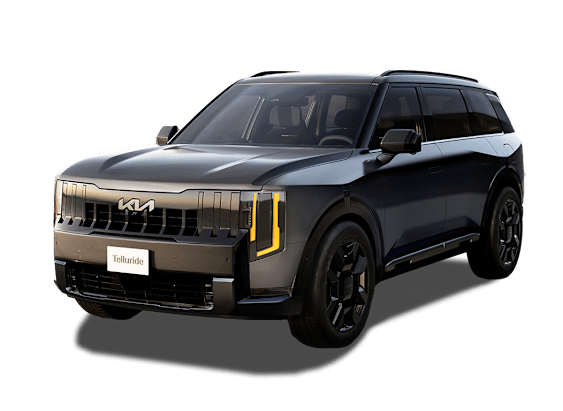
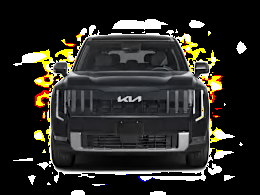
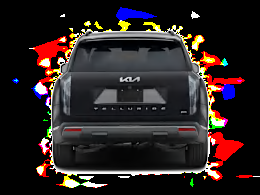
The Kia Telluride took the market by storm when it went on sale as a 2020 model. At the time, other three-row SUVs excelled in different facets of this family-focused category, such as interior conveniences, fuel efficiency, or reliability. But the Telluride immediately stood out as the most well-rounded three-row midsized SUV, proving capable in just about every way that matters to most buyers.
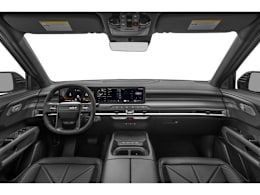
This set high expectations for the second-generation Telluride, which grew 2.3 inches bumper-to-bumper with a 3-inch longer wheelbase, giving it a bit more interior space. Kia gave it a thorough redesign inside and out, with a modern, vaguely Range Rover-ish exterior and a screen-heavy cockpit that, unfortunately, eliminated many of the dashboard’s central physical controls.
Kia Telluride at a Glance
- A comfortable, secure, and predictable driving experience that suits a big family hauler
- Some difficult-to-use controls and ergonomic issues detract from an otherwise spacious, well-equipped three-row midsized SUV
- The new turbocharged four-cylinder engine is noisy and offers no benefit in fuel economy or acceleration over the prior-generation V6
Under the hood is a new 274-hp, 2.5-liter turbocharged four-cylinder engine mated to an eight-speed automatic transmission, with standard front-wheel drive and available all-wheel drive. The engine is a departure from the Telluride’s Hyundai counterpart, the Palisade, which still has a V6 under the hood. For the first time, the Telluride is also available with a hybrid powertrain, which will receive its own separate Consumer Reports road test.
After our auto experts spent months conducting over 50 specific tests and evaluations at Consumer Reports’ 327-acre Auto Test Center, along with many miles behind the wheel on public roads, it’s clear that the Telluride isn’t the slam-dunk over the competition that it used to be. While the Telluride remains well-equipped for its price, it saw a dramatic drop in its Consumer Reports road-test score largely due to two issues: harder-to-use controls and a loud, unrefined-sounding engine.
The Telluride’s competitors have also caught up in recent years with compelling models like the Honda Pilot, Subaru Ascent, and Toyota Grand Highlander, all of which achieved higher road-test scores than the Telluride. Further, the Palisade now outscores the Telluride by a significant margin, with the Hyundai standing out as one of the highest-rated models in the class.
As one of our testers said, "The Telluride is one of those ‘I like it, but I don't love it’ kind of vehicles. This new model lost some of the magic of its predecessor.”
“I miss the old V6 and the previous model's sharper handling,” agreed another tester. “It rides well, though, with good bump absorption. The engine has decent midrange torque, and most shifts are smooth. But it's hard to get past the way it sounds; the engine is so grumbly at lower revs, and its noises don't match the sleek styling and size of the vehicle.”
Another tester had a more positive overall take on the latest Telluride. “It feels premium and above its class in terms of design, materials, and just the look and feel of the whole thing,” he said. “Yet it remains attainable and practical. In some ways, it’s more compelling to me than the Palisade because of its curb appeal. Plus, if you take noise out of the equation, the Telluride’s turbo-four is actually nicer to use than the Palisade’s V6. But the Telluride’s climate controls sure are annoying.”
We bought a 2027 Kia Telluride EX AWD for $48,080—anonymously from a local dealer, as we do with every vehicle we test—for this road test review. Our Telluride was assembled in West Point, Georgia.
Driving experience
All nonhybrid Tellurides have a 274-hp, 2.5-liter turbocharged four-cylinder engine and an eight-speed automatic transmission. The powertrain provides ample verve for merging and passing. Shifts are smooth more often than not, but testers noted occasional hesitation when accelerating away from rolling stops.
Unfortunately, the latest Telluride (which is 350 pounds heavier than the previous version) is slightly slower from 0 to 60 mph in our tests, taking 8.3 seconds compared to the outgoing model’s 7.2 seconds. While that’s nearly identical to the redesigned Palisade, it lags behind other direct competitors. There wasn’t an improvement in fuel economy over the previous Telluride’s 291-hp, 3.8-liter V6, either, where smaller engines often shine. Both the old V6 and new turbo four-cylinder achieved 21 mpg overall in Consumer Reports’ tests.
As such, it’s hard to see a compelling reason Kia ditched the last-gen’s V6 for this new engine, especially when you factor in the most annoying part: its sound. The turbo-four emits a nearly constant grumble at lower revs during regular driving, which some testers compared to that of an old diesel tractor. The interior’s decent isolation from wind and road noise is both a blessing and a curse insofar as you can hear the engine note loud and clear.
As for handling, the softly-sprung Telluride exhibits a fair amount of body roll on twisty roads, and steering feel is muted, but overall, it’s easy to control. The more comfort-oriented suspension remains predictable and secure when it matters, allowing it to achieve a par-for-the-class 52 mph during our avoidance maneuver, which mimics swerving around an obstacle that suddenly appears in the road.
The Telluride’s brakes feel slightly soft when you first press down on them, but our testers found it easy to control braking force thanks to their consistent, predictable behavior. In both our wet and dry braking tests, it delivered short, consistent stops.
Cabin comfort
The Telluride’s fit and finish is above average among midsized three-row SUVs, mixing contrasting materials and textures in a visually appealing way. The triangular-quilted leatherette seats in our lower-tier EX test vehicle add a luxurious touch to this family SUV. It also has upscale features like ventilated front seats and separate climate controls for the rear passenger area. That said, we noted visible plastic mold lines in some spots, such as the edges of the door pockets. The latest model also uses more hard plastic on its door panels than the previous Telluride.
Getting into and out of the first two rows of seats is a breeze, thanks to the Telluride’s large, wide-opening doors. The driver benefits from an upright seating position and good outward visibility, along with ample headroom and no intrusion into right knee space from the center console. Unfortunately, several testers found that having the steering wheel in a lower position caused the rim to block some information on the driver’s instrument screen. Both the door and the center armrests have overly firm padding, and a few testers noted that their right elbow often landed uncomfortably on the seam between the armrest and the front of the center console.
Most testers were lukewarm on the front seats. Some thought the driver’s seat was accommodating and comfortable, while others noted an issue or two, ranging from a too-flat bottom cushion to an overly firm upper seatback to the forward-set headrest. Most agreed that the seatback bolsters, at least, were pronounced enough to hold the driver in place through corners.
The Telluride’s second-row seats are firm and mostly flat, but comfortable even for adults thanks to generous headroom and knee room, ample foot space under the front seats, and plenty of adjustability. Underleg support is also really good. The third-row seat is sufficiently spacious for a midsized SUV, but it sits low, has limited foot room, and is really best-suited for kids.
There’s ample space behind the third-row seat—enough to fit 2 large suitcases and 6 backpacks in our measurements. Fold the second- and third-row seats down, and the result is 45.5 cubic feet of cargo space, which is competitive for the class.
Controls and usability
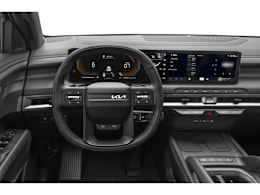
Our Telluride has a 12.3-inch infotainment touchscreen, along with a 4.2-inch digital driver’s information screen sandwiched between digital gauges. Thankfully, Kia’s onscreen infotainment menus have fairly intuitive layouts, with large tiles and a customizable home screen. A bar of capacitive-touch shortcut buttons sits below the main touchscreen, where some users rest their hands while using the screen above, leading to accidental button presses.
Built-in navigation is standard and includes a robust search feature that responds well to voice commands and can display directions on the small driver’s display. Wireless Android Auto and Apple CarPlay also come standard.
Sadly, the Telluride’s overreliance on capacitive-touch and onscreen controls is a usability downgrade compared to the previous model. One of Kia’s more baffling design choices is the placement of the primary climate touchscreen, tucked behind the upper-right edge of the steering wheel, between the driver’s instrument screen and the main infotainment display. Testers found that a good portion of the screen was blocked by the wheel rim, making it difficult for the driver to see and use certain functions.
On the bright side, there are large redundant physical climate control buttons located beneath the center dashboard air vents that are easy to use for common functions, including driver and front passenger temperature, fan speed, and airflow mode. Pop-up icons appear on the infotainment screen temporarily as you make changes with these buttons, but unfortunately, there isn’t a static climate bar that makes it simple to check the climate status.
Further, there are too many functions in general that are obscured from the driver’s view, like the ignition button that’s located inboard on the gear selector stalk, and the engine stop/start and power liftgate buttons, both of which are hidden on the driver’s left dashboard area.
Active safety and driver assistance
The Telluride includes the brand’s latest bundle of active safety and driver assistance systems, which includes automatic emergency braking with pedestrian and cyclist detection, automatic emergency braking that operates at highway speeds, blind spot warning, rear cross traffic warning, reverse automatic emergency braking, lane centering assistance, lane departure warning, lane keeping assistance, adaptive cruise control, and automatic high beams.
We’re happy to see that both a rear occupant alert system and a belt minder come standard. The rear occupant alert is designed to remind the driver—based on rear-door logic—to check the rear seat when the Telluride is turned off, helping prevent children and pets from being unintentionally left behind in the vehicle. We’re happy to see that it also includes rear occupant motion-sensing technology. If the radar system detects movement when the vehicle is parked and locked, the SUV will honk the horn and send an alert to the driver’s phone.
The Telluride also comes with a Safe Exit Assist system, which can detect when a vehicle or bicycle is approaching from behind or alongside while parked on a city street and an occupant is about to open a door into traffic.