
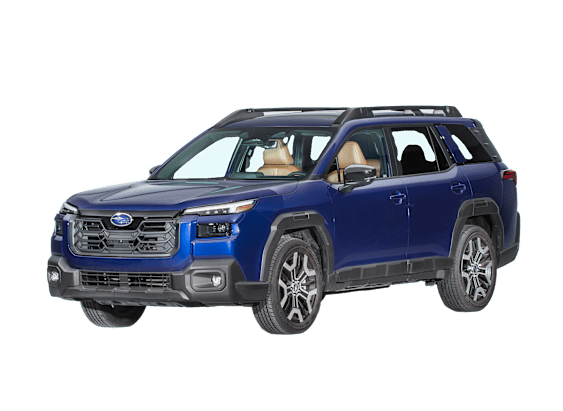
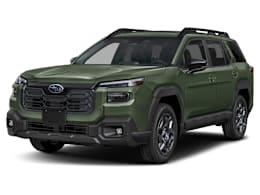
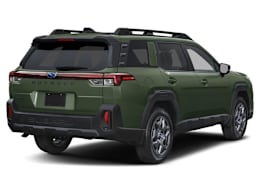
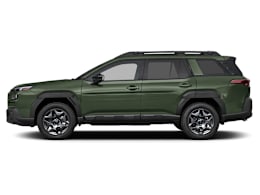
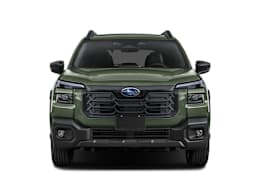
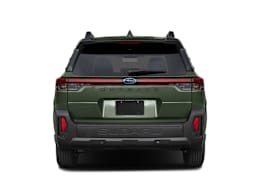
The latest Outback marks a dramatic departure, styling-wise, from its heritage, officially transitioning from a tall station wagon to an SUV. All it took was for Subaru to raise and flatten the roof, square off the nose, and deck the vehicle with more rugged, blocky styling. Now it looks like a true two-row midsized SUV, fitting between the Subaru Forester and the larger three-row Ascent.
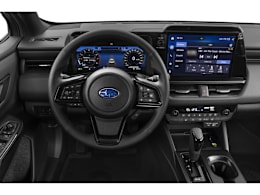
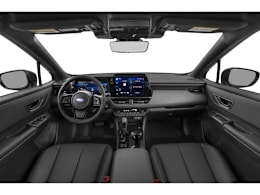
The added headroom is sure to be appreciated by drivers and passengers, but the more significant change to the cabin is the modernized interior, which features a horizontal center screen, a new infotainment system, and the return of long-lost physical climate controls.
The familiar four-cylinder boxer engines continue with refinements: a base 180-hp naturally aspirated engine and a 260-hp turbocharged version. Of course, all-wheel drive is standard. The Outback features the latest generation of the brand’s EyeSight suite of active safety and driver assistance features, with enhanced camera and radar sensors.
With the updates and revised pricing ladder, the Outback carves a niche above the Honda CR-V and Toyota RAV4, yet slots below the Honda Passport and Toyota 4Runner. Not a bad place to be.
Subaru Outback at a Glance
- New exterior styling ditches the wagon look in favor of SUV blockiness
- Most Outback traits remain, including a comfortable ride and competent handling
- The standard engine sounds and feels underpowered
- Wilderness and XT trims get a punchy turbocharged four-cylinder
- All-new infotainment system and physical climate controls are a vast improvement
We tested two versions of the new Outback. We bought a 2026 Subaru Outback Premium for $40,098 and a 2026 Outback Touring XT for $50,290—both anonymously from an area dealer, as we do with every vehicle we test—for the purpose of this road test review. Our Outbacks were assembled in Ota, Gunma, Japan.
We also borrowed a 2026 Outback Wilderness edition from Subaru for evaluation, with an as-driven cost of $50,535. Likely due to a combination of its electronic dampers and all-terrain tires, the ride quality proved even better at lower speeds in the Wilderness than the two tested Outback trims, with an impressive ability to absorb all manner of bumps. The downside to those all-terrain tires is a slight increase in tire noise and slightly “squishier,” less confidence-inspiring handling.
After our testers spent months compiling results from more than 50 specific tests and evaluations at Consumer Reports’ 327-acre Auto Test Center in Connecticut, along with lots of miles behind the wheel on public roads in both trims, we determined that most of what owners liked about the previous Outback carries over. The front seats are comfortable and supportive, the rear seat is spacious, and the ride is pleasant and very absorbent. Yet Subaru improved the interior space and design, including an easier-to-use infotainment touchscreen and physical climate controls.
Drivability differs heavily by engine choice. The standard 2.5-liter engine in the base Premium can feel underpowered, whereas the turbocharged Touring XT delivers punchy, effortless acceleration and quieter overall operation.
But that’s not to say that the more expensive Touring XT is worth the extra investment; our staff consensus points to the lower-tier Premium as the smarter buy, given its nearly identical road-test score and thriftier fuel economy. Plus, while the Touring XT’s cabin is slightly more plush, it isn't leaps and bounds better than the base model.
Regardless of the powertrain or trim, some of our staff miss the "wagon-ness" of the previous Outback. Where the outgoing model had some elegance, with its chrome window accents and gentle curves, the new version is, to put it bluntly, a block, with discordant lines and odd-shaped plastic wheel arches fitted with nonfunctional “grab handles.”
A few styling oddities aside, we came away with overwhelmingly favorable feelings about the new Outback. As such, it remains a top contender in the midsized two-row SUV class.
“I was pleasantly surprised by how well-equipped this base trim is with just one option package on it, especially compared to the Touring XT that's $10,000 more,” said one of our testers. “Is the engine in the Premium a bit weak on power? Definitely. But does it have just enough forward surge for most situations? Sure. (Am I going to keep asking myself questions? Probably.) To get an interior that looks and feels so close to the top trim, and that also includes heated seats, a heated steering wheel, and a pretty nice infotainment system for about $40,000, feels like a good value.”
“While the non-turbo Premium feels somewhat weak compared to the Touring XT, I think it has enough power for most people, and it’s right in line with vehicles like the Honda CR-V and Mazda CX-50, which can also feel short-winded on the highway,” said another tester. “The ride is quite good, and the controls are fairly straightforward. However, both versions suffer from elevated engine, road, and wind noise at times.”
“The interior is roomy, especially the rear seat. Large cargo area, too. The turbo-four in the Touring XT makes it more enjoyable to drive than the base model. This is also a step up for Subaru in comfort features; previous top trims didn’t feel as nice as this one does. It feels like a baby Ascent in some ways to me,” said a tester.
Driving experience
Power delivery from the Premium’s naturally aspirated four-cylinder engine can be annoyingly abrupt at low speeds, especially when taking off from a stop, making it difficult to drive the Outback smoothly. Once underway, the 180 hp the engine produces is adequate for regular around-town driving. The continuously variable transmission (CVT) does a good job of keeping revs low in those situations, while simulated upshifts help maintain palatable engine noise levels during moderate acceleration. But when stronger oomph is needed, the engine often feels underpowered, with limited reserves. Moving down the road with any alacrity requires the engine to be revved pretty high, and it gets uncomfortably loud when doing so.
The 260-hp, 2.4-liter turbocharged four-cylinder found in the Wilderness and XT trims delivers stronger, quieter power that, overall, makes the Outback much more pleasant to live with. What’s great about the turbo engine is that it has enough power that it doesn’t need to work very hard or rev high during regular driving. That helps counteract the fact that its CVT rarely does simulated upshifts.
By the numbers, the Touring XT with the turbo engine zipped from 0 to 60 mph in 7 seconds flat, while the Premium ambled to 60 mph in 9.1 seconds. Fuel economy is in the Premium’s favor, managing 27 mpg overall in our testing, 2 mpg better than the Touring XT. But both pale compared to the Toyota Crown Signia’s 37 mpg overall, thanks to its hybrid powertrain.
Both Outback versions handle well, though neither is the least bit sporty. The steering is nicely weighted, if a bit slow on turn-in, but it feels natural and delivers some feedback to the driver. Body roll picks up and becomes pretty noticeable if you take a turn with some verve, though it remains fairly responsive to the driver’s inputs. The lighter Premium model feels a bit more lively on the road, but the Touring XT proved more responsive around our twisty road course. The Premium exhibited shorter stopping distances on both our dry and wet surfaces, but the Touring still performed adequately.
The Outback provides a plush suspension that effortlessly irons out road imperfections. The Premium rides slightly better, likely due to its smaller wheels and tires. Broken pavement is felt more in the Touring XT, but they both ride really well, with excellent bump absorption and composed body control.
The Outback’s boxy new shell seems to catch a lot of wind on the highway, as evidenced by testers' complaints about elevated wind noise. There’s also noticeable road noise and tire hum. Engine noise is almost always a sore spot with Subarus, as their flat-four engines tend to sound a bit gruff.
Cabin comfort
The cabin is significantly nicer than that of prior Outbacks or even newer Subaru models, such as the Forester and Impreza. The base Premium trim, in particular, punches well above its weight in terms of material quality. We were particularly smitten with the lined door pockets—an uncommon feature at this price point. The Touring XT has real leather and a few nicer bits here and there. But the difference between the bottom and top trims is surprisingly minimal.
The Outback’s driving position is upright and elevated with a good view out over the hood. We appreciated the plush, supportive armrests, but testers found the left footrest cramped and awkward, and taller drivers felt they were sitting too high. Some testers also noted that the turn signal icons tend to be blocked by the steering wheel when it’s in a lower, more comfortable position. Outward visibility is aided by the low dashboard, relatively thin roof pillars most of the way around the vehicle, and tall, squared-off glass.
We found the front seats comfortable, whatever the trim. The seats have soft padding, yet are nicely shaped with good-sized bolsters on both the bottom cushion and seatback. Although testers liked the Premium’s seats, most preferred the Touring XT’s, which have greater adjustability, including four-way lumbar support and a manual bottom cushion extender.
The rear seat is spacious and comfortable, with abundant headroom, ample knee room, and decent space for your feet under the front seats. The bottom cushion provides good underleg support, although if it were higher off the floor or raked back more, it would be even better. Cargo space behind the rear seat is quite good, aided by the flatter roofline vs. the previous Outback’s wagon-like slope. But competitors like the Honda Passport and Mazda CX-70 offer significantly more room for families.
Controls and usability
The Outback features a completely redesigned infotainment system centered around an all-new, 12.1-inch landscape-oriented touchscreen. The new interface demonstrates significantly improved responsiveness compared to previous iterations of Subaru’s system, although initial startup time can still be somewhat slow.
The screen layout is logically organized, with a clutter-free design and a static left-hand menu bar that provides immediate access to essential functions such as the home screen, navigation, media, and phone. We particularly appreciate the dedicated volume knob and the reintroduction of physical climate controls, which offer tactile feedback and ease of use while driving. Two of our few minor criticisms are that the climate controls are mounted a bit low (but the trade-off, compared with controls on a touchscreen or a capacitive-touch panel, is worth it), and the functions on the steering wheel remain rather crowded.
Active safety and driver assistance
Standard active safety and driver assistance features on the Outback include automatic emergency braking with pedestrian and cyclist detection, automatic emergency braking that operates at highway speeds, blind spot warning, rear cross traffic warning, reverse automatic emergency braking, lane centering assistance, lane departure warning, lane keeping assistance, adaptive cruise control, and automatic high beams.
A rear occupant alert system comes standard and is designed to remind the driver—based on rear-door logic—to check the rear seat when they turn the Outback off, helping to prevent children and pets from suffering heatstroke or hypothermia if unintentionally left behind in the vehicle. There’s also a rear belt minder, which alerts the driver if a rear passenger unbuckles their seat belt during the trip.
The top Touring and Touring XT trims add hands-free active driving assistance with pre-curve speed control, active lane change assist, and Emergency Stop Assist with Safe Lane Selection. If the driver becomes unresponsive while adaptive cruise control is in operation, this system can turn on the emergency flashers, slow the car, and pull it onto the shoulder.