
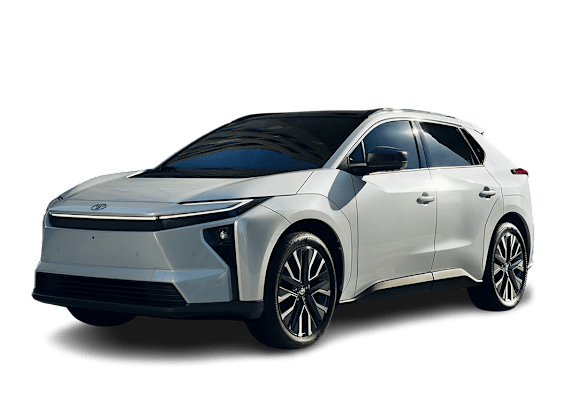
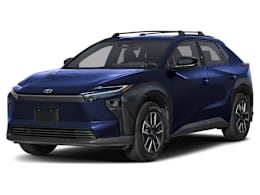
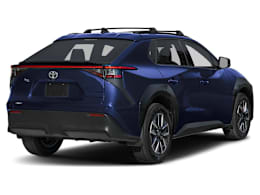
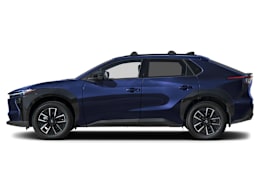
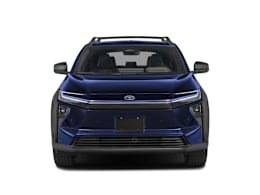
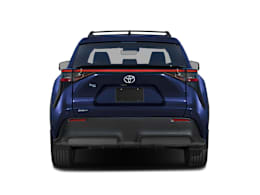
The bZ is an updated version of Toyota’s first all-electric vehicle, originally called the bZ4X when it debuted for the 2023 model year. Besides a less confusing name, Toyota gave the new model more power, a longer driving range, faster charging, and updated styling.
The key changes to the bZ, which stands for “beyond zero,” are with the electric powertrain. All-wheel-drive models now produce 338 hp—more than a 50-percent increase over the old bZ4X. The maximum driving range for front-wheel-drive versions is now rated at 314 miles per the EPA, up from 252 miles. The all-wheel-drive model we tested is EPA-rated for 288 miles; however, the bZ fell short in our highway-range testing.
Hardware changes brought faster charge times, and, most importantly, the bZ comes with a Tesla-compatible North American Charging Standard (NACS) port, granting it access to Tesla’s vast Supercharger network.
There is also a new bZ Woodland model that stretches about 6 inches longer than the regular bZ, boasts 375 hp, standard all-wheel drive, premium interior features, and off-road-oriented driver-selectable modes.
The bZ’s mechanical twin, the Subaru Solterra, has been similarly updated for 2026. Unlike the bZ, the Solterra is only offered with all-wheel drive.
Toyota bZ at a Glance
- Impressively quick, even for an EV
- Disappointing wet stopping performance
- Awkward driving position
- Lacks one-pedal driving functionality
We conduct more than 50 individual tests and evaluations on every vehicle we purchase at Consumer Reports’ 327-acre Auto Test Center in rural central Connecticut. Our testers also log thousands of miles on public roads over several months. After we tallied the bZ's results, its road-test score proved a clear step up from the bZ4X, with a longer driving range, quicker acceleration, and more efficient home charging.
The bZ is now a stronger competitor to the likes of the Chevrolet Equinox EV, Ford Mustang Mach-E, Hyundai Ioniq 5, Tesla Model Y, and Volkswagen ID.4. We think it’s a solid choice for EV buyers looking for an easy-to-live-with car.
As one of our testers said, “Overall, the bZ is a pretty nice-driving, easy-to-use, and easy-to-live-with EV. It has strong power with impressively little motor whine, good steering, and comfortable front seats. The odd instrument panel screen is growing on me a bit, though I still feel like I have to peer up and over it.”
Other testers were a bit more lukewarm on the bZ. “This Toyota is a tough sell when an Ioniq 5 SEL AWD is nearly the same price, has the same range, faster charging, one-pedal driving, a built-in route planner, remote start from the key fob...the list goes on,” said one.
“I think this car is for people who are truly all-in on the EV experience, but don’t care about driving long distances,” remarked another tester.
We bought a 2026 Toyota bZ XLE AWD for $42,959—anonymously from an area dealer, as we do with every vehicle we test—for the purpose of this road test review. Our bZ was assembled in Aichi, Japan.
Driving experience
With 338 hp on hand, the dual-motor bZ we tested isn’t lacking for zip. It produces an instantaneous yet smooth grunt at lower speeds, and it recorded an impressive 4.7-second 0-to-60-mph time. And unlike the previous 214-hp bZ4X we tested, that forward thrust doesn’t peter out above 60 mph.
We appreciate that Toyota makes it easy to adjust the bZ’s regenerative braking (which slows the vehicle when you release the accelerator pedal, recouping energy that is sent back to the battery) levels with paddles behind the steering wheel. But it’s disappointing that, unlike many EVs, even the most aggressive level doesn’t allow for “one-pedal driving,” which lets the driver slow the vehicle significantly by releasing pressure on the accelerator pedal, without needing to touch the actual brake pedal to come to a stop.
Point the bZ toward a bend in the road, and it feels predictable and easy to control. The soft, comfort-focused suspension absorbs most bumps well, but the limited steering feedback makes the car feel neither precise nor enjoyable to drive when the pace is pushed. Dry panic-brake stopping distances proved competitive, but the 152 feet that the bZ needed to stop from 60 mph on our wet surface is 7 feet longer than what the old bZ4X managed.
One aspect of its overall EV-ness that held the line is the bZ’s mostly quiet cabin. Testers consistently praised the bZ’s unobtrusive powertrain, which produces very little electric motor whine. Road and tire noise are kept to reasonable levels, with just a touch of wind noise as the only slight audible annoyance.
Cabin comfort
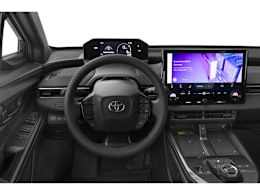
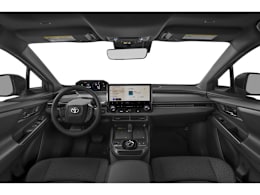
In a word, the bZ’s interior fit and finish is unimpressive. There’s a ton of flat black plastic seemingly everywhere, with lots of hard, unfinished surfaces. This is not an impress-your-friends-with-something-fancy kind of car. The driving position takes some time to get used to because the instrument screen is set so far forward on the dashboard that the driver has to look over the steering wheel to see it, rather than through it, as in most vehicles. We found that drivers who prefer a lower steering wheel position adapted more easily; others found it awkward.
One thing Toyota definitely got right, however, is the front seats. Most testers found them comfortable and supportive, with well-shaped side bolsters and good adjustability. On the other hand, the rear seat is unimpressive. The bottom cushion’s low height provides hardly any underleg support, and there’s almost no room under the front seats for rear passengers’ feet.
Finding places to stash your keys, wallet, and day-to-day detritus in the bZ is frustrating because there's limited small-item storage. We like that there are two phone charging pads on top of the center console, but that’s about the only convenient spot available to put anything. The rest of the storage space is under the center console, in a difficult-to-access location.
At least the cargo area can accommodate a decent amount of stuff, including multiple suitcases, duffel bags, and backpacks behind the upright rear seat. However, unlike many EVs, the bZ does not come with a front trunk (or “frunk”).
Controls and usability
The bZ has a slim dashboard design, with color-adjustable accent lighting, and a large 14-inch infotainment touchscreen. The screen consolidates media and climate into a single display, meaning some basic tasks require multiple steps. The climate controls are now at the bottom of the center screen, similar to what we’ve seen in recent Lexus models. We’re glad to see, though, that the temperature dials and defrosters remain as physical controls. It’s also key that safety-critical controls, such as for the emergency flashers, headlights, and wipers, are all physical.
Unfortunately, Toyota still insists that its infotainment system does without a “home” screen and split-screen capability, forcing users to switch back and forth between features such as navigation and media. At least this annoyance is partially offset by the ability to display select information within the driver’s instrument screen.
Another odd design decision from Toyota is the bZ’s electronic gear selector, which requires a touch more thought than necessary. The monostable design requires the driver to push down before rotating the dial left or right to shift into Reverse or Drive, respectively, adding an extra step.
Active safety and driver assistance
Standard active safety and driver assistance features include automatic emergency braking with pedestrian, cyclist, and motorcycle detection, along with automatic emergency braking that operates at highway speeds, blind spot warning, rear cross traffic warning, reverse automatic emergency braking, lane centering assistance, lane departure warning, lane keeping assistance, adaptive cruise control, and automatic high beams.
A rear occupant alert system is standard. It’s designed to remind the driver—based on rear-door logic—to check the rear seat when the bZ is turned off, helping prevent children and pets from suffering heatstroke or hypothermia if unintentionally left behind in the vehicle. There’s also a rear belt minder, which alerts the driver if a rear passenger unbuckles their seat belt during the trip.
The bZ comes with a Safe Exit Alert system that monitors for vehicles and cyclists approaching from behind when parked on a city street, and only allows passengers to open the doors when it's safe to do so.