Sign In

The small SUV class is one of the sweet spots of the auto market. The best models provide much of the convenience and versatility of larger SUVs, along with more agile handling, better fuel economy, and a more accessible price tag. But let's face it, you can spin your wheels researching and comparing the many models—and figuring out which best fits your needs, lifestyle, and budget.
We'll make it easier. Here, we're focusing on the four high-scoring models in our test Ratings with as-tested prices less than $30,000: the Subaru Forester, Honda CR-V, Mazda CX-5, and Toyota RAV4. All are well-rounded models that are versatile, comfortable, fuel efficient, and reliable. And each has been redesigned in the last couple of years.
Most people will probably find one of these models is just right for them. But while they may look similar on paper, each has its own character, and its strengths and weaknesses. With its road-test score of 88, the Forester leads the pack in our Ratings, but the others scored very close to each other.
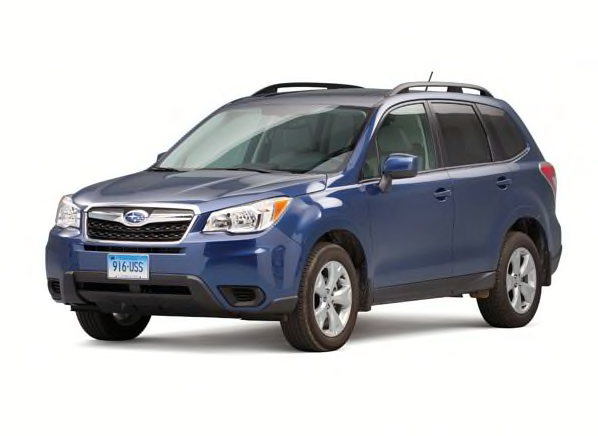
It's right if: You want a good value that's fuel-efficient and practical, if not very flashy.
The Forester has always been a sound, functional vehicle with an unpretentious demeanor. While that image has made it hard for the Forester to stand out to car shoppers in this crowded field, things are changing. With its 2014 redesign, this new model has climbed securely to the top of our Ratings. How? By focusing on the fundamentals and fine-tuning what buyers really want in an SUV.
The Forester puts function in front of form. Instead of following the contemporary trend toward descending rooflines and curvaceous bodies, it provides a space-efficient design, large windows, and big square doors. That recipe has resulted in the easiest access and the best view out of almost any vehicle, and one of the roomiest rear seats in the class, with copious head and leg room.
The new Forester also delivers quicker acceleration than its predecessor, and a class-leading 26 mpg overall and 35 on the highway. Our midtrim 2.5i Premium version even has a power seat and a backup camera, handy features that some similarly priced competitors lack.
For all its virtuous simplicity, however, the Forester's redesign has also brought trade-offs. The ride, which used to be calm and cushy, is now rather firm and jittery. Handling is responsive and very secure, but the Forester isn't as agile as, say, the Ford Escape, Mazda CX-5, or Toyota RAV4.
The interior trim was modestly upgraded but remains austere, with a few cheap-looking touches. More notable, the Forester's in-car electronics and infotainment connectivity are behind the curve, especially in the areas of wireless Bluetooth phone pairing and audio streaming.
Best version to get: For less than $27,000, you get a nicely equipped 2.5i Premium, with handy features such as a power driver's seat and giant sunroof. Heated seats come with a $500 option package. For a better-equipped version, you can move up to the 2.5i Limited for about $3,000 more, which adds standard leather, heated seats, automatic-climate-control, and a power tailgate. With a Touring version, which starts at $29,995, you get a navigation system, but it's not very good. More worthwhile, you can also opt for Subaru's $2,400 EyeSight suite of electronic safety features. For more power, you can get a turbocharged XT model, but we think most buyers would be happy with the 2.5i versions.
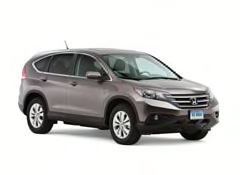
It's right if: You want a sensible SUV that's easy to live with, rides well, provides a lot of cargo space, and is very reliable and competitively priced.
Redesigned for 2012, the CR-V was chosen as our 2013 Top Pick for small SUVs in Consumer Reports' Annual Auto Issue, although it's since been outscored in our testing by the Subaru Forester. Overall, it's a family-friendly model that treats you to a large rear seat, easy access, lots of cargo space, and a comfortable ride. It's powered by a quick, responsive 2.4-liter four-cylinder engine, coupled with a super-smooth five-speed automatic transmission. That combo delivered 23 mpg, which is decent in this class, but isn't quite as thrifty as the others here.
The CR-V's absorbent suspension provides commendable isolation from bumps and ruts. It also handles well in everyday driving, with quick, well-weighted steering and controlled body lean in corners. But when we pushed it to its handling limits, body lean increased dramatically and the vehicle felt unsteady, although its electronic stability control system kept it in line.
You'll also have to put up with pronounced road noise, although it's not as bad as in, say, the Mazda CX-5. Drivers are treated well in the roomy, although fairly basic cabin. A large windshield and front windows help provide good visibility to the front and sides. But beefy rear roof pillars create large corner blind zones. Fortunately, a backup camera is standard on all models.
It's hit or miss with electronic features. You'll get basics such as Bluetooth compatibility, audio auxiliary, and USB inputs, and iPod control through the audio systems. But satellite radio, which is included in many competitors, is only available, curiously, on leather-trimmed versions.
Best version to get: All trim versions, including the base LX, come well equipped. Moving up to the popular EX adds alloy wheels and a sunroof. And the high-end EX-L adds leather, heated seats, and a power driver's seat.
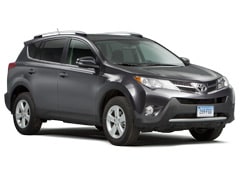
It's right if: You want a nice blend of fuel efficiency, agility, roominess, and reliability, but can put up with a firm ride and noisy cabin.
Versatile, efficient, and easy to live with, the RAV4 has been one of our top-rated SUVs for years. And its 2013 redesign brings more agile handling and an easier-to-use rear hatch that lifts up instead of swinging to the side. Meanwhile, Toyota has dropped the optional third-row seat, which few people will miss, and the sprightly, efficient V6 engine, which some will miss.
The RAV4's 2.5-liter four-cylinder engine, mated with a six-speed automatic transmission, delivers spirited performance and squeezes out 24 mpg overall, which is better than most competitors but slightly below the Subaru Forester's 26 and the Mazda CX-5's 25. A roomy interior, super-easy access, and mostly intuitive controls add to its appeal.
On the road, the RAV4 is fun to drive, rivaling the CX-5 for friskiness. It provides quick, well-weighted steering and decent road feel. And when pushed to its handling limits, the RAV4 remained planted, steady, and unflappable.
Knocks? The ride is taut and controlled, but it borders on being overly firm. Also, the cabin is fairly noisy and some interior trim is quite basic.
The seats are well-shaped and firm. But the XLE version we tested lacks an adjustable lumbar bulge. Rear seating is spacious and comfortable, at least for two adults. And access to the front or rear doesn't get easier.
Bluetooth smart-phone pairing is simple, although our XLE's Bluetooth hands-free voice command capabilities were surprisingly limited, and the system blocks out phone contacts while you're on the move.
Rear cargo space is generous, and the rear seat is split into three sections, so you can fold the center one down and still seat two passengers.
Best version to get: The XLE is the best overall value. It includes standard automatic climate control and a power sunroof for less than $27,000. A power driver seat might remedy some complaints about comfort, but you can only get that feature on the top-of-the-line Limited trim. Some rivals, such as the Subaru Forester Premium, offer more equipment for the money.
Note: Consumer Reports has removed the RAV4 recommendation, because of poor performance in the Insurance Institute for Highway Safety's new small-overlap test.
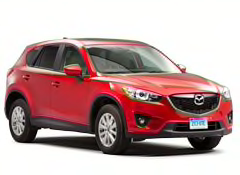
It's right if: You want a fun-to-drive, fuel-efficient SUV, and don't mind putting up with a stiff ride and noisy cabin.
The CX-5 has been a bit of a sleeper since it was introduced last year. But the stronger, more spirited 184-hp, 2.5-liter four-cylinder engine that it received this year should wake people up. Included in mid- and top-trim models, the new four feels more muscular and provides much quicker acceleration than the pokey 155-hp, 2.0-liter four that the CX-5 originally came with and now powers only the base Sport version. And it got the same impressive fuel economy of 25 mpg overall, second only in this class to the Subaru Forester's 26 mpg.
Handling is the CX-5's forte, making it one of the more fun-to-drive SUVs we've tested. It feels taut and alert when tackling corners, and it's one of the few SUVs that's enjoyable to thread along a twisty road. The toll for this sporty attitude is so-so ride comfort. The suspension is rather stiff, with a mild underlying choppiness on the highway that wears thin over time.
Inside, the CX-5 has a surprisingly roomy interior and comfortable seats, although a rather austere ambience. Cabin noise is a real problem, though. Road, wind, and engine sounds combine to produce a constant din that will turn off some people.
The CX-5 also has a relatively high price; midtrim versions don't include several features found on competitors, such as heated seats and automatic headlights. Although a blind spot monitoring system does come on most CX-5s.
The midtrim Touring version brings the best blend of price and equipment, and should appeal to the vast majority of buyers. We'd skip the base CX-5 Sport version, with its underpowered 2.0-liter engine, unless you choose the slick-shifting manual transmission and can do without all-wheel drive.
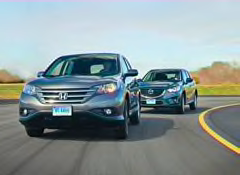
Different people have different priorities. So, here's a quick rundown of models that stand out in some key areas. See our full small-SUV ratings.
Fuel economy
You can expect about 23 to 24 mpg overall from a small SUV. The champ is the Subaru Forester with 26. And the CX-5 comes in at 25 with either of its two engines. Despite Ford's touted EcoBoost technology, we've measured only 22 mpg overall with either turbocharged Escape engine. Opting for front-wheel drive can get you about 1 mpg more than all-wheel drive in a small SUV.
Fun-to-drive
The Ford Escape is arguably the nimblest model in the class. And if you get the 2.0-liter turbo engine you also benefit from effortless power delivery. The Volkswagen Tiguan comes close to the Escape in its fun-to-drive quotient, with the Toyota RAV4 and Mazda CX-5 not far behind. The Forester and Honda CR-V are OK, but nothing special. The Forester's continuously variable transmission does little to satisfy driving enthusiasts.
Ride comfort
If you value an absorbent, isolating suspension above all, then the Honda CR-V is your choice. But if you want a good balance between a steady ride and agile handling, the Ford Escape has the edge. After those two, the Forester is a decent choice. You might get annoyed by the RAV4's firm ride, and the CX-5's stiff, choppy ride won't endear itself over the long haul.
Rear-seat room
The Forester's rear seat is particularly spacious and provides good support; it even includes reclining seatbacks for added comfort.
Acceleration
Surprisingly, the Mazda CX-5 with the optional 2.5-liter SkyActiv engine is super fuel efficient and one of the quickest vehicles in this class. The Ford Escape with its optional 2.0-liter EcoBoost turbocharged four isn't far off the Mazda's pace. But the tiny turbocharged Nissan Juke is slightly quicker than either.
Quietness
This class is not known for quiet cabins. But if that's important, and you don't want to go with a relatively expensive Volkswagen Tiguan or Buick Encore, the Ford Escape is the best choice.
Upscale cabin
Most small SUVs lean more toward being utilitarian than plush. The interiors of the Volkswagen Tiguan and top-trim Ford Escape Titanium are a cut above the class standard, but that's also reflected in their prices.
Cargo space
The Honda CR-V, Subaru Forester, and Toyota RAV4 have generous cargo volume, with the RAV4 slightly edging out the others.
Seven-passenger capacity
If you want a third-row seat in your small SUV, there's the Mitsubishi Outlander and Nissan Rogue. But keep in mind, a third row in such a small vehicle tends to be tiny and only for kids.
Electronic features
All models let you plug in a portable music player or smart phone. And most have standard Bluetooth capability (although the Subaru Forester's system is cumbersome). Comprehensive voice commands help keep your eyes on the road when choosing songs from a connected device. And Ford's SYNC system is a common and affordable option in the Escape, as is the UVO system in the Kia Sportage. Toyota's optional Entune infotainment system, available in the RAV4, lets you use apps such as Pandora, OpenTable, Bing, and more when it's connected to a smart phone.
Backup camera
We think all SUVs should have a backup camera. It's standard on all versions of the Honda CR-V and Toyota RAV4, and on all 2014 Ford Escapes. Blind-spot monitoring is standard on many versions of the Mazda CX-5.
Towing
Most small SUVs can tow only 1,500 to 2,000 pounds. If you need more capability, the Ford Escape, when equipped with the optional 2.0-liter EcoBoost four, can tow 3,500 pounds. And the coming Jeep Cherokee will be rated to tow 4,500 pounds with its optional V6.
Stick shift
Only the Subaru Forester offers a manual transmission on an all-wheel-drive model. You can get a stick-shift, front-wheel-drive version of the Mazda CX-5, Kia Sportage, and Volkswagen Tiguan, but only in basic trim levels.
Off-road capability
Most small AWD SUVs can handle muddy roads and moderate off-road conditions. Higher-trim Foresters offer the optional X-mode traction assist system, which optimizes AWD operation for off-road conditions and includes hill-descent control. The Jeep Patriot and coming Jeep Cherokee are even more capable, with advanced electronics that help the vehicle adapt to different conditions and underbody protection for rough trails.


 Build & Buy Car Buying Service
Save thousands off MSRP with upfront dealer pricing information and a transparent car buying experience.
 Get Ratings on the go and compare
while you shop


