Sign In

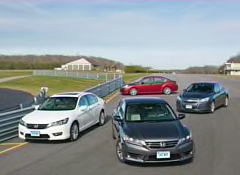
In recent months we've seen many of the most popular midsized sedans receive major redesigns or notable freshenings that have altered the landscape in the category. That includes the three models in this month's report: the Honda Accord, Chevrolet Malibu, and Subaru Legacy.
Through 2012 our Ratings shifted as we tested redesigns of the Nissan Altima, Toyota Camry, and Volkswagen Passat. Meanwhile, we just bought several redesigned Ford Fusions, and we're putting them through their paces at our track.
Lost in the flurry of shapely redesigns is the Honda Accord, which looks a lot like its predecessor. With a roomy interior, very efficient and refined drivetrains, a fun-to-drive character, and an attractive list of features, it's convincing evidence that Honda may be back on track after a string of unimpressive introductions. The new four-cylinder Accord tops its class, edging out the Hyundai Sonata and Toyota Camry, and the V6 model is challenging the Camry Hybrid and V6 Camry for the top spot among pricier family sedans.
Why some vehicles are not recommended. The Chrysler 200, Dodge Avenger, and Hyundai Sonata Hybrid score too low. The Sonata Limited has below-average reliability. The Malibu is too new for us to have reliability data, and we have insufficient reliability data on the Volkswagen Passat V6.
The first version of the revamped Malibu to hit dealerships was the mild-hybrid Eco, which we tested for our August issue. It has a plush ride and quiet cabin and got a stingy 29 mpg, but we found its $28,285 price steep and its rear seat relatively tight. For this issue, we tested a conventionally powered Malibu with a new 2.5-liter, four-cylinder engine. With better performance and handling, it scored notably higher than the Eco. But its $26,030 sticker price is high for a modestly equipped four-cylinder sedan.
Though the Legacy had been redesigned for 2010, Subaru gave it several tweaks for 2013, including suspension-tuning changes and a new four-cylinder engine and continuously variable transmission. The sedan is spacious, fuel efficient for an all-wheel-drive car, and nicely equipped for the price. Handling is tidier now, but the Legacy lost its previously cushy ride. The noisy and unrefined drivetrain also cost the car points in our testing. Overall, the Legacy really isn't better; it's only a bit different.
The Accord and Legacy are recommended. The Legacy has had above-average reliability, and we expect the same for the Accord, based on its good track record. Though the Malibu scored high enough to be recommended, it's too new for us to have reliability data.
An encouraging trend we're seeing among redesigned sedans is a notable boost in fuel economy. The gas mileage we're measuring banishes old notions of what should be expected of a midsized sedan. Only two years ago, 26 or 27 mpg represented the cutting edge of efficiency for a conventionally powered model with a four-cylinder engine, with a couple of hybrids pushing the boundaries to 34 mpg.
In the past year or so, the game changed: The Toyota Camry Hybrid surprised us with a stellar 38 mpg, and the new four-cylinder Altima and Accord deliver 31 and 30 mpg overall, respectively, and the V6 Camry and Accord get 26 overall. The lesson for consumers: You no longer have to put up with a small, noisy car to get excellent gas mileage.
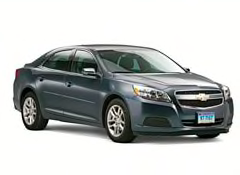
You'll appreciate the redesigned Malibu if you prize a plush, comfortable ride and a very quiet cabin. That's where this solid, easygoing sedan excels. It also has simple controls, decent fuel economy, and sound, secure handling, although the Malibu is clearly no sports sedan.
You'll probably come away disappointed, however, if you need a roomy rear seat. The Malibu's is relatively tight, with less space for legs and knees than in most competitors.
The Malibu is also no great value. Even our moderately equipped 1LT cost $26,030, notably more than higher-rated competitors. Sales incentives seem inevitable.
A reasonably refined and powerful 197-hp, 2.5-liter four- cylinder engine is matched with a smooth and responsive six-speed automatic transmission. That powertrain helps the Malibu get a reasonable 26 mpg overall.
The Malibu rides comfortably, with well-controlled body motions. Bumps are smothered in a way that would be commendable even in a larger, more expensive sedan. Steering response is prompt and well weighted. When pushed to its handling limits, the Malibu proved secure but was unexceptional, and understeering early at our track reduced driver confidence.
Inside, generous seat and wheel adjustments help dial in a comfortable position, but the cockpit is a bit narrow. Visibility is limited to the sides and rear, but a rear backup camera helps. The interior is nicely finished.
The front seats are wide and softly padded, but the scratchy fabric seems like something you'd find in a taxi. Opting for leather improves the looks and comfort.
Controls are simple, with large, clear buttons. A 7-inch touch screen is used for some audio functions, but the menus are straightforward. Chevy's MyLink system lets you control portable music players by voice.
You can expand the large trunk by folding the 60/40-split rear seatbacks. Instead of a spare tire, 2013 Malibus include a 12-volt air inflator and a can of tire sealant.
| Highs | Ride, controls, quiet interior, transmission |
|---|---|
| Lows | Rear seat, price |
| Trim line | 1LT |
| Drivetrain | 197-hp, 2.5-liter four-cylinder engine; six-speed automatic transmission; front-wheel drive |
| Major options | 17-inch wheels, power driver's seat, rear camera |
| Tested price | $26,030 |
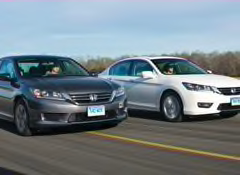
You may have to look twice before noticing it, but the Accord has had a major redesign for 2013. And though Honda has slipped with other models it redesigned in recent years, it nailed this one. The new Accord is roomy, nice to drive, well equipped, and very fuel efficient.
Its 2.4-liter four-cylinder engine, when matched with the smooth continuously variable transmission, squeezes out an excellent 30 mpg overall and 40 on the highway. That's as good as a tiny Honda Fit and better than most compact cars. The 3.5-liter V6 is super-smooth and quite powerful, snapping off a 6.3-second 0-to-60 mph time that is competitive with some sports cars. And its 26 mpg overall is among the best in its class.
Inside, you are treated to one of the best driving positions available, comfortable seats, and terrific visibility. All Accords have a standard backup camera, rare among family sedans. Uplevel models include advanced safety features seldom found in this category, including forward-collision and lane-departure warning systems, and Honda's new Lane Watch blind-spot camera system.
Honda has also kept the Accord's pricing competitive. Our $23,270 four-cylinder LX and $30,860 V6 EX-L cost the same as or less than many other similarly equipped family sedans.
In the final tally, the four-cylinder Accord jumped 10 points in our Ratings to take over the top spot among entry-level sedans. And the V6 is behind only the Toyota Camry Hybrid and V6 Camry among high-end family sedans, and neither Camry drives as well.
To get the best feature set at a reasonable price, consider the EX version. And most buyers should be pleased with the four-cylinder. Based on its history, we expect above-average reliability for the Accord.
The right stuff
The Accord is one of the more agile family sedans, with subdued body lean and decent steering feedback. The Sport's handling is a bit sharper but at the cost of a slightly stiffer ride. On-track behavior was predictable, with the four-cylinder being more enjoyable than the V6. Both performed well in our avoidance maneuver.
Though the ride is supple and controlled, it lacks the comfort found in some competitors because of some short, quick motions. Honda has finally solved the Accord's longtime problem with road noise; road and wind noise are nicely muted. The four-cylinder and CVT work without the din found in some competitors. And the V6 is even quieter, producing just a smooth hum. Two hybrid versions, including a plug-in, will come later.
The CVT is smooth, quick, and unobtrusive, marking a new benchmark for that type of transmission. You'd be hard pressed to tell that it isn't a conventional automatic, high praise indeed. A six-speed manual transmission is also available with the four-cylinder, a rarity among family sedans, but it comes only with cloth seats on the sedan. The V6's six-speed automatic shifts smoothly and responsively. The only way to pair the V6 with a manual is in the Accord coupe.
Engaging "Eco" mode holds the car in higher, fuel-saving gears and blunts throttle response. The instrument cluster lights change to a green hue to reinforce your eco-friendly behavior. But if you give in to the devil on your shoulder and get on the gas too much, the glow turns a reprimanding white.
A well-tailored fit
Drivers will find plenty of space in the cabin. The cloth front seats are wide and supportive, although the LX model lacks power seats and lumbar adjustment. The powered leather seats provide better support and more adjustments and have two-position seat memory, a unique feature in this class. The rear has a supportive bench that's comfortable for two adults but tight for three.
Fit and finish is generally very good. But a few cheap touches are evident, such as chintzy door-panel switches and unconvincing textured plastic "wood grain" on our EX-L.
The Accord's gauges are a model of clarity, and most controls are easy to use. Basic versions have a simple-to-use radio, but opting for the EX-L adds a more complicated one that uses a small touch screen for certain functions. Navigating the screen can be a bit convoluted, and it needs a firm tap to register. Top-trim versions have an even more complicated radio with a touch screen and a multifunction knob that controls navigation and audio functions.
All Accords come with standard dual-zone automatic climate control, a nice touch. Uplevel models allow you to adjust the climate system by voice, but using the normal buttons is faster and easier.
Honda's first venture into the world of in-car music apps is Aha with HondaLink, a neat system. Bluetooth integration works well with iPhone and Android phones. Music on your device can be accessed by voice command, and text messages can be read aloud and responded to with preset replies.
The trunk is large and nicely trimmed, but its hinges may crush fragile items. The seat folds in one piece to expand the trunk; a more versatile split design isn't offered.
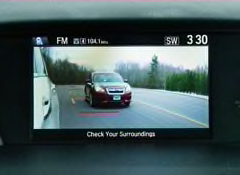
A new approach to blind-zone monitoring
Honda's Lane Watch system provides a new twist for checking blind spots. When the right turn signal is activated, a camera automatically displays the area to the right of the car on the dash's screen. That proves helpful when merging into right-lane traffic, parallel parking, or checking for bicyclists. But watching the moving images while driving can be distracting. And nothing warns you about vehicles in the driver's-side blind spot. Overall we'd rather have a conventional blind-spot monitoring system, which isn't available.
| Highs | Drivetrain, fuel economy, V6 acceleration, roomy interior, handling, driving position, visibility, lots of features, controls on the LX |
|---|---|
| Lows | Complicated optional radio, ride is a bit choppy |
| Trim lines | LX, EX-L V6 |
| Drivetrains | LX: 185-hp, 2.4-liter four cylinder engine; continuously variable transmission. EX-L: 278-hp, 3.5-liter V6; six-speed automatic transmission; front-wheel drive. |
| Major options | None |
| Tested prices | LX: $23,270; EX-L: $30,860 |
| Other trim lines | Sport, EX, Touring, Hybrid, Plug-in Hybrid |
| Other drivetrains | 196-hp, 2.0-liter four-cylinder and electric motor; 6-speed manual transmission |
| Braking | Short stops on dry surfaces, but wet stops were a bit longer. |
|---|---|
| Headlights | Low-beam performance is good, with decent levels of intensity and good visibility forward and to the side of the road. A distinct cutoff can reduce the visibility range when driving over dips and bumps. The high beams provide very good forward visibility and better intensity. |
| Access | Getting into the front or rear seats is easy through the large door openings. |
| Visibility | Visibility is impressive, thanks to upright styling, thin roof pillars, and a wide expanse of glass all around. All trims come with a standard backup camera. |
| Cabin storage | There's adequate interior storage for smaller items, a USB port, and two 12-volt power points. |
| Head restraints | There are locking head restraints in all seating positions. The rear-center head restraint is not tall enough to provide adequate protection, even when it's raised. |
| Child seats | It may be difficult to secure a rear-facing child seat with the safety belt because the belt anchors are located far forward. Lower LATCH anchors are available in both rear outboard positions, but they are recessed behind the seat cushion and can be awkward to access. |
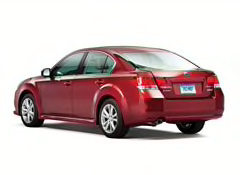
If you want an affordable family sedan with all-wheel drive, the Legacy is the only game in town. It's also a nice, value-packed ride, with a spacious interior and good fuel economy. Where it falls a bit short is in refinement and performance.
For 2013, Subaru tweaked the steering and suspension, which helped make emergency handling more secure and predictable. But the changes also robbed the car's ride of its plushness; it's still good, but no longer great.
The redesigned 173-hp, 2.5-liter "flat-four" engine delivers slightly quicker acceleration and fuel economy of 26 mpg overall, which is impressive for an AWD car. Still, most competing four-cylinder sedans are quicker.
The Legacy's real Achilles' heel is its continuously variable transmission. It's well behaved during casual driving, but it tends to exacerbate engine noise when you're accelerating or merging on the highway, and its performance is a bit rough around the edges.
The optional 256-hp six-cylinder engine is more refined and enjoyable to drive, but it adds $3,000 to the price. Expect about 22 mpg overall.
The Legacy is more fun to drive than a typical family sedan. In corners, turn-in response is quick and body lean is contained. But steering is short on driver feedback. When pushed to its handling limits, it remained stable and composed.
The optional EyeSight suite of electronic safety aids works well. It sounds an alert if the driver strays outside the lane or begins weaving inside a lane, and it can automatically brake to prevent some low-speed collisions.
You'll find generous room, great visibility, and super-intuitive controls, but the cabin has a somewhat spartan ambience.
In front, short seat cushions reduce thigh support, but rear-seat comfort is impressive even for three people, although toe room is limited. The trunk is large, and the rear seatback folds 60/40 for more space.
Skip the Legacy's optional navigation system, which complicates the radio controls. But unfortunately you'll have to get it if you want the EyeSight features.
| Highs | Standard all-wheel drive, visibility, rear seat, fuel economy (for an AWD car), controls |
|---|---|
| Lows | Acceleration, engine noise, unrefined CVT |
| Trim line | 2.5i Premium |
| Drivetrain | 173-hp, 2.5-liter four-cylinder engine; continuously variable transmission; all-wheel drive |
| Major options | All-weather package (heated seats and mirrors, wiper deicer) |
| Tested price | $24,189 |


 Build & Buy Car Buying Service
Save thousands off MSRP with upfront dealer pricing information and a transparent car buying experience.
 Get Ratings on the go and compare
while you shop


