Sign In


Volvo's American brand image links to a handful of recurring themes, namely safety and station wagons. For decades, boxy Volvo wagons carried families and their golden retrievers to canoeing trips and East Coast colleges. Over the years, safety remained a defining pillar for the brand, but Volvo culled wagons from its U.S. lineup, leaving only the jacked-up SUV-imitating XC70. Now the V60 brings the Volvo wagon back to America.
Based on the S60 sedan, the V60 competes with European wagons such as the Audi Allroad and BMW 3 Series. All three cars are sized more for small families or couples hauling around outdoorsy gear, rather than being sedan-based moving vans.
But this isn't your father's Volvo station wagon. Like other modern Volvos, the V60 breaks free of the box that once defined the Swedish cars. While the V60 is undeniably stylish, its designer lines force some practical concessions. The opening to the cargo area is relatively small and the pinched side rear windows cut some into visibility. Adults fit in the tight rear seat. Typical for the class, it's far from spacious.
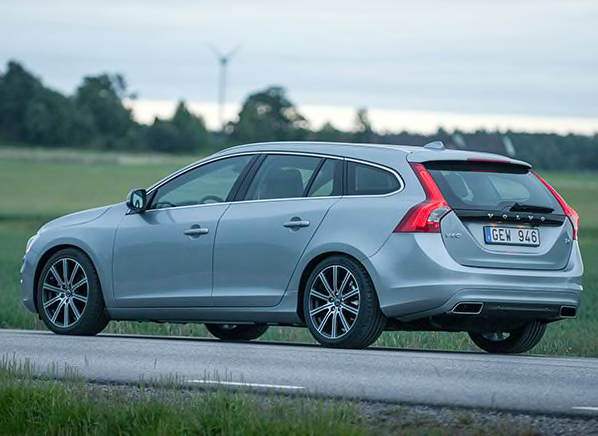
Volvo's return to the wagon market isn't the only big news here. The S60 and V60 introduce Volvo's new four-cylinder Drive-E engine lineup. The brand will eventually shift to a fully four-cylinder fleet, and front-wheel-drive models are the first to receive the new 240-hp, 2.0-liter turbocharged four, mated to an eight-speed automatic transmission. First impressions of this powertrain are highly positive. Acceleration is strong when desired and we saw about 30 mpg in our mixed driving.
The 2.0-liter four is also more refined than Volvo's mainstay five-cylinder engines, although the new start/stop system restarts with a bit of rumble and shake. Those old turbocharged five- and six-cylinder engines and six-speed automatic transmissions remain in all-wheel-drive V60 models, at least for the time being. One bit of nomenclature confusion: the front-wheel-drive V60 is badged T5 on the decklid, even though there are only four-cylinders under the hood.
Like the S60, the V60 feels enjoyable to drive, with well-weighted and responsive steering. Our press car, rented for a fee from Volvo, had the optional $1,500 Sport package. Its sports suspension and 19-inch wheels deliver very little body roll, but they return a rather stiff ride. We'd skip that option, even though the wheels are very attractive and the optional well-bolstered sports seats are very comfortable for the long haul.
See our wagon buying guide and ratings.
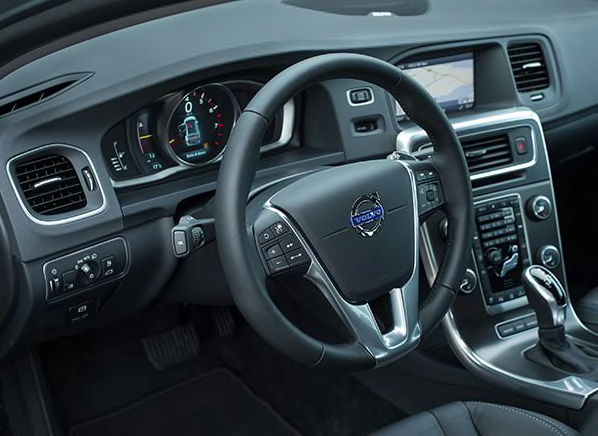
Modern Scandinavian minimalism marks the interior, with brushed metallic trim–wood is optional–adorning our car. There's a storage well behind the signature waterfall console, whose front houses the mostly straightforward climate and radio knobs and buttons. Some radio functions are convoluted. Same goes for paging through the display options for the fully digital gauge cluster. Even the standard nonsports seats are very comfortable, although the old-fashioned manual knob for lumbar adjustment is awkward. Volvo promises to change to a power adjustment soon.
No Volvo discussion is complete without a mention of safety. The S60 does extremely well in crash tests, including the tough Insurance Institute for Highway Safety small overlap test. There's no reason to expect the structurally similar V60 to perform differently. Volvo's City Safety low-speed accident avoidance system is standard; it automatically brakes the car to avoid low-speed collisions.
Still, we get the feeling that Volvo is falling behind a bit with offering state-of-the-art safety gear at a competitive price. Blind-spot monitoring is a $900 standalone option. A rear camera comes with the $2,550 Premier Plus package; it should be standard, period. Forward-collision warning is only available on the V60's expensive top trim level. As other brands, such as Chevrolet and Honda, trickle such features down to midlevel models, Volvo should make more of this equipment standard, if it intends to preserve its safety leadership.
That brings us to the price. The V60 we drove was a midlevel Premier Plus, which is the most popular trim and the best overall value. Adding the blind-spot detection, metallic paint, and heated front seats brought the total to $40,725. That's not exactly cheap, but it's a lot less money than the all-wheel-drive-only Audi Allroad or BMW 3 Series.
Overall, if the V60 fits your lifestyle, it has a lot going for it. Efficient, well finished, and enjoyable to drive, it's likely to please those who were waiting for the return of the Volvo wagon—as long as they don't need a whole lot of space.
—Tom Mutchler

 Build & Buy Car Buying Service
Save thousands off MSRP with upfront dealer pricing information and a transparent car buying experience.
 Get Ratings on the go and compare
while you shop

