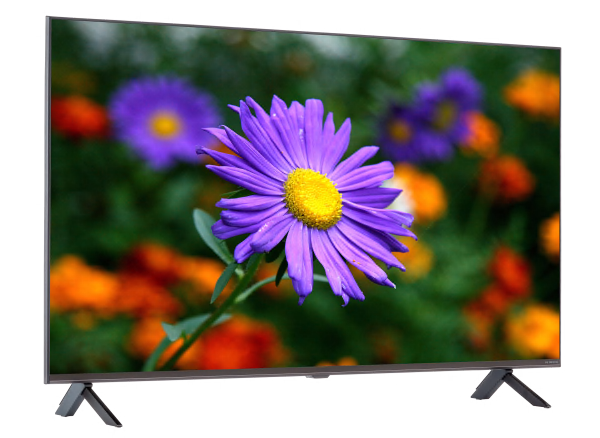
HD PICTURE QUALITY. HD picture quality was Very Good, overall. Reproduction of fine HD image detail was Excellent. However, the edges of objects in the image were over-enhanced which visibly reduced image fidelity. Color accuracy was Excellent, so colors, especially flesh tones, look very natural and lifelike. Very Good contrast—the difference between the darkest blacks and brightest whites—gave images convincing depth and dimension. Black levels were Very Good, and delivered fairly deep blacks that helped the contrast in darker scenes. LG's Vertical Edge-lit local-dimming feature helped. But dark scenes tended to reveal "glowing halos" around content, especially when viewed at off angles, which was distracting. The quality appeared worse as we viewed from the sides—see our Viewing Angle results, below. Black levels were fairly deep, just shy of the very best models, which gave dark scenes better depth. This was among the brightest models we've tested (with the backlight control turned up), so the picture was well suited for a very sunny room—a lower setting is recommended for a dimmer viewing environment. Its reproduction of smooth edges on image content with minimal "jaggies" (jagged edges) was Very Good for "up-converted" HD-to-UHD images deinterlacing of 1080i video, and film-based 1080i content were both Excellent.
4K UHD PICTURE QUALITY. Overall 4K UHD picture quality was Very Good, overall. In our UHD testing, we played native-4K movies and test videos (non HDR) thru the TV's HDMI input, and found their image detail was all there. For color, contrast and black level, the TV performed similarly to its HD picture quality.
HIGH DYNAMIC RANGE (HDR) PERFORMANCE. HDR performance had limited effectiveness In our tests, the display's lack of high peak brightness capability (by HDR standards) limited its ability to show the benefits of our HDR 4K content. It excellently revealed the contrast between moderately bright and very bright highlights, while the brightness levels in the mid-to-lower tones, like those in an indoor scene, were much dimmer than expected. It did a good job reproducing a greater range of nuanced shadow detail, from black to white, with no obvious banding within the gradually shaded areas, but we noted some loss of detail within the highlights of the brightest areas. Brightly colored objects remained nicely saturated.
VIEWING ANGLE. This LG model has a narrow viewing angle overall, below-average performance among TVs. Only those seated directly in front of the screen will see the best picture quality. We examined the image quality at various viewing angles—its image quality notably decreased as we moved away from the center position. In our tests, the picture did show some slight dimming from the sides, but not to a distracting degree. When we viewed the TV from the sides, the image quality degraded significantly. The picture showed a strong loss of color, so flesh tones looked very washed out. Black levels visibly brightened, and reduced the contrast especially on dark scenes. Halo effects around objects in darker scenes (a side effect of the local dimming feature) also become more prominent at off angles. We viewed the image from above and below center screen, and noticed Good vertical viewing angle performance, with only slight changes in color, contrast, and black level.
MOTION BLUR. In our motion tests, this LG TV had Good motion performance, with some blurring. It does not have a special feature to minimize motion blur.
SOUND QUALITY. We got Good sound quality, about average among the models we've tested. When watching a blockbuster movie, a concert, or TV show, it can deliver decent performance but just not like the better performers. In our listening evaluations, we found the bass (low frequencies) to be adequate but lacking a sense of fullness and some definition. Treble (high frequencies) was satisfactory. The overall sound was closed in. This TV should be OK if the room isn't too noisy—we found the speakers could produce a Good volume level and without obvious distortion. Overall, though imperfect, most people would find this sound quality acceptable.
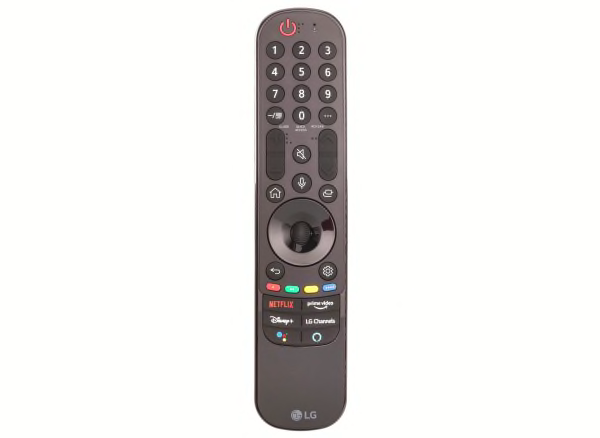
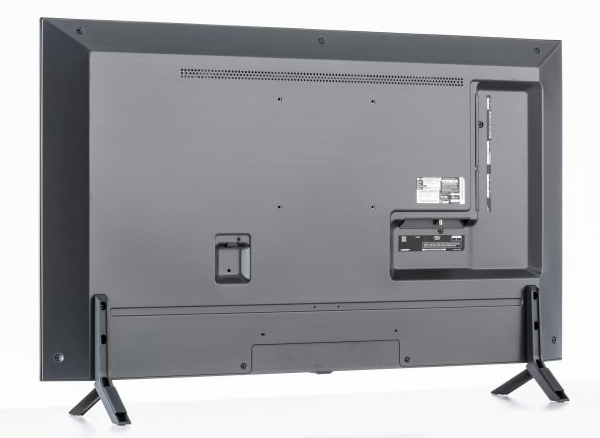
EASE OF USE. Consider the TV's stand is 37 inches wide when choosing a table top to place it on. On first power up, an on-screen guide appeared—which you could choose to follow when setting up the TV. The remote controls the TV via an RF signal and doesn't need to be pointed at the TV. It's a motion-control point-and-click design that you wave around in order to navigate the menus. It has a full number keypad for entering channel numbers. It has a scroll wheel for quickly navigating through a menu. It includes all the buttons we typically expect: power, channel up/down, volume control, mute, source input, menu, and exit buttons. The remote has a microphone for accessing a built-in voice assistant feature. It also has dedicated buttons for streaming Netflix, Prime Video, Disney+, and LG Channels.
INTERNET FEATURES. This TV provides internet functionality via its "WebOS" portal, with access to a library of applications, and a full web browser. Movie streaming services that can be downloaded to this TV, or are built-in, include Netflix, YouTube, Amazon Prime Video, Hulu, Disney, Apple TV and HBO Max. More so, Netflix, YouTube, Amazon Prime Video, Hulu, Disney, Apple TV and HBO Max can be streamed in 4K UHD. It includes the built-in virtual assistants LG ThinQ, Google Assistant, and Amazon Alexa, which allow you to use natural speech to ask questions, launch applications, and search programming by talking to the remote. LG also claims this TV will support external voice assistants Amazon Alexa, Google Assistant, and Apple Siri HomeKit.
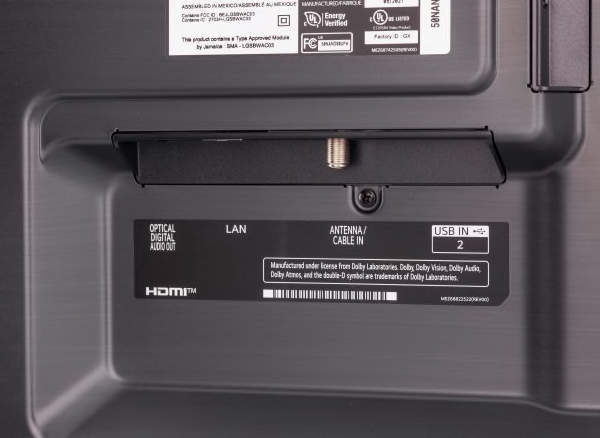
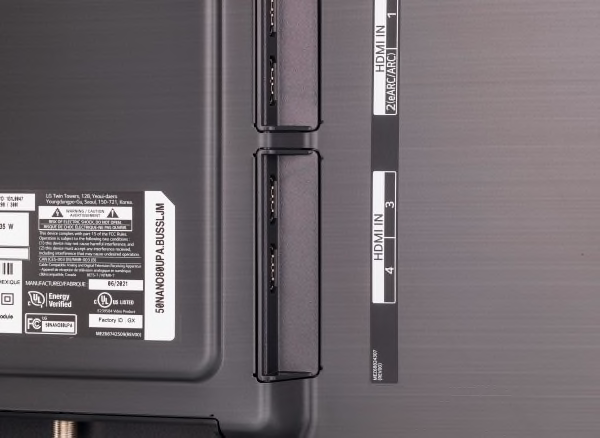
CONNECTIONS. This model has four HDMI inputs (one supports ARC, enhanced audio return channel). It also has two USB ports, an optical digital audio out, an Ethernet port, WiFi wireless networking DLNA, to access files within your home network and AirPlay, for sharing videos, photos, music, and more from Apple devices to the TV.
WHAT'S INCLUDED. You get with this TV: a printed user manual, a quick start guide, an electronic user guide via the TV's menu, a remote control with batteries, and a detachable power cord.
ABOUT UHD TESTING. Ultra-high definition "UHD" can refer to both the TV and program content. While the UHD industry standard includes 4K and 8K, most UHD TVs and UHD content at this time are 4K. A 4K UHD image is presented as 3840 x 2160 pixels—four times the pixel-count of HD. We test UHD TV picture quality using 4K UHD movies, videos, photos, and test patterns to confirm these displays deliver performance to this format's full potential. We examine the TV's ability to reproduce 4K UHD image detail, as well as high dynamic range (HDR)—for TVs that support this capability. Image quality is tested using a UHD movie player connected to the TV's HDMI input, and from files stored on USB flash drive. We also check how well the TV can upscale HD movies to the display's higher UHD resolution while keeping artifacts such as "jaggies" along the edges of image content to a minimum. The best UHD TVs, and HDTVs, present high fidelity images that reveal the full quality of the best source content without degradation.