Media Room
Media Room
Media Room
Release date 02/28/2008
YONKERS, NY — A cheaper car can cost consumers more in the long run compared with a more expensive alternative, according to Consumer Reports' new owner-costs comparisons, which appear in the Annual April Auto Issue. In fact, says CR, a car’s sticker price doesn’t tell the whole story.
At about $17,500, a Mitsubishi Lancer could cost $5,000 less than a Mini Cooper to drive home. But considering the total costs of ownership for each car, the Lancer could cost drivers around $3,000 more over the first five years. A Toyota Highlander can cost $3,000 more to purchase than a V6 Ford Explorer, but owning the Ford after five years can end up costing an additional $6,500.
Consumer Reports recommends that in addition to looking for a good deal on their next car, car shoppers also consider how much the model will cost them to own. To help consumers; CR is introducing new owner-cost estimates in the April issue which can help consumers compare models and possibly save thousands of dollars. CR's estimates include depreciation, fuel costs, interest, insurance, maintenance and repair, and sales tax. Because depreciation is factored into the estimates, CR assumes that the vehicle will be traded in after five years.
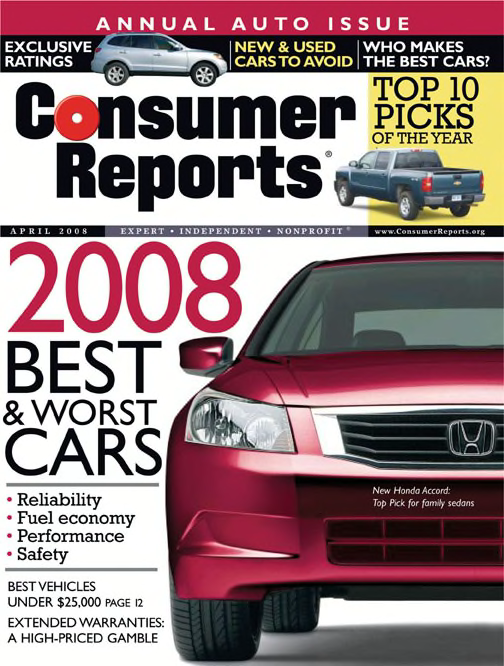
The cost of vehicle ownership for 262 cars is available in the Annual April Auto issue of Consumer Reports, which hits newsstands on Tuesday, March 4. Online subscribers to www.ConsumerReports.org can compare the costs for one, three, five, and eight years of ownership.
"CR's cost of vehicle ownership comparisons are useful to consumers because they provide a benchmark for car shoppers to compare the total costs of their choices over time,” said Rik Paul, automotive editor, Consumer Reports.
CR's calculations in seven common automotive categories show that the most expensive vehicle to run for five years is the Mercedes-Benz S550 at about $101,750. CR's calculated that the least expensive vehicle to run over five years was the Toyota Yaris with a manual transmission, at about $23,250.
Costs vary among similar models
In analyzing ownership costs, CR made some notable discoveries:
Calculating the Costs
CR's cost-of-ownership ratings comprise six main factors:
Depreciation is the largest cost factor by far. To calculate depreciation, CR starts with the price that a typically equipped model sells for; if a model often sells at a large discount CR factors that into the price. From that figure, CR deducts the wholesale trade-in value of the car at the end of the period, based on data from CR's Used Car Price Service. The average model depreciates about 65 percent over five years. When CR doesn’t have depreciation data for a new model, it uses estimates based on comparable vehicles.
Fuel costs can really add up, especially for SUVs. Drivers could pay more than $10,000 to fill up a Dodge Nitro over five years, for example, while a similar-sized but more-efficient RAV4 V6 could save consumers $2,000 during that time. To calculate fuel costs, CR assumes the vehicles are driven 12,000 miles a year, the average reported by survey respondents. To that, CR applies the national average price of regular gas as of December 2007, or the price of premium or diesel fuel if applicable.
Interest is tied directly to vehicle price. It’s calculated based on a five-year loan, the typical financing term. CR assumes a 15 percent down payment and uses the average interest rate of 6.86 percent as reported by Bankrate.com in December 2007.
Insurance costs vary depending on many factors, including drivers’ age, location, and driving record. And they can dramatically boost ownership costs of models that would otherwise seem affordable. Costs are derived from data from the Insurance Institute for Highway Safety.
Maintenance and repair makes up about 4 percent of ownership costs on average over the first five years, according to data from 675,000 Consumer Reports and ConsumerReports.org subscribers who responded to the online version of CR's Annual Car Reliability Survey. Respondents supplied estimated costs for the past year, excluding tires, and their responses provided data for more than 300 models up to eight years old. CR used estimates based on similar models when data was unavailable. CR found that the Range Rover is the most expensive vehicle on average for 5 and 8 years for maintenance and repairs, costing about $2,000 in the fifth year alone. The comparable Toyota Land Cruiser, on the other hand, costs only $600 in that year.
Sales tax costs owners roughly as much as maintenance and repair does. CR uses the national average of 4.83 percent.
CR's Annual April Auto Issue is on sale from March 4 through June 4. The Consumer Reports Auto Issue is available wherever magazines are sold. Free highlights from the April Auto Issue will be available at https://Cars.ConsumerReports.org.
Consumer Reports is one of the most trusted sources for information and advice on consumer products and services. It conducts the most comprehensive auto-test program of any U.S. publication or Web site; the magazine’s auto experts have decades of experience in driving, testing, and reporting on cars. To subscribe to Consumer Reports, call 1-800-234-1645. Information and articles from the magazine can be accessed online at www.ConsumerReports.org.