 Media Room
Menu
Suggested Searches
Recent Searches
Suggested Searches
Product Ratings
Resources
Chat With AskCR
Resources
All Products A-ZThe payment for your account couldn't be processed or you've canceled your account with us.
Re-activateMy account
Sign In
My account
Sign In
Media Room
Release date 09/02/2008
According to the Environmental Protection Agency (EPA), about 25 percent of products in a category should qualify for Energy Star. But until recently, for example, 92 percent of all dishwashers qualified. Under a tighter standard, it’s now about 50 percent. A high number of residential-use oil-fired boilers (67 percent) and dehumidifiers (60 percent) also qualify for the program.
What’s more, it usually takes the Department of Energy (DOE) three years to publish new rules – a period that includes comments from manufacturers, organizations such as Consumers Union, and others – and another three years for the updated standards to take effect. Input into the rule-making process by those who have a vested interest in easy-to-meet standards, such as manufacturers, can also dilute those standards.
Energy Star is a 16-year-old federal voluntary program administered by the DOE and EPA that covers more than 50 product categories. The program grew out of efforts by the federal government to forge a set of nationwide guidelines and create a logo that clearly indicates energy-efficient products. Qualifying Energy Star appliances and consumer electronics should use less energy – about 10 to 25 percent less than the DOE’s maximum allowed amount for that category.
Energy Claims Not Met In Consumer Reports’ Tests
New, sharp-looking appliances may be tempting to consumers, but their energy-consumption claims may not reflect real-life use. Consumer Reports’ comparative energy tests of refrigerators, which are tougher than the DOE’s and better resemble how consumers use refrigerators, found five Energy Star models – three from LG and two from Samsung – whose annual energy consumption would likely be far greater than that claimed on their EnergyGuide labels.
For example, Consumer Reports found that the Samsung RF267ABRS, a refrigerator equipped with French doors and through-the-door ice and water dispensers, used 890-kilowatt-hours per year – a number higher than the 540 kWh annual consumption claimed under the less rigorous Energy Star Program. There was an even larger difference between company claims and Consumer Reports’ more-demanding test measurements for the LG LMX25981ST French-door fridge. LG claims it uses 547 kWh per year, but Consumer Reports’ tests found that real-life energy use would be more than double. In the case of the LG models, the Energy Star protocol allows for the ice maker to be turned off during testing, resulting in the ice melting. Consumer Reports believes that consumers would not turn off the icemaker, and that appears to be a primary reason for the discrepancy between the Energy Star and Consumer Reports’ test results.
No Independent Verification
Consumer Reports notes another flaw with the Energy Star program. To qualify, many companies must self-certify that their products comply with the standards. The DOE does not test products for compliance with Energy Star standards. There’s often no independent verification of what manufacturers report. Instead, the government relies mostly on manufacturers to test their competitors’ appliances to the same standards and report back on results of suspicious energy-use.
Consumers Union has made some recommendations that can help fine-tune the Energy Star program, including:
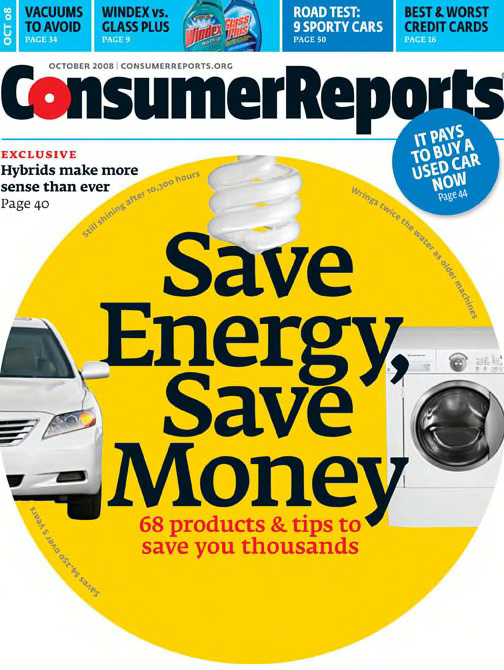
The full report on the Energy Star program is featured in the October issue of Consumer Reports. The report also contains a guide to help consumers interpret the EnergyGuide label, a comparison of energy consumption over the decades by televisions, nine myths about compact fluorescent light bulbs and Consumer Reports’ first ever ratings of tankless water heaters. For more information on the how to save energy and money, check out the October issue of Consumer Reports on newsstands September 2, 2008 or visit www.ConsumerReports.org.
Consumer Reports is a nonprofit membership organization that works side by side with consumers to create a fairer, safer, and healthier world. For 80 years, CR has provided evidence-based product testing and ratings, rigorous research, hard-hitting investigative journalism, public education, and steadfast policy action on behalf of consumers’ interests. Unconstrained by advertising or other commercial influences, CR has exposed landmark public health and safety issues and strives to be a catalyst for pro-consumer changes in the marketplace. From championing responsible auto safety standards, to winning food and water protections, to enhancing healthcare quality, to fighting back against predatory lenders in the financial markets, Consumer Reports has always been on the front lines, raising the voices of consumers.
© 2008 Consumer Reports. The material above is intended for legitimate news entities only; it may not be used for advertising or promotional purposes. Consumer Reports® is an expert, independent, nonprofit organization whose mission is to work side by side with consumers to create a fairer, safer, and healthier world. We accept no advertising and pay for all the products we test. We are not beholden to any commercial interest. Our income is derived from the sale of Consumer Reports® magazine, ConsumerReports.org® and our other publications and information products, services, fees, and noncommercial contributions and grants. Our Ratings and reports are intended solely for the use of our readers. Neither the Ratings nor the reports may be used in advertising or for any other commercial purpose without our prior written permission. Consumer Reports will take all steps open to it to prevent unauthorized commercial use of its content and trademarks.
Consumer Reports is a nonprofit membership organization that works side by side with consumers to create a fairer, safer, and healthier world. For 80 years, CR has provided evidence-based product testing and ratings, rigorous research, hard-hitting investigative journalism, public education, and steadfast policy action on behalf of consumers’ interests. Unconstrained by advertising or other commercial influences, CR has exposed landmark public health and safety issues and strives to be a catalyst for pro-consumer changes in the marketplace. From championing responsible auto safety standards, to winning food and water protections, to enhancing healthcare quality, to fighting back against predatory lenders in the financial markets, Consumer Reports has always been on the front lines, raising the voices of consumers.
© 2008 Consumer Reports. The material above is intended for legitimate news entities only; it may not be used for advertising or promotional purposes. Consumer Reports® is an expert, independent, nonprofit organization whose mission is to work side by side with consumers to create a fairer, safer, and healthier world. We accept no advertising and pay for all the products we test. We are not beholden to any commercial interest. Our income is derived from the sale of Consumer Reports® magazine, ConsumerReports.org® and our other publications and information products, services, fees, and noncommercial contributions and grants. Our Ratings and reports are intended solely for the use of our readers. Neither the Ratings nor the reports may be used in advertising or for any other commercial purpose without our prior written permission. Consumer Reports will take all steps open to it to prevent unauthorized commercial use of its content and trademarks.