 Media Room
Menu
Suggested Searches
Recent Searches
Suggested Searches
Product Ratings
Resources
Chat With AskCR
Resources
All Products A-ZThe payment for your account couldn't be processed or you've canceled your account with us.
Re-activateMy account
Sign In
My account
Sign In
Media Room
Release date 10/06/2008
Consumer Reports found that many retailers and manufacturers donate expiring goods that aren’t spoiled to hunger-relief charities and others donate directly to local groups. These goods are usually fine for people to eat because many date codes on products indicate when an item is apt to be fresh and flavorful rather than unfit for consumption. Consumers can find information on how long products stay good enough to eat by visiting www.fsis.usda.gov and entering the search term “food product dating.”
Most grocery chains and major food manufacturers work with Feeding America, the largest hunger-relief charity in the U.S. The organization also works with the agricultural industry to collect items that aren’t suitable for retail sale but are still suitable for consumption. It distributes more than 2 billion pounds of donated groceries per year to 200 food banks, which work with community-based food pantries and soup kitchens to feed the hungry.
Besides expiring goods, Feeding America also collects bruised produce, items with missing labels, overstocks, and discontinued merchandise. The organization asks supermarkets to freeze fresh meat shortly before its sell-by-date, which provides an extra 60 to 90 days to distribute the food.
For many years, supermarkets were reluctant to donate perishables because executives worried about lawsuits stemming from the consumption of bad food, even if spoilage occurred after the products left the store. However, fears were allayed by the federal Good Samaritan Food Donation Act, signed in 1996, which shields companies from liability as long as the food was donated in good faith.
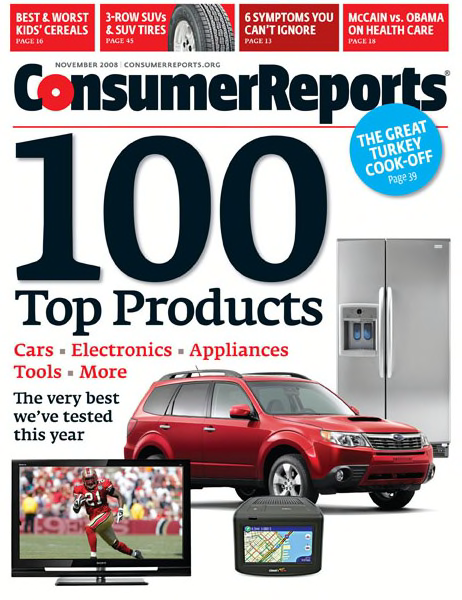
The full report on expired groceries is featured in the November issue of Consumer Reports, on sale October 7 and online at www.ConsumerReports.org.
Consumer Reports is a nonprofit membership organization that works side by side with consumers to create a fairer, safer, and healthier world. For 80 years, CR has provided evidence-based product testing and ratings, rigorous research, hard-hitting investigative journalism, public education, and steadfast policy action on behalf of consumers’ interests. Unconstrained by advertising or other commercial influences, CR has exposed landmark public health and safety issues and strives to be a catalyst for pro-consumer changes in the marketplace. From championing responsible auto safety standards, to winning food and water protections, to enhancing healthcare quality, to fighting back against predatory lenders in the financial markets, Consumer Reports has always been on the front lines, raising the voices of consumers.
© 2008 Consumer Reports. The material above is intended for legitimate news entities only; it may not be used for advertising or promotional purposes. Consumer Reports® is an expert, independent, nonprofit organization whose mission is to work side by side with consumers to create a fairer, safer, and healthier world. We accept no advertising and pay for all the products we test. We are not beholden to any commercial interest. Our income is derived from the sale of Consumer Reports® magazine, ConsumerReports.org® and our other publications and information products, services, fees, and noncommercial contributions and grants. Our Ratings and reports are intended solely for the use of our readers. Neither the Ratings nor the reports may be used in advertising or for any other commercial purpose without our prior written permission. Consumer Reports will take all steps open to it to prevent unauthorized commercial use of its content and trademarks.
Consumer Reports is a nonprofit membership organization that works side by side with consumers to create a fairer, safer, and healthier world. For 80 years, CR has provided evidence-based product testing and ratings, rigorous research, hard-hitting investigative journalism, public education, and steadfast policy action on behalf of consumers’ interests. Unconstrained by advertising or other commercial influences, CR has exposed landmark public health and safety issues and strives to be a catalyst for pro-consumer changes in the marketplace. From championing responsible auto safety standards, to winning food and water protections, to enhancing healthcare quality, to fighting back against predatory lenders in the financial markets, Consumer Reports has always been on the front lines, raising the voices of consumers.
© 2008 Consumer Reports. The material above is intended for legitimate news entities only; it may not be used for advertising or promotional purposes. Consumer Reports® is an expert, independent, nonprofit organization whose mission is to work side by side with consumers to create a fairer, safer, and healthier world. We accept no advertising and pay for all the products we test. We are not beholden to any commercial interest. Our income is derived from the sale of Consumer Reports® magazine, ConsumerReports.org® and our other publications and information products, services, fees, and noncommercial contributions and grants. Our Ratings and reports are intended solely for the use of our readers. Neither the Ratings nor the reports may be used in advertising or for any other commercial purpose without our prior written permission. Consumer Reports will take all steps open to it to prevent unauthorized commercial use of its content and trademarks.