Different Prices for the Same Ride: How Uber and Lyft Use AI to Get More Money Out of You
A Consumer Reports investigation found that customers see dramatically different prices for the same rides ordered at the same time. The study also raises questions about consumer discounts.


Uber and Lyft, the two most popular ride-hailing companies in the U.S., routinely charge different customers significantly different prices for the same rides, a monthslong Consumer Reports investigation has found. Across the routes we tested, the median difference between the lowest and highest price groupings was 42.4 percent.
Both apps also regularly entice customers to book rides by offering supposed discounts on what appeared to be inflated original prices, a practice that experts say not only is deceptive and manipulative but also may violate several states’ consumer-protection laws. We found that 12.4 percent of all discounts advertised on both platforms fell into this category. We believe these discounts to be fake—what experts and regulators call false reference pricing or fictitious discounts.
Uber and Lyft deny that they engage in any fictitious pricing, attributing our findings to real-time marketplace conditions.
They also challenged our methodology and conclusions and stated that they do not personalize base fares for individual consumers or engage in behavioral or surveillance pricing. CR is not disputing this; rather, it is questioning whether the price differences observed are based only on market forces.
Uber also disputes that the rides our volunteers priced should be considered the same. We define the same ride as a trip from the same starting point to the same ending point priced at almost the same time—generally within six minutes of one another and, in many cases, within the same minute. Uber says they are not the same trip. “In a real-time marketplace, a trip is defined not only by where it starts and ends, but also by when it is requested and what marketplace conditions exist at that exact moment,” the company writes.
Algorithmic and AI-driven pricing tactics like those used by Uber and Lyft are attracting growing attention and criticism from consumers, lawmakers, and regulators alike. A CR investigation of the grocery delivery app Instacart found that the company used AI-enabled software to group customers and charge them different prices for the same products at some of the nation’s largest grocery chains. This year, Connecticut and Maryland became the first states in the U.S. to ban certain forms of personalized pricing, and other states are considering similar measures.
Uber and Lyft have both exploded in popularity since they launched in 2009 and 2012, respectively. After years of rapid growth, Uber had more than 200 million active users at the end of 2025, while the much smaller Lyft had nearly 30 million.
Uber is considered a pioneer of “dynamic” and “surge” pricing, where prices can rapidly fluctuate based on changing supply and demand. Americans have grown accustomed to—if also frustrated with—the idea of paying more for goods and services during periods of high demand or low supply, as with flights, hotel rooms, and concert and sporting-event tickets.
But the pricing practices observed in our Uber and Lyft tests are different from dynamic or surge pricing. Because our volunteers booked identical rides at roughly the same time, the dramatic price differences we saw can’t be explained away purely by the economics of supply and demand.
In addition to the dramatic range of prices for similar rides and the fake discounting, our tests found that Uber and Lyft take between 43 and 49.5 percent of each fare, a percentage that has been growing in recent years as drivers’ shares have fallen.
To calculate the average amount each company takes from each trip, we also conducted a first-of-its-kind test in which volunteers requested rides and were subsequently matched with a driver from a select pool of workers affiliated with the Drivers’ Union in Portland, Ore., where there are minimum pay levels and city-imposed fees. We then compared the receipts from both riders and drivers to see how much people were paying and how much drivers were receiving from fares.
CR’s testing was conducted in March and April and consisted of both “virtual” testing, in which volunteers checked the prices of 30 select routes (15 for Uber and 15 for Lyft) across 17 states, and 12 in-person tests in which volunteer riders purchased the same rides at the same time in Portland. The CR tests examined advertised offers and promotions for both Uber and Lyft before rides were ordered and paid for.
The analysis did not control for certain marketplace variables, such as driver supply, differences in estimated arrival times, routing differences, traffic changes, rider location precision, or network latency, because those factors were outside the scope of the rider-facing data we collected. (These factors are also generally not accessible to outside researchers like CR.) The analyses were designed to evaluate observed rider-facing pricing patterns and platform economics across comparable routes and closely aligned booking windows, rather than to model all internal marketplace variables that may influence platform pricing in real time. In addition, our volunteer sample was not representative of the U.S. population. We do not believe these limitations substantively impact our findings.
Different Prices for the Same Rides
David opens his Uber app on a Wednesday evening and looks for an UberX ride between two towns near Florida's Gulf Coast. The price is discounted from $98.95 to $89.05.
Chuck opens his Uber app and looks at the same Florida route as David. His undiscounted fare is $65.95.
Same route.
Nearly the same time.
Different prices.
This wasn't an isolated case.
In New York City, a 30-minute, 8-mile Uber ride from Chinatown in Manhattan to Long Island City in Queens would have cost three customers less than $40.
Seven other riders saw prices between $40 and $47.
Seventeen got prices between $47.94 and $47.96.
And two other customers saw prices of nearly $49 and almost $50.
Another example: For an 18-mile Lyft trip across the Kansas City metro area, about half of the 55 volunteer riders would have paid roughly $40.
But seven were quoted less than $31 and six others were quoted around $50, $55, and $65.
The highest fare, in other words, was more than double the lowest.
Across three virtual and two in-person CR tests, 174 volunteers priced more than 40 routes on Uber and Lyft across the U.S.
All were checked at nearly the same moment, and on every single route, the same trip came back with a constellation of different prices. Some had promotions and discounts. Many did not.
Each square at right represents one rider at the price they would have paid.
The median difference between the highest and lowest price groups on the 30 virtual routes was 42.4 percent.
Experts who reviewed our findings said that, while they expected to see evidence of dynamic pricing, they didn’t expect to see such large price differences between the highest and lowest fares. “The magnitude of the high/low price differentials is astonishing,” says Len Sherman, an executive-in-residence at Columbia Business School in New York City who has written several papers on the economics of the rideshare industry.
There’s a simple reason companies like to offer different prices to different customers for the same thing: It enables them to increase sales and profits.
For years, both Uber and Lyft followed a generations-old taxi industry practice of setting rider fares based on fixed per-mile and per-minute rates, with additional fees, surcharges, surge premiums, and the occasional discount mixed in. But starting around 2016, both apps began shifting to “up-front pricing,” where they show would-be riders algorithmically generated fares for yet-to-be-booked trips based not only on real-time conditions like traffic delays, construction, and weather conditions but also on short-term shifts in supply and demand.
The change in pricing strategy has paid off handsomely—at the expense of consumers and drivers.
Starting around September 2022, Uber began gradually increasing passenger prices and decreasing driver pay, resulting in the company taking a larger share of fares—from 32 percent in 2022 to 42 percent by the end of 2024, Sherman has found.
As a result, Uber’s profits from its ride-hailing services (excluding its food-delivery business) have nearly quadrupled in just six years—from almost $2.1 billion in 2019 to nearly $7.9 billion in 2025, according to the company’s annual reports. Over the same span, Lyft has also experienced a rapid increase in profitability, going from a loss of about $679 million in 2019 to a profit of nearly $529 million in 2025.
And researchers who have studied Uber and Lyft have found that Uber charges higher prices for trips to and from more expensive hotels and that Uber and Lyft’s Chicago fares were higher for trips tied to lower-income and nonwhite neighborhoods. That Chicago study concluded that “no two ridesharers, even when requesting a ride milliseconds apart in the same location, are likely to be charged the exact same price.”
Both Uber and Lyft deny they use personal data to help set base prices, which is often referred to as personalized or surveillance pricing. They argue that any visible price differences are the end result of an efficient and reliable, albeit complex, real-time marketplace. (Lyft called the racial disparity study “deeply flawed” because it relied on neighborhood demographics rather than driver data.)
Both Uber and Lyft have acknowledged they use personal data to offer discounts and promotions, and maintain that doing so offers consumers some benefits. A 2017 study by two University of Chicago business professors found that personalization could increase a test company’s profits by 55 percent while lowering prices for more than 60 percent of its customers. In a statement to CR, Uber described personalization as a “common business practice designed to make promotions more relevant and effective based on how consumers use a service.”
Both companies have written detailed defenses of their pricing tactics. In a Medium post this March, for example, Uber acknowledged that “riders may sometimes see different prices for what they consider to be the ‘same’ trip.” Those variations, the company said, are “uncommon” and may reflect even very short-term changes in supply and demand; imprecise GPS signals that can make side-by-side phones seem up to 32 feet apart; promotions and memberships; and estimates of how long it will take a specific driver to pick you up.
Uber said it begins calculating how much to charge you even before you hit the request button, meaning that “even a slight difference in how long your app takes to load can change the information to calculate your price,” the company wrote.
Lyft executives have similarly portrayed the company’s dynamic pricing algorithm, sometimes referred to as “Prime Time,” as a tool for addressing what it calls “marketplace imbalances.” Lyft describes one such imbalance as when there are too few drivers in a given area, leading to long wait times for potential customers. In a 2020 Medium post, Lyft wrote that one customer’s decision to request a ride can affect other “riders and drivers in a completely different part of town half an hour later. Our algorithm needs to be able to compute prices that balance the entire network of markets in near real-time.”
CR’s tests stand in stark contrast to many of these arguments.
For starters, the price differences we found were, contrary to Uber’s claim, not uncommon: All 30 virtual routes we tested across the country had at least two price clusters separated by at least 5 percent. Most of the routes we tested had many more. For the in-person tests in Portland, Ore., we looked at more than 10 routes; identical airport trips we purchased with 10 in-person volunteers had eight different prices, with a handful of discounts applied. One route in Kansas City, Mo., had 29 different prices for 55 potential customers, all for the same ride.
We also designed the tests to determine whether time was a factor in the prices our volunteers saw. Because dynamic pricing can shift from one moment to the next, we had our volunteers price the same routes at almost the same time—generally within six minutes of one another and, in many cases, within the same minute.
For example, we had our volunteers price an Uber ride in the Phoenix metro area, and 18 of them recorded their fares at exactly 5:47 p.m. local time. Those 18 riders saw base prices of roughly $55, $57, $58, and $60. But when discounts were applied, the final prices began to spread out unevenly. Thirteen got flash promotions—three with 5 percent, two with 10 percent, and several with very specific dollar-amount discounts, like $8.24 off. The result: The lowest price was $41.21, and the highest was $56.96, a difference of $15.75, or about 38 percent.
Another route we checked in Atlanta—a crosstown, 5-mile ride on Lyft—was captured by 37 of our volunteers at exactly 8:26 p.m. local time. Lyft’s starting fare was split into two main groups: Some were quoted exactly $12.92 and $12.94, the other group $14.99, a 16 percent difference before a single discount was applied. After discounts were applied, the final prices for those more than three dozen riders, who all looked at the same route within the same minute, ranged from just $2.28 to the original price of $14.99.
“You controlled for time and supply and demand. So their argument there doesn’t hold up,” says Sherman at Columbia. “So what the heck is going on?”
Feeling the Injustice
Gretchen Forsyth, who is legally blind, moved to the Las Vegas suburb of Summerlin, Nev., last year and relies on Uber and Lyft for grocery store runs, doctors’ appointments, and dinners with friends and family. Forsyth, 75, tries to limit her Uber and Lyft rides to a few times per week but feels “trapped” by a lack of other reliable transportation options.
“They’re taking advantage of my situation. It’s predatory,” Forsyth says, after we described the findings of our tests. “I believe companies ought to profit from offering a service, and Uber was a godsend for me when it first launched. But this is just profit-motivated and it’s dishonest.”
Questionable Discounts
Discounts and time-limited “flash” promotions now appear to be a major part of each company’s business model. In our tests, nearly 50 percent of Uber and Lyft’s up-front prices supposedly reflected some kind of discount or savings.
According to an analysis by a research team at the University of Nevada, Las Vegas, of roughly 20 million rides taken across the U.S. in 2023, an average of 8.5 percent of Uber rides and just 1.9 percent of Lyft rides had an explicit, advertised discount. Two years later, in 2025, those percentages had grown dramatically, to 11.67 percent of Uber rides and 21.25 percent of Lyft rides with a discount.
“You see this transition from these kinds of one-off type deals for Uber and Lyft, to something where they actually make these promotions a core part of their business,” says Mark Tremblay, an economics professor at UNLV who studies algorithmic pricing and conducted the analysis. “What we see is a turning point where discounts and promotions become the new world order.”
When we looked more closely at the supposedly discounted rides in our tests, however, we found that they weren’t necessarily discounts at all.
Tessa's UberX ride is discounted from $82.08 to $65.95. A banner at the top of Tessa's screen says: "Fares lower than usual," with an arrow pointing down.
Chuck opens his Uber app and looks at the same route as Tessa. His UberX fare is quoted at $65.95, but there's no discount.
In fact, 40 other riders on that route saw prices ranging from $65.93 to $65.99.
That means Tessa's "discount" from $82.08 is fake. $65.95 is the route's approximate starting price.
Each ring on the right is the "original fare" shown to one rider for a short Miami trip.
Most cluster around $22.13. Some at $14.95. A few are scattered elsewhere.
For each rider who saw promo language, a line traces from the anchor price (the hollow circle) to what they actually paid (the solid dot).
Notice where the dots land.
The remaining riders were shown no anchor, no crossed-out price, no "Discount applied" message. They were just quoted a fare.
Their fares land within a dollar of the same price.
The red band marks one dollar on each side of Alan's $14.95. Of the 24 riders on this route who were promised a discount, 19 ended up paying essentially what Alan paid, the price available to someone who saw no promo at all.
Their supposed discounts were fake.
Users of ride-hailing apps may be especially susceptible to fake discounts, says UNLV economist Tremblay. “It’s not like when you go to the grocery store and you have some idea how much eggs or milk should cost,” he says. “Even though people use ride-share a lot, they’re not necessarily taking the same ride over and over, and so it gets kind of tricky and challenging for consumers.”
In CR’s tests, we found that 12.4 percent of all advertised discounts appeared to be fake; the remaining 87.6 percent of discounts were either small discounts from a common starting price or more substantial discounts.
The Federal Trade Commission clearly defines fictitious pricing in its deceptive practices guidelines, but the agency largely stopped enforcing those guidelines more than 50 years ago. Several experts who study and track misleading and deceptive pricing tactics, however, say the fake discounts we found may run afoul of consumer-protection laws in several states, including California, Massachusetts, Ohio, and New Jersey, among others. Veena Dubal, a law professor at the University of California, Irvine, described our findings as “actionable” under several of those laws.
Fake discounts or not? You be the judge.
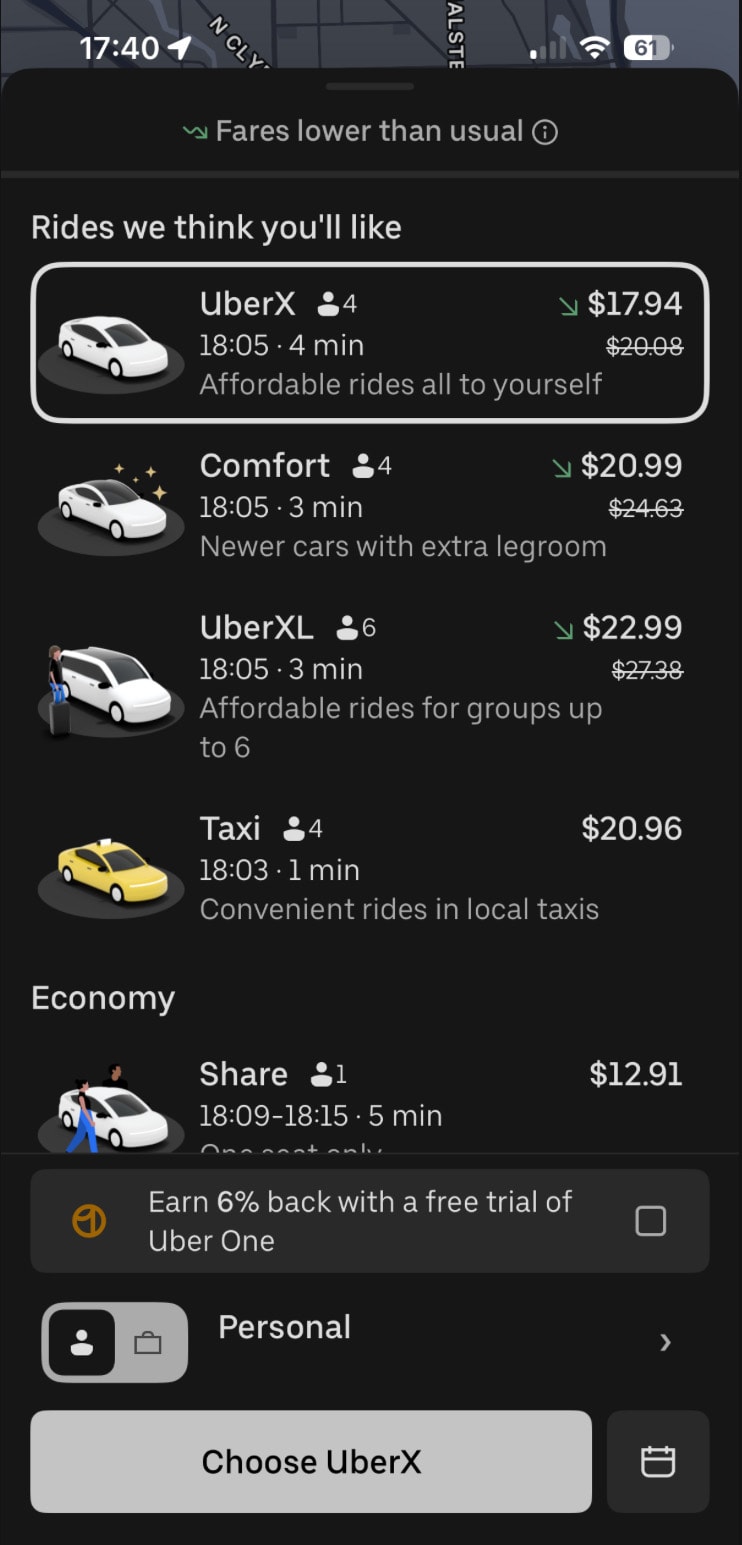
An Uber spokesperson says ride offers like this one—where the price appears above a crossed-out higher price—are not meant to suggest the fare has been discounted. When accompanied by phrases like “Fares lower than usual,” Uber says, it’s merely “historical comparison messaging.” Experts say consumers are unlikely to make that distinction. We counted these as purported discount offers along with other fares shown next to crossed-out higher fares.
While using algorithms to help set prices is not illegal, it can be used to “turbocharge” false and deceptive pricing tactics, says Laura Smith, legal director for the nonprofit Truth in Advertising, which studies the issue and has tracked more than 300 active class-action lawsuits on pricing over the past decade.
Algorithmic pricing “makes it especially hard for consumers to know what’s going on and even harder for regulators to detect, unless someone does the sustained, controlled testing that you did,” Smith says.
The way Uber uses algorithms and AI to change prices makes it near-impossible for consumers to comparison shop or understand why a friend standing nearby might receive an entirely different price, experts say.
“Now they’re going further and attacking the idea of a reference price,” says Katie Wells, a senior fellow at the nonprofit AI Now Institute who assisted CR with the testing methodology for this investigation. “Fake discounts feel creepy and exhausting in the moment. How can we ever know if we’re getting a deal?”
Driving Down Pay
Stephanie King, 61, worked as a medical office manager for more than 20 years but was struggling to make ends meet, so she started driving for Uber and Lyft in 2018. In her first year, she made roughly $60,000, including $1,000 and $500 bonuses. But since then, her driving income has fallen even as her living costs have increased. Performance bonuses are smaller, and pay guarantees frequently change. Today, King says she earns roughly $35,000 a year and relies on credit cards to get by each month.
“They keep shifting all of the ways you can make money, so that you can’t get a good picture of what’s actually going on,” King says. “As soon as you figure out how much you need to work to live in a given week, they say, ‘Hey, we have another idea.’ They keep pulling the rug out from under us.”
Uber and Lyft Respond to CR’s Findings
Lyft challenged CR’s findings, citing an “observer effect,” meaning that by having dozens of people checking prices for the same route at the same time, CR may have artificially inflated demand for that ride and influenced the final prices our volunteers saw. Uber said that because its ride prices change “nearly every second,” it was “impossible” for us to ensure that trip requests happened at exactly the same time.
In short, Uber and Lyft argue that no two trips on their platforms—no matter how seemingly close in time and location they are to each other—can ever truly be the same.
“In an open, dynamic marketplace like ours, with nearly 1.7 million mobility and delivery trips per hour, a trip is defined just as much by when it is requested and what’s happening nearby as where it is going,” Uber said in a statement to CR.
But several experts we shared our findings with dispute that argument. On nearly every route we tested, they noted, we found that at least some of our volunteers converged on the same price for the same ride at almost the same time. And it would be difficult for CR’s tests alone to create artificial spikes in demand, given the relatively small number of volunteers we used and the mostly large and densely populated places we chose for our test rides, experts said.
“You’re saying that a few dozen people caused such a dramatic effect? Maybe if it was the heat of rush hour, from the airport to downtown, a truly hot surge area, but that doesn’t apply here,” says Christo Wilson, a computer science professor and associate dean at Northeastern University in Boston who previously audited Uber and Lyft’s pricing models for the city of San Francisco.
So what explains the different prices our volunteers saw, according to the companies? Uber and Lyft said that a wide variety of factors—rider demand, the supply of available drivers, location, time, estimated trip time and distance, weather, promotional offers, and traffic patterns, among them—all play a part in both original and final prices.
“Price differences reflect real marketplace dynamics,” Lyft’s Sid Patil, executive vice president of the company’s marketplace division, said in a statement. “At any given moment, more drivers may be available in a specific area, different demand levels, or different promotional activity. All in all, our marketplace ebbs and flows, depending on locations, times, events, weather, and other factors.”
Uber and Lyft said the only truly personalized pricing on their platforms is through their promotional offers, such as new-rider discounts and “re-engagement offers,” which they use to entice back customers who haven’t used the app in a while. Neither company provided a complete list of all the factors they use to personalize promotional offerings.
But elsewhere, both Uber and Lyft have detailed the types of data they collect and how it could be used, in their U.S. patent filings and company privacy policies.
Lyft said in a statement that it doesn’t group, or “segment,” its customers or use behavioral data to set base prices. But the company acknowledged that it uses a “broad set of signals” for its promotions and discounts. Lyft’s privacy policy goes into detail about some of the customer data it collects: how you interact with the Lyft app; your address book and calendar, if you consent; and the creation of inferences about who you are. Lyft provides two examples in its privacy policy: If you frequently ride to and from airports, you may be identified as a frequent traveler. Lyft says it may also infer your gender based on your first name.
Lyft’s patents go much further, outlining “sensitivity” scores and models, which can be used to predict the “importance” or “priority” of a given trip, arrival, or drop-off location; an “intent” model, which is capable of using your demographic info to predict a ride before it is even requested; and a willingness-to-pay score, defined as the “willingness by the mobile requestor device to pay a higher transportation service amount.”
Uber said in a statement that it, too, doesn’t use “protected characteristics,” such as race, gender, ethnicity, and disability status, for base prices or promotions; nor does it use “rider-specific behavioral characteristics.” But that did not address the use of behavioral data of larger customer groups. Uber did acknowledge that it uses personal data for promotions and discounts. Uber’s patents show it can use a phone’s sensor data and your past behavior for its models. That data can include how quickly and accurately you type an address; your gait and walking speed, which can be used to infer your height, weight, and body type; and even the precise angle at which you hold your phone, to spot any deviation from the norm. Your ride history is also a powerful predictor of both who you are and where you’re likely to go. Uber outlines one such example in one of its advertising patents: If someone routinely requests an Uber to a day care center or school before going to a workplace or university, they could be identified as a single working parent. From there, the age, gender, and sex of the rider, and the rough ages of the rider’s children, can be determined through the ride history alone, Uber says.
“Earlier generations of these pricing systems really focused on time, supply and demand, and price elasticities and efficiencies. But now, many companies actively use behavioral and context data to inform their models. They don’t even necessarily need your personal data,” says M. Keith Chen, a behavioral economist and professor at the University of California, Los Angeles, who previously worked as Uber’s head of economic research and helped create its surge pricing algorithm.
Both Uber and Lyft also denied offering their customers fictitious discounts. Lyft attributed our findings on these discounts to the fact that “prices change constantly based on real-time marketplace conditions.” Uber called our testing “fundamentally flawed” because, in its view, you can’t establish a true baseline price on its platform.
“If one user’s undiscounted price matches another user’s discounted price, that’s simply because these prices were different to start with, due to changes in real-time marketplace conditions,” Uber said in its statement.
Experts also dispute those arguments, saying the fact that many volunteers saw exactly the same final price for many of the routes we chose suggested that there was, in at least some cases, a true algorithmically determined starting price.
“I don’t agree that there is no baseline price, even with ride-share,” says Chen at UCLA. “What you’re seeing with your data is indeed a baseline.”
Uber also took issue with our fake discount analysis. We counted fares as discounted when what appeared to be an original price had a strikethrough and a lower price was displayed. Uber said in a statement that when these prices are accompanied by labels such as “Fares lower than usual,” they are not meant to suggest a discount but instead a “historical” or “informational” comparison.
Lastly, Uber and Lyft said the percentage of each fare they take is much lower than what CR calculated. They put their U.S. “take rates” at “around 20%” and “significantly lower than 30%,” respectively.
The disagreement largely comes down to different accounting practices: Uber and Lyft say our calculations don’t acknowledge the large and growing amounts they spend on auto insurance to cover drivers when they’re en route to and during rides.
But experts we spoke to say the companies’ insurance expenses are simply a cost of doing business that, under standard accounting practices, shouldn’t be excluded. (Sherman at Columbia says excluding them is “very misleading.”) And they note that both companies have created their own in-house insurance subsidiaries, with billions in reserves available for claims.
Uber also argued that because the driver and riders were in the same location, the experiment minimized pickup distance and “created an artificial scenario that isn’t representative of reality.” While our tests were designed to have riders and volunteers near one another, our analysis of how much Uber and Lyft take from each fare is similar to other studies. Experts say Uber and Lyft do, in fact, take nearly half of customer fares. An analysis of rides provided by three Uber drivers with over 50,000 rides between them, by Sherman of Columbia, found that Uber’s share has now risen to more than 50 percent in many cities. In a separate analysis conducted for CR using ride-hail trip data from Oregon, Princeton’s Workers Algorithm Observatory calculated that, on average, Uber took 44 percent and Lyft took 52 percent of the amount a rider paid for a trip.
Technical accounting issues aside, Uber and Lyft drivers we spoke to say their take-home pay is an ever-shrinking portion of what their riders actually pay—and far less than what they’ve been led to believe they would make. In 2024, for example, Lyft announced it would guarantee drivers 70 percent or more of rider payments each week, “after external fees.” (Later that year, the company settled with the Federal Trade Commission and paid a $2.1 million fine for what the agency described as “deceptive earnings claims” about how much drivers could expect to make, and this year announced it would cap its fee at 30 percent.)
Before Uber changed how it pays drivers, its drivers expected to keep 80 percent of their fares, according to lawsuits filed against the company.
Mohamed Drissi, a 43-year-old driver in Portland, Ore., who is originally from Morocco, says his take-home pay has gradually decreased over the six years he’s driven for Uber. “There’s the insurance fee, the city fees, the Uber fee, whatever that is. And after all that, it’s not $70 [out of $100]. It’s a lot, lot less,” he says.
Indeed, on Mohamed’s six test trips with us, his passengers paid about $126 in fares, not counting tips. Of that amount, $66.73 went to Mohamed, $58.41 went to Uber, and $16.66 went to city and airport fees. Not including government fees, then, about 53 percent went to Mohamed and 46 percent went to Uber. (Again, Uber says a lot of that 46 percent goes to insurance.)
No Driver, No Dilemma
Chet Mehta, 64, who lives in Austin, Texas, worked as an engineer for IBM for 38 years and is now retired. He uses Uber and Lyft primarily for airport trips. He says he has increasingly found himself comparison shopping among the ride-hailing companies and is taking more rides in Waymo self-driving cars, which don’t have human drivers.
“I understand the concept of dynamic pricing, but I don’t feel comfortable with it. One of the things Uber and Lyft claim is that their discounts are real and drivers are getting their fair share, but I have no clue if that’s true or not,” Mehta says. “At least with Waymo, I know that a worker isn’t being gouged or taken advantage of.”
‘They Won’t Tell Us’
In just the past few years, Uber and Lyft have become modern-day business success stories, but for drivers and customers, it might not feel that way.
After years of staggering losses, both companies are now profitable and, together, control roughly 95 percent of the ride-hailing market in the U.S.
For riders, the net effect of all of this has been more expensive rides that have outpaced inflation, and driver pay that hasn’t kept up. In 2025, the average Uber and Lyft customer prices rose by 9.6 percent, while average driver pay per hour increased by 3.6 percent, according to Gridwise, a driver assistance app that compiles driver data. The U.S. consumer price index for 2025 increased 2.7 percent.
Both Uber and Lyft have also successfully fought off myriad attempts by local and state governments to further regulate them. In 2020, California voters approved Proposition 22, one of the most expensive ballot measures in U.S. history, which exempts Uber, Lyft, and other gig apps from that state’s labor law. It allows Uber and Lyft to employ drivers as independent contractors rather than full-time employees. But drivers’ groups there say Uber and Lyft have violated the California law by deactivating some drivers and making it difficult to appeal those decisions.
And even though minimum driver pay rules have been enacted in cities like Minneapolis, New York City, and Seattle, there have been accompanying issues: Tipping in New York City and Seattle has plummeted, and Minnesota passed a state law that preempted the Minneapolis rule with lower minimum driver pay.
Most Americans think drivers for ride-hailing services should keep the bulk of their fares. In a nationally representative Consumer Reports survey of 2,183 U.S. adults conducted in April, more than half of Americans said that most or all of the money from a ride-hailing app should go to the driver. Twenty-five percent said fares should be split equally between the driver and the company, and just 2 percent said most or all of the money should go to the company. Fifteen percent had no preference.
Uber and Lyft’s prices and fares, along with the factors that go into prices and discounts, could be independently evaluated by regulators or outside researchers. But Uber and Lyft do not make this information public, with Uber calling it “sensitive intellectual property” and Lyft calling it proprietary. While some level of price personalization is widely accepted by U.S. consumers—a senior discount for public transit or a movie, for example—many of those who audit algorithms say tech companies are essentially creating their own unique prices and discounts without explaining who they’re being offered to and why.
“It all depends on what kind of data they’re using, and the truth is, nobody knows what Uber and Lyft are doing. They won’t tell us. They won’t allow for independent audits,” says Wilson at Northeastern. “But these systems impact peoples’ lives and livelihoods, and if they’re going to have that impact on the world, it’s simply not okay to hide behind that lack of transparency.”
This work is made possible, in part, by a grant from the Alfred P. Sloan Foundation. CR’s work on privacy, security, AI, price transparency, and financial technology issues is also made possible by the vision and support of the Ford Foundation, Craig Newmark Philanthropies, and Heising-Simons Foundation.

See the Data Behind Our Investigation
How CR Journalists and CR’s Community Reports Work Together
Consumer Reports is an independent, nonprofit organization where a range of experts—from journalists to testers to community organizers—work together to change the marketplace. Community Reports, CR’s participatory science project, is focused on working with our members to uncover problems—and develop solutions—for a fairer, safer, and more transparent marketplace. Read more about how this investigation with the Community Reports team came together, check out the data, and sign up for the next investigation.
Correction: On June 25, 2026, Uber wrote to CR saying that it used the anonymized test data CR provided to re-identify our volunteers and their quoted prices and found three specific data-collection user errors among the hundreds of Uber prices recorded in screenshots by our 174 volunteers. After investigating those cases, we amended the article as follows:
• We changed a data visualization that referenced a volunteer named Camille, who incorrectly typed the wrong address for the Florida #2 route. (Our screenshot showed she entered the correct location name; Uber said its data shows she entered a different location with the same name.) We also removed this volunteer’s quoted price from our dataset, decreasing the highest fare on that route from $94.96 to $89.05.
• One volunteer mistakenly set the Uber app to collect prices for Uber Reserve trips, which are generally more expensive than standard on-demand Uber trips. We removed from our dataset the five UberX route prices collected by this volunteer, recalculated the percentage spread between the highest and lowest price groups for each route and the median across all 30 routes, and updated the data visualizations accordingly. The median difference between the highest and lowest price groups across all 30 virtual routes for both Uber and Lyft changed from 49.8 percent to 42.4 percent as a result. These changes also resulted in the percentage of fictitious discounts we observed increasing from 10.8 percent to 12.4 percent.
• One volunteer typed the wrong address for the Idaho-to-Washington route. We removed this volunteer’s quoted UberX price from our calculations, which did not change that route’s percentage spread between the highest and lowest price groups.
• We also clarified that rides on any given route were generally booked by our volunteers within six minutes of each other, and in many cases within the same minute.
None of the corrections change our overall findings or conclusions that both Uber and Lyft use AI to charge consumers different prices.


