Energy you can afford
Upload your energy bill. Get resources. Help fight unfair practices.
Bill Decoder, part of the new Power Smarter with Consumer Reports initiative, uses real energy bills from people like you to:
- Map energy price trends across the nation
- Uncover what's increasing prices
- Gather evidence to fight for fairer rates
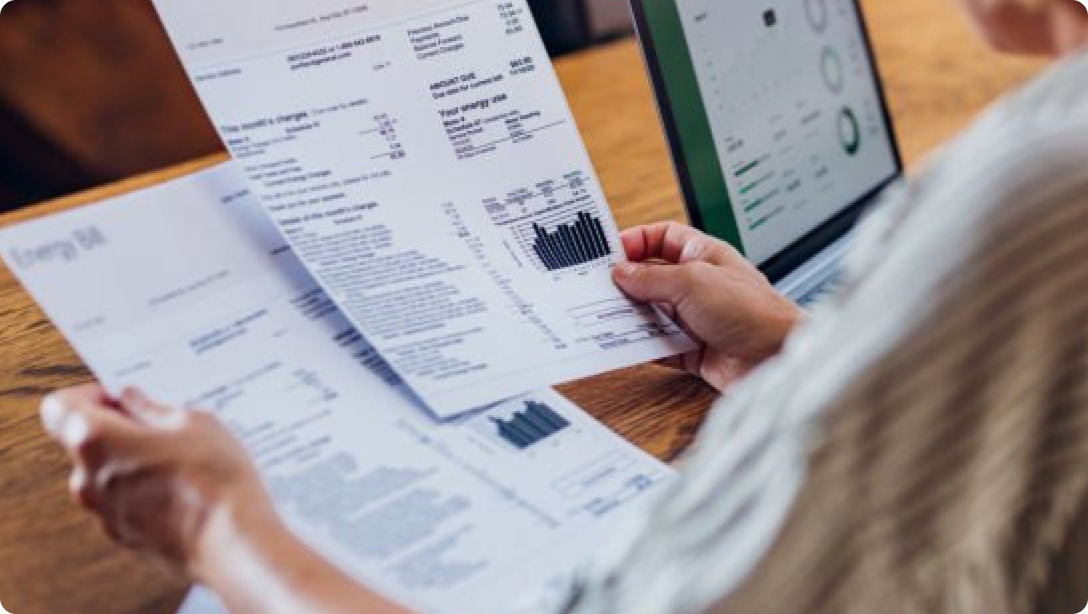
Enabling change, one household at a time.
Submitting your bill to Consumer Reports provides instant access to money-saving resources, information on local bill assistance programs, and CR’s advice on how to make your home as energy efficient as possible, with more personalized insights to come.
Your bill also powers CR’s advocacy and investigative reporting efforts to reduce everyone’s costs and improve transparency.
Want to know more about uploading your bill? Read the FAQ below.
Rising energy costs are impacting communities nationwide
- 40%
- Higher electricity bills since 2020
- 68%
- Americans who say their household finances are strained by their home energy costs*
- 78%
- Americans are at least somewhat concerned that their electricity bills would increase because of new data centers being built*
Consumer Reports nationally representative survey of 2,146 U.S. adults conducted in November 2025.
Frequently Asked Questions
About my bill(s)
Why does CR need my bill to understand my Energy costs? Can I just report the total amount?
First and foremost, we’d like to help decode your bill. That means that the total number you are paying is just a part of the equation - there’s also break downs in terms of usage rate vs. transmission costs, riders, surcharges, adjustment mechanisms, taxes and fees, late fees, arrears indicators, and disconnection notices. Not all of these things will be on every bill, but we’re hoping that, over time, we’ll be able to build a sophisticated tool which will help you understand each of those parts of your bill and how you can take action to effect it.
We’re also using the bills to understand the total amount each individual pays while also looking for ways that utilities are making pricing information unnecessarily confusing, adding riders, passing on infrastructure costs to consumers or hiding fees. This information is critical to how we will analyze equity and clarity from utilities.
Finally, we want to use the bill to be absolutely sure that the information we’re gathering is correct - while some consumers are aware of what terms like “kWh” mean, many others are new to this space and we want to be sure that we’re getting accurate data.
I can't find a PDF version of my bill. How do I download my bill?
To find a PDF copy of your bill, you can log in to your account using these links. We’ve listed the largest providers here.
Generally, these are the steps to follow:
- Step 1: In most cases, go to your Utility’s website and create an account or log into your existing account to find your most recent bill.
- Step 2: Usually, clicking on the bill will give you the option to download it. Most of the time it will already be in the PDF format that we need.
- Step 3: Some companies automatically email you a copy of your bill each month, already in PDF format. Check your inbox if you’re having trouble logging into your account.
Why are you asking for a PDF of the bill (as opposed to a picture or a physical copy)?
We’re asking for a portable document format (PDF) copy of your bill because we’re working with a technology that can extract the key data elements relevant to pricing automatically and securely from images. While our tool can extract the data from other image files (.JPEG, .PNG) it is the most effective with this file format.
What other formats do you accept for bill submissions?
While we prefer PDFs, we can accept other image formats (e.g., .PNG, or .JPG) via our microsite form.
If you do not have access to a scanner or a digital version of your bill, you may still submit your bill by mailing it to
℅ Alan Smith
Consumer Reports
101 Truman Ave,
Yonkers, NY, 10703
We may use these bills at a different stage of the project than those submitted digitally. If you choose to mail us a physical copy of your bill, please send us a copy – not your only original – and use a permanent marker to black out your name, street address (you may leave your ZIP code visible), email address, phone number, utility account number, billing information (other than your zip code), or other personally identifying information. CR will not return submitted copies.
Why are you asking for more than one bill?
An individual energy bill is a single snapshot of time. While some bills do contain historical usage date, we’d also like to see the bill from the same billing period one year earlier, so we can compare and contrast. That piece of data is entirely optional - If that bill is not available to you for any reason, you don’t have to add it in.
Over time, you can come back and continue to donate your energy bills to CR as many times as you’d like. We will track your usage data over time, and provide you with personalized recommendations and more detailed decoding of your bill as we learn more about your home and your utility. We may associate information from your bills with your CR account, questionnaire responses, and any other submissions to operate and improve the Bill Decoder and conduct research, as described in the Bill Collection Notice and CR Privacy Policy.
Can I submit a bill using the Bill Decoder tool multiple times?
Yes. As we continue to build out the Bill Decoder tool, we hope to be able to offer individual users advice and education based on the bills they submit over time.
My bill is different from the standard, because I am a member of an energy coop, I live in a condo or community that pays bills collectively, because I have solar panels on my home, or because of another unique use case. Does that matter?
That’s ok! If the bill relates to your residence, please submit it only if you are the account holder or are otherwise authorized to provide it. Different billing arrangements can help CR understand consumers’ energy costs. Do not submit another person’s bill without authorization.
About my Privacy
What data is collected, and how is it stored?
For the purposes of the study, we collect four kinds of information: 1) electric utility bill(s), 2) questionnaire responses, 3) website use information, and 4) CR account and contact information.
These CR uses are administrative, technical and physical safeguards designed to protect this information. CR may associate submitted bill information with your CR account, questionnaire responses, website use information, and other submissions for the purposes described in the Bill Collection Notice and CR Privacy Policy.
Separately, when you create your free member account, we collect data such as first name, last name and email address which is used in accordance with our Privacy Policy.
Finally, ConsumerReports.org uses cookies and other technologies to understand how people use the site, for marketing purposes, and for other reasons as described in our cookie policy.
How is data collected?
We enable volunteers to share energy bills and related information through the Bill Decoder tool.
Consumer Reports takes privacy seriously and actively works to secure your personal information. When you upload your bill, we store the bill in systems designed to ensure that the information is protected and secure. Authorized CR personnel and service providers working under CR’s instructions may access the bill as reasonably necessary to process the submission, verify accuracy, operate and protect the Bill Decoder, and conduct the research. CR uses automated tools designed to redact information that is not needed and create a working copy, but automated redaction may not detect every item. CR then extracts information relevant to the bill project, such as usage rates, transmission costs, riders, surcharges, adjustments, taxes, fees, balances, arrears, and disconnection notices.
We will delete the original uploaded bills after it is no longer needed for processing, verification, quality review, security, fraud prevention, or applicable legal requirements. CR may retain extracted information from the bills and associate it with your account, questionnaire responses, and other submissions as needed to provide Bill Decoder features and conduct research. Aggregated or deidentified research information may be retained for a longer period.
Will anyone see my bills?
Your original bills may be viewed by authorized CR personnel and service providers working under CR’s instructions when reasonably necessary to process the submission, fact check our reader tool and perform quality review, verify extracted information, protect the service, or support the research. We will attempt to automatically obfuscate your name and address before humans look at your bill (but automated redaction may not detect every item or remove information that is not needed before humans review your bill).
What if I feel worried about sharing the personal information on my bill?
It is understandable to feel concerned about sharing your personal information. Consumer Reports takes privacy seriously and actively works to protect your personal information. CR uses safeguards designed to protect submitted information, but no system can be guaranteed completely secure and automated redaction may not detect every item. Please remove sensitive information that is not needed before submitting the bill.
CR does not need and asks you not to submit Social Security numbers, bank or payment-card information, account login credentials, security codes or PINs, medical information, or other unrelated sensitive information. You may also remove your name, full street address, email address, phone number, utility account number, and barcodes or QR codes before submitting your bill.
You can also use programs like Adobe Acrobat Reader (which you might already have on your computer) or other PDF manipulation programs that allow you to open the document, black out anything you don't want us to see, and then save the pdf again with the black-out in place. Do not assume that the PDF manipulation programs permanently removes the underlying information. Simply placing a black shape over text may not remove it. You should save and reopen the redacted file to confirm that the covered information cannot be selected, copied, searched, or revealed before uploading it.
How long do you keep the data?
We delete the uploaded PDF bills when it is no longer reasonably needed for processing, verification, quality review, security, fraud prevention, or applicable legal requirements, in accordance with our data retention policy. CR may retain extracted information associated with your account and other submissions as needed to provide Bill Decoder features and conduct research. Aggregated or deidentified research information may be retained for a longer period.
What type of analysis will be done with the information I submitted?
- Personalized Bill Decoding: What can we learn together about your bill? What changes can you make to your own usage to bring the bill down? What changes can you and your community make to systematically lower everyone’s bills?
- Examining the affordability of utility bills: To what extent has the connection between billing and actual household consumption been severed?
- Financial returns on sustainable energy choices: Is the move toward efficiency providing real rewards for participants?
- The influence of data centers and industrial loads: Who is footing the bill for this rapid expansion?
- Utility structure and corporate models: Does the underlying business approach impact the customer?
- Advocacy and household results: Is the influence of consumer groups truly felt?
Will you share my bill?
CR will not publish your original bill or provide it to academic or research partners. Authorized CR personnel and service providers working under CR’s instructions may process or review the bill for the purposes described above. We will delete the original bills when they’re no longer needed in accordance with our retention schedule.
Will you share data with third-party researchers?
Yes. We may share aggregated or deidentified bill information and participant responses with academic or research partners to further the research goals of this initiative. We will not share the original bill or information that reasonably identifies you, and we will require recipients of deidentified information not to attempt to reidentify individuals or use the information for unrelated purposes.
How will you de-identify data before sharing with research partners?
Before sharing information with research partners, CR will remove direct identifiers and take reasonable measures designed to prevent the information from being associated with an individual or household. CR may share aggregated findings or deidentified record-level information subject to safeguards against reidentification, unrelated use, and unauthorized disclosure.
About our Research
How long will the research study be available for and how many people do we need to participate to get relevant data?
For our first round of research, we will be collecting bills for at least twelve weeks and plan to release an initial report in the winter of 2027. Based on what we collect, we hope to improve our tool so that it can give consumers like you more personalized advice and decoding help on their bills.
Is this study limited to residents of the United States?
Yes.
Why is CR asking extra survey questions? Are they important to the research findings?
Our extra questions are critical to contextualizing what we can learn from the bills themselves, and answering them will greatly impact the study. For example, information about ownership or renter status will help us personalize the recommendations we give for home efficiency improvements, or the existence of solar panels on a property will dramatically change the usage rate of energy from the grid.
Why do you need to sign up for a CR member account?
A free CR member account allows CR to authenticate you, associate your submissions over time, provide Bill Decoder features, and communicate with you about your participation. CR handles account information as described in the CR Privacy Policy.
I completed the study. How do I access my CR member benefits?
As a part of creating the most secure process possible for collecting your bills, you’ve been signed up for a “Basic” membership of CR. This is a free membership, and makes you eligible for CR tools and services like: My Products, which allows you to save your car and CR-tested product info to receive recall and maintenance alerts, Car Recall Tracker, which allows you to find out if your car has a recall and what to do next, TV Screen Optimizer, which allows you to get the perfect picture on your TV, and the You Test and Share your story tools.
You can review and access your CR member benefits here: https://www.consumerreports.org/membership
Will I receive emails?
When you sign up to participate in the Bill Decoder tool, you will receive welcome email communications with instructions on how to create and manage your account, as well as ongoing administrative emails. You will also receive periodic emails about the Power Smarter campaign, and opportunities to contribute to energy affordability research and advocacy.
CR will send you information, offers, and other periodic email communications for Consumer Reports members. If you do not wish to receive emails for members, you can manage your email communications preferences here. If you do not wish to receive emails about consumer advocacy, you can opt-out here.
Why does the site use cookies?
When you use our websites or other digital services or open our emails, CR and other service providers may collect information through cookies, web beacons and other technologies. This Cookie Policy explains these technologies and how you can control their use. This policy applies to all Consumer Reports websites and other digital services that link to this policy.
These cookies and other technologies help make our digital services better and enhance the user experience by offering you a more relevant and customized experience. We also use cookies to monitor and stabilize our websites, measure the use and effectiveness of our content, remember you when you log in, and promote Consumer Reports products and services that are relevant to your interests. Read more in more in our cookie policy.
For more information about CR’s privacy practices, please visit our Privacy Policy.
Can I submit a bill and not sign up for a free membership account?
In order to submit your bills digitally, participants must create a free member account. If you prefer not to create a free member account, and would still like to submit your bill for this participatory research study, you may mail a copy of your bill to:
Consumer Reports
Alan Smith
101 Truman Ave,
Yonkers NY 10703
We may use these bills at a different stage of the project than those submitted digitally. Before mailing a bill, use a permanent marker to black out your name, street address (you may leave your ZIP code visible), email address, phone number, utility account number, barcodes or QR codes, security codes or PINs, bank or payment-card information, and other information not needed for the research. CR will not return submitted copies.