
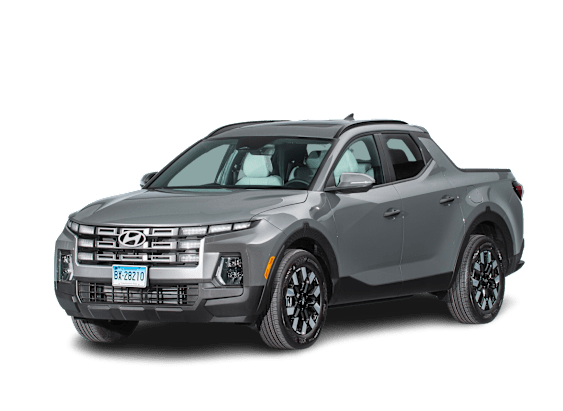
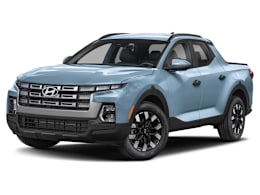
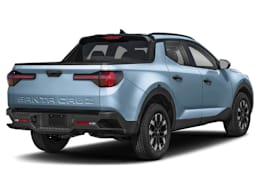
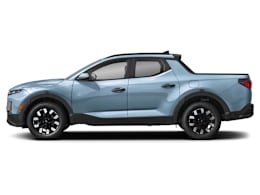
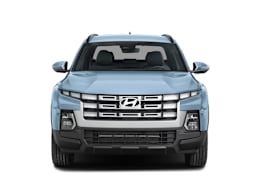
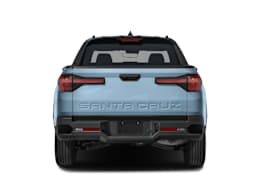
The Santa Cruz combines the attributes of a small SUV and a pickup truck into one vehicle. Similar in concept to the Ford Maverick or the larger Honda Ridgeline, the Hyundai Tucson-based Santa Cruz could be perfect for the buyer who wants a stylish mode of transport with a car-like ride, handling, and maneuverability, but also occasionally needs an open bed to avoid getting their SUV’s cargo area dirty.
At just over four feet long, the Santa Cruz’s bed is smaller than that of any other small pickup, including the Maverick and Ridgeline. As such, it isn’t as well-suited to carrying bicycles or many other common recreational toys without installing extra racks. But the Santa Cruz—which Hyundai markets as a “Sport Adventure Vehicle”—is great for transporting grubby garden supplies, grills and coolers for tailgating, or carrying wet gear back from the lake when towing a small boat or jet skis.
Hyundai Santa Cruz at a Glance
- Car-like handling and ride quality with a small pickup bed for dirty cargo
- The turbocharged engine on higher trims is easier to live with than the noisy, underpowered base powertrain
- Mostly simple, intuitive controls, other than the capacitive-touch climate panel
- An available tonneau cover can turn the bed into an enclosed trunk
After our testers spent months daily-driving the 2026 Santa Cruz and compiling results from over 50 specific tests and evaluations at Consumer Reports’ 327-acre Auto Test Center, we feel as if its funky exterior may set false expectations of how interesting it is in other regards. It’s a fairly normal, if bland, driving experience, and the choices Hyundai made as to what to include—and leave off—on our mid-grade test pickup are baffling. Somehow, our SEL Activity has a retractable tonneau cover, sunroof, and heated front seats, but lacks navigation and adaptive cruise control. And the plastic steering wheel is a total letdown.
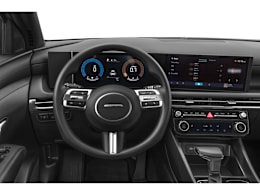
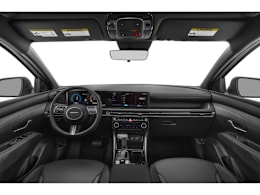
The cabin has quality materials, stylish controls, and more padded surfaces than many pickups. The 12.3-inch infotainment touchscreen is easy to use, with large, simple-to-decipher icons, and it features standard wireless Android Auto and Apple CarPlay. We also appreciated the conventional, easy-to-operate gear selector. In fact, our main source of frustration is the capacitive-touch climate-control panel that was introduced for the 2025 model year. While at least all its functions are always visible and not buried in on-screen menus, it still takes extra attention to use.
The SE, SEL, and SEL Activity trims come with a rather strained 191-hp, 2.5-liter four-cylinder with either front- or all-wheel drive. The higher XRT and Limited models have a 281-hp, 2.5-liter turbocharged four-cylinder engine and standard all-wheel drive. This powertrain delivers dramatically better low- to midrange power. All Santa Cruzes come with a conventional eight-speed automatic transmission for 2026. Unfortunately, Hyundai is discontinuing the Santa Cruz after the 2026 model year.
In terms of truck duty, turbocharged models can tow up to 5,000 pounds, a capacity more often associated with larger vehicles. It also has a respectable 1,410-pound payload rating. The composite bed has a small, concealed under-floor storage compartment. The built-in hard, rollable tonneau cover that comes on higher trims is handy for keeping cargo safe from weather and theft, although the setup eats up nearly a foot of space at the front portion of the already-short bed.
“With the turbo engine, this is a pretty solid pickup. But it feels totally underpowered with the base engine, and that's with nothing in tow,” said one of our testers. “With the bed full of stuff and a few passengers, I imagine it could get pretty sketchy merging onto a fast-moving freeway. That said, the rest of the vehicle is okay. The ride is comfortable, the handling is good for a pickup, and you get most of the latest technology.”
“I didn't see the point of the Santa Cruz the first time we tested it, because the bed is so ridiculously small,” admitted another tester. “But my guess is that for many people, the diminutive size is actually spot-on. They just need a bed that's big enough to throw dirty stuff for household chores, etc. The tonneau cover keeps everything safe and protected from rain. But the base engine is underwhelming, and it sounds noisy a lot of the time.”
“The Santa Cruz is more comfortable and livable than larger midsized pickups,” said one of our testers. “But this is not a lot of car for nearly $39,000. It also feels like the next Subaru Brat or Baja, destined to be relegated to the ‘what’s that?’ of automotive history.”
We bought a 2026 Hyundai Santa Cruz SEL Activity AWD for $38,680—anonymously from an area dealer, as we do with every vehicle we test—for the purpose of this road test review. Our Santa Cruz was assembled in Montgomery, Alabama.
Driving experience
It’s the crossover of pickups, feeling far more like a Tucson with a tiny pickup bed than a traditional body-on-frame truck. That’s no coincidence, as the Santa Cruz is largely based on the Tucson. Unfortunately, the 2.5-liter four-cylinder base engine the two models share is just as anemic in the Santa Cruz as when we tested it in the Tucson. While it’s adequate for slower, in-town driving, that lack of power forces the Santa Cruz’s eight-speed automatic transmission to work overtime at highway speeds.
“In my commute, the transmission has to downshift twice to climb a very modest hill, which makes the engine scream for mercy,” said one tester of our naturally aspirated Santa Cruz. “It’s rather unpleasant. I’d say get the turbo version, or don't bother.”
Despite having an initial surge of power off the line, which some testers found annoyingly abrupt, the non-turbo Santa Cruz’s acceleration is slow. It needed 10.3 seconds to go from 0 to 60 mph in Consumer Reports’ tests. For comparison, that’s about 3.5 seconds slower to 60 mph than we previously achieved with the turbo engine and the old dual-clutch automatic. And in a true “huh?” moment, the regular Santa Cruz isn’t more fuel-efficient than the turbo model; they both achieved 24 mpg overall in our testing. Of note, the turbo version’s fuel economy was likely aided by the outgoing dual-clutch transmission, which is typically more fuel-efficient than conventional automatics.
As such, we believe it’s worth paying extra for the upgraded powertrain. With 281 hp on tap, the 2.5-liter turbocharged four-cylinder makes the Santa Cruz feel zippy, with especially strong low-to-midrange grunt.
For the 2026 model year, all Santa Cruzes get the same conventional eight-speed automatic transmission, which should solve our complaints about the old dual-clutch transmission’s low-speed clunkiness.
The Santa Cruz offers a nice balance between a comfortable ride and predictable handling, despite some moderate body roll, limited tire grip, and steering that’s a little too light for our tastes. Those factors, combined with slightly slow steering, compromised its run through our avoidance maneuver test. While its 52-mph speed is commendable for a pickup, that’s notably slower than similarly designed unibody pickups like the Maverick and Ridgeline.
The Santa Cruz’s suspension absorbs most bumps well, even soaking up larger potholes nicely. It’s also pretty easy to maneuver, especially in comparison to larger midsized or full-sized pickups, the latter being a real bear to park in tight lots, garages, or on city streets.
Its brakes offer nice feedback and are easy to modulate, and offer excellent dry-weather stopping performance. However, stops on our wet surface were on the long side.
Cabin comfort
Our mid-grade SEL Activity came with a fairly no-frills interior with some frustratingly obvious examples of cost-cutting. For example, our testers universally panned the hard-plastic steering wheel—without any wrap—on a mid-level trim. While there are some visible plastic mold lines here and there, the interior at least feels solidly assembled, with tight, uniform panel gaps, and soft imitation leather upholstery.
The front seats are fairly basic but comfortable and supportive, with the driver’s seat featuring two-way lumbar adjustment. The driving position is slightly elevated, giving a decent forward view, yet there’s still plenty of headroom. Most drivers found that the hard plastic center console intruded into their right knee space. Getting into and out of the front seats is easy, even though the step-in is slightly higher than in its SUV counterpart, the Tucson.
The rear seat has decent headroom, but the seatback is very upright, which compromises comfort. There also isn’t a drop-down center armrest, like in many vehicles. It’s a tighter squeeze to get into the rear seat, due to small doors and tight knee room. Plus, the pillar behind the door angles slightly forward, requiring some occupants to duck around it to fit.
The Santa Cruz has several clever cargo features. Not only does the bed have an under-floor storage bin that can hold up to three backpacks, but starting with the third-tier SEL Activity trim, the Santa Cruz gets a standard retractable tonneau cover—a real boon for keeping stuff protected from rain and theft.
At 16 cubic feet, the main bed is a full 10 cubic feet smaller than its most similar competitor, the Maverick, but it still fits a sheet of plywood above the wheel wells.
Controls and usability
The Santa Cruz has mostly straightforward controls, with lots of physical knobs, switches, and buttons. Like many other recent Hyundai and Kia models we’ve tested, the dashboard of our Santa Cruz features dual 12.3-inch displays—one for the driver’s instrument screen and the other for the central infotainment touchscreen.
Phone and media features, vehicle settings, and (when equipped) navigation all live on the center touchscreen. Large, high-contrast labels and icons, helpful home-screen widgets for commonly accessed features, and logically arranged menu structures make the Santa Cruz’s infotainment system easy to use. While the right edge of the screen can be a reach for some drivers, most onscreen buttons are oriented toward the left, closest to the driver. Wireless Android Auto and Apple CarPlay come standard.
Unfortunately, the climate controls have been moved to a new capacitive-touch panel below the center screen, which washes out in sunlight and briefly lags in response. Thankfully, the temperature controls are still physical knobs that stick up from this smooth panel.
Active safety and driver assistance
Standard active safety and driver assistance features include automatic emergency braking with pedestrian and cyclist detection, blind spot warning, rear cross traffic warning, reverse automatic emergency braking, lane centering assistance, lane departure warning, lane keeping assistance, and automatic high beams. Adaptive cruise control is only available on the XRT and Limited trims.
A rear occupant alert system comes standard and is designed to remind the driver—based on rear-door logic—to check the rear seat when they turn the Santa Cruz off, helping prevent children and pets from being unintentionally left behind in the vehicle. There’s also a belt minder, which reminds rear passengers to buckle up and alerts the driver if a rear passenger unbuckles their seat belt during the trip.