
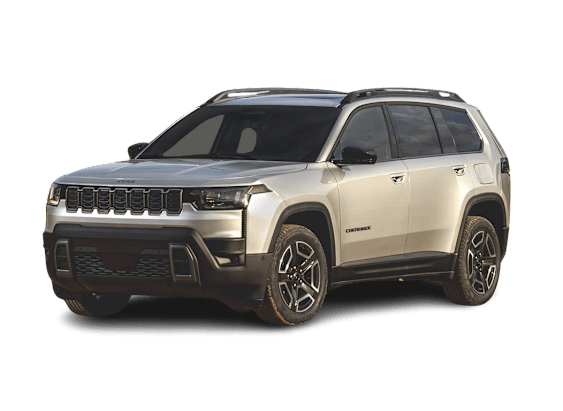
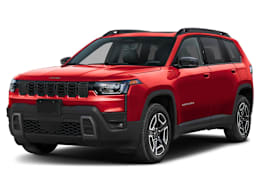
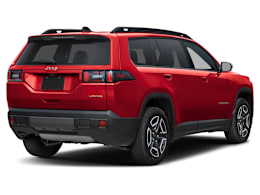
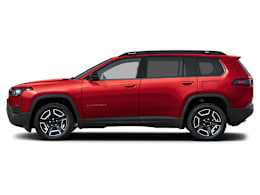
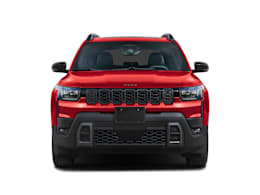
The Jeep Cherokee returns after a three-model-year hiatus, now packaged exclusively as a hybrid. During that period, the Cherokee grew, gaining 5 inches in overall length with a 6-inch-longer wheelbase. The increased dimensions give the Jeep a size advantage over small SUVs like the Honda CR-V, Hyundai Tucson, Mazda CX-5, Subaru Forester, and Toyota RAV4. Further, it’s only just a smidge smaller than true midsized SUVs like the Jeep Grand Cherokee, Honda Passport, Nissan Murano, and Subaru Outback.
Of note, the Cherokee is the first regular, non-plug-in hybrid for Jeep and for Stellantis (Jeep’s parent company) in the U.S. The powertrain uses a 1.6-liter turbocharged four-cylinder engine and a two-motor transmission for a combined output of 210 hp, with standard all-wheel drive.
Jeep Cherokee at a Glance
- A true “tweener,” the Cherokee is larger than most compact SUVs, but smaller than midsized models, benefiting rear-seat space and cargo volume
- Has some nice interior touches, including a fair amount of padded panels
- Unimpressive fuel economy for a hybrid
- Loud and unpleasant engine note during harder acceleration
- Awkwardly large octagonal steering wheel
- Annoying and unresponsive capacitive-touch climate controls
After our testers spent months compiling results from more than 50 specific tests and evaluations at Consumer Reports’ 327-acre Auto Test Center in rural central Connecticut, along with lots of miles behind the wheel on public roads, the Cherokee arrives feeling a generation behind hybrid compact SUV benchmarks like the CR-V and RAV4. Fuel economy is disappointing, at just 31 mpg overall in our testing—a far cry from the EPA-estimated 37 mpg combined. The driving experience is marred by an unrefined powertrain with laggy throttle response and a loud engine drone during hard acceleration. Meanwhile, the steering feels light, vague, and disconnected from the driver.
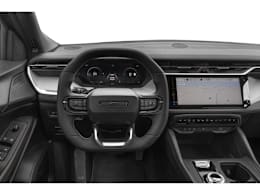
Ergonomics are compromised by a bizarre, oversized octagonal steering wheel that blocks the driver's view of the volume knob and seat-heater controls. Furthermore, testers were frustrated by the unresponsive capacitive-touch climate controls.
"It's unrefined in too many ways to be competitive in the cut-throat small SUV class,” said one of our testers. “From the engine noise and vibrations to the power delays and unsettled ride, Jeep has somehow succeeded in making a new vehicle feel old."
"The Cherokee is so late to the party that it's moved to another location—and became a different kind of party," quipped another tester.
We bought a 2026 Jeep Cherokee Laredo 4x4 for $40,490—anonymously from a local dealer, as we do with every vehicle we test—for this road test review. Our Cherokee was assembled in Toluca, Mexico.
Driving experience
The Cherokee’s turbo-hybrid powertrain works well when driven gently, but comes across as unrefined when operated with more zest. Use a lighter foot on the throttle, and it takes off smoothly from a stop thanks to an initial surge of electric power. We noticed a greater “bump” when the gas engine started up during the transition from electric-only to hybrid operation than in most other hybrids, though.
Push it a bit to squirt into traffic, and the engine feels weak, with an unpleasant soundtrack as the electronic continuously variable transmission (eCVT) lets the revs rise and hang annoyingly high. If it’s currently running on electric power and you’re looking for a bit more speed, there’s a wait for the gas engine to start up. If you need full power and floor it, for example, to get around a slower car in a two-lane passing zone, engine revs rise quickly, but turbo lag causes a noticeable delay before the powertrain produces some real giddyup.
At our test track, the Cherokee needed 8.7 seconds to hit 60 mph. While that’s not slow, and is quicker than the Forester Hybrid, that’s a notable 1 second slower than the RAV4. We could see buyers willing to endure some of Cherokee’s idiosyncrasies if it returned stellar fuel economy. But it doesn’t. It only managed 31 mpg overall in our testing—that’s far off the EPA-rated 37 mpg combined on the vehicle’s window sticker. It’s also well behind the RAV4 (40 mpg overall) and Mazda CX-50 Hybrid (37 mpg overall).
We reached out to Jeep regarding the discrepancy between our test results and the EPA estimate, and were given this statement: “The 2026 Jeep Cherokee is the most fuel-efficient Jeep vehicle ever without a plug. Mileage can vary due to numerous factors, including driving style.”
On the brighter side of things, the Cherokee boasts a stout 3,500-pound towing capacity—matching the RAV4, and far surpassing most other small SUVs.
Our testers didn’t feel much better about the Cherokee’s handling than they did the powertrain. The steering feels light and loose as you turn into a corner, which detracts from driver confidence. Many testers were also bothered by the steering wheel itself, which feels oddly large in diameter, has quite a thick rim, and a strange octagonal shape. The lack of handling ability and tire grip was borne out in our avoidance maneuver exercise, where the Cherokee only managed 51 mph, while many other small SUVs are good for 53 to 54 mph.
Bump absorption isn’t bad. There’s a softness to the suspension that lets it soak up minor road imperfections nicely. But rougher roads with larger bumps cause some hard hits to enter the cabin. The rear of the Cherokee also gets unsettled and moves around over mid-corner pavement irregularities.
Panic-brake stopping distances were on the longer side compared to several competitors. The Cherokee needed 137 feet to stop from 60 mph on our dry surface and 150 feet on our wet surface. That’s 8 and 10 feet longer, respectively, than the RAV4 needed. On the road, our drivers found the brake pedal slightly spongy. The hybrid’s regenerative braking system also tends to clamp down in an unpredictable fashion just as you’re coming to a stop.
Wind and road noise are pretty well controlled. But the engine gets loud during even moderate acceleration, with a truly unpleasant coarse and buzzy sound. You can also feel vibrations through the steering wheel and gas pedal at times. Sharper road imperfections bring a fair amount of clunks from the suspension.
Cabin comfort
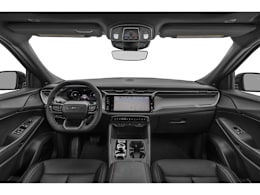
The interior has a simple and tasteful design. There are nice details throughout the cabin, with many padded surfaces, textured trim, contrasting colors, and some exposed stitching. Still, the cabin looks better than it feels. Some of the plastic panels are flimsy and cheap, like the sides of the center console, and we noticed some rough surfaces.
Front headroom is quite good, and the armrests are well-placed, though they could use softer padding. Several drivers discovered that the plastic center console hemmed in their right knee. Those of us who sometimes wear shorts were annoyed by the cheese-grater-like slats carved into the plastic there, which made things even more uncomfortable.
Outward visibility isn’t bad among small SUVs, but that’s not to say it’s very good. It’s nowhere near as airy as the Forester, for example. The windshield pillars are thick and get even thicker at their bases, which makes them difficult to see around, especially at urban intersections or through sharp corners. The front and rear side windows are good-sized, but the rearmost roof pillars are extremely chunky.
Most testers were nonplussed by the cloth front seats. It’s a seat that seems aimed at fitting a vast array of body types, with fairly flat and widely spaced side bolsters. As such, lateral support is lacking, and some found an odd juxtaposition between the soft bottom cushion and the overly firm upper portion of the seatback. We can’t fault the rear seat for space, or for how easy it is to get into and out of it, thanks to wide-opening doors and a tall roof. There’s lots of headroom and knee room, along with ample foot space under the front seats. Unfortunately, the bottom cushion is so low to the floor that it doesn’t provide much underleg support, reducing comfort.
Cargo space is good, but it doesn’t have as much of an advantage—given the Cherokee’s outsized body—over other compact SUVs as you might expect. We were able to fit 4 large suitcases, 1 overnight duffel bag, and 4 backpacks behind the Cherokee’s rear seat. The RAV4 did that, plus an extra backpack. When we folded the rear seatbacks down, we measured 38.5 cubic feet of cargo space with our expandable pipe-frame box. That only just equals the Forester Hybrid, though it’s 1.5 cubic feet more than the CR-V Hybrid, and about 3 cubic feet larger than the CX-5 and RAV4.
Controls and usability
The Cherokee has a 10.25-inch digital driver’s instrument screen and a 12.3-inch center infotainment touchscreen that houses the Uconnect 5 software used in other Stellantis vehicles. The infotainment system feels outdated due to its small, thin fonts, and the undersized buttons are difficult to press while driving. At least the icons along the left menu bar are larger and easier to use. The system is highly customizable, improving the experience, but also adding complexity. The driver’s instrument screen is easy to read and offers multiple customizable layouts; however, its menu is slow to respond to steering-wheel button inputs.
We found the capacitive-touch strip for the climate controls located below the infotainment screen difficult to use compared with physical buttons. Testers found them often unresponsive, with selections sometimes requiring multiple attempts. Compounding the usability challenge is that the temperature is displayed in the top corners of the infotainment screen, far from where your gaze is directed when trying to press the capacitive-touch buttons.
The volume knob and the driver’s heated-seat control on the left side of the infotainment screen are completely blocked by the steering wheel. The tuning knob is in plain sight, but it’s a far reach, effectively designating the passenger as the DJ, unless the driver uses the steering wheel controls. Android Auto and Apple CarPlay paired quickly—a performance that’s always appreciated.
Finally, there are the interior door releases. With your hand on the door pull, you have to use an awkward wrist angle to reach and press the recessed electronic door release button—especially if you have small hands.
Active safety and driver assistance
Standard active safety and driver assistance features include automatic emergency braking with pedestrian and cyclist detection, automatic emergency braking that operates at highway speeds, blind spot warning, rear cross traffic warning, reverse automatic emergency braking, lane centering assistance, lane departure warning, lane keeping assistance, adaptive cruise control, and automatic high beams.
We’re happy to see that a rear occupant alert system is standard, but we’re disappointed that a belt minder is not. The former is designed to remind the driver—based on rear-door logic—to check the rear seat when the Cherokee is turned off, helping to prevent children and pets from being unintentionally left behind in the vehicle. Belt minders alert the driver if a rear passenger unbuckles their seat belt during the trip.