

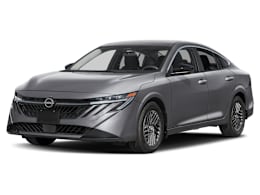
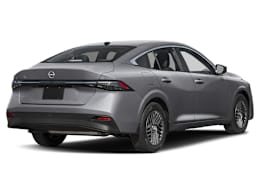
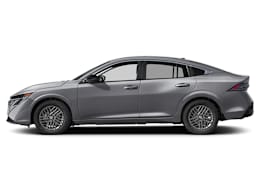
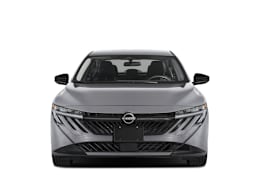
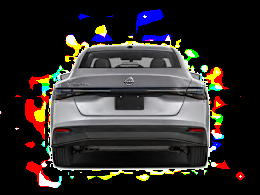
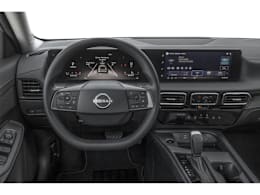
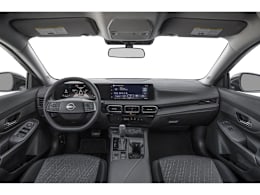
We praised the previous Sentra for its nimble handling, impressive fuel economy, roomy cabin, and intuitive controls, so we were eager to see what Nissan would do with the redesigned model. As it turns out, Nissan didn't radically overhaul the Sentra. Instead, it amounts to a significant freshening, with updated exterior and interior styling, and revised controls and displays. Power comes from the same engine as the previous generation: a 149-hp, 2.0-liter four-cylinder that’s paired with a continuously variable transmission (CVT) and drives the front wheels.
Key Takeaways
- Overall, the Sentra is a good, basic car, with some nice features for the price
- Nimble, entertaining handling
- Excellent fuel economy, especially considering that it’s not a hybrid
- Some controls, such as for the cruise control and wipers, work great; others, like the capacitive-touch climate controls, are frustrating to use while driving
- The Sentra’s wet stopping distance is on the long side
Road Test Review
We conduct more than 50 individual tests and evaluations on every vehicle we purchase at Consumer Reports’ 327-acre Auto Test Center in rural central Connecticut. Our testers also log thousands of miles on public roads over several months. After we tallied the results, the Sentra earned a mid-pack road-test score and remains a reasonably priced small sedan that delivers nimble handling and decent fuel economy. But the latest Sentra is plagued with some tiny infotainment screen icons, along with capacitive-touch climate controls that are more difficult to use than physical buttons or knobs.
The Sentra competes with other compact cars like the Honda Civic, Hyundai Elantra, Kia K4, Mazda3, Toyota Corolla, and Volkswagen Jetta.
Perhaps the most notable omission regarding the new Sentra is the lack of a hybrid powertrain. And while the Sentra’s 34 mpg overall is quite good, it gets absolutely trounced in the fuel economy competition by hybrids from Honda, Hyundai, and Toyota.
Despite its shortcomings, the Sentra gets a lot right. As one tester said, “This is a likable car and a good value. It feels small and easy to maneuver, has a smooth CVT that eagerly simulates upshifts, and nimble handling. But the ride occasionally feels stiff, the capacitive-touch climate controls aren't the best, and the car is pretty noisy.”
The Sentra’s value was consistently praised by testers. “It’s clear that Nissan spent some money on the interior and bringing in technology and features expected in a higher-end vehicle,” said a tester.
“I couldn't wait to get out of this car,” countered another tester. “I don’t like how abrupt the throttle is at low speeds, and there’s a lot of wind noise. I didn't find the front seats comfortable, either—I kept having to adjust my seating position.”
We bought a 2026 Nissan Sentra SV for $26,145—anonymously, as we do with every vehicle we test—for this road-test review. Our Sentra was assembled in Aguascalientes, Mexico. We also borrowed a 2026 Sentra SR from Nissan to experience a higher trim as part of our road test evaluation.
Driving experience
The 149-hp four-cylinder engine and CVT provide adequate acceleration in regular driving. Our test car made the run from 0 to 60 mph in 9.2 seconds, which is on the slow end of the class. Yet, from a standstill, power delivery can come on abruptly, making the Sentra harder to drive smoothly than it should be. Otherwise, the engine and transmission worked nicely. We like that the CVT uses simulated upshifts that mimic the operation of a conventional automatic transmission. We bet some owners won’t even realize they’re using a CVT.
One of the highlights of the Sentra is its nimble, sharp handling and well-weighted steering that delivers a welcome amount of feedback to the driver. It made it through our avoidance maneuver exercise at 54 mph, putting it in good company with other compact cars. As the previous Sentra was one of the better-handling small cars, we’re happy that Nissan didn’t mess up a good thing.
Unfortunately, the Sentra doesn’t break new ground in small-car ride comfort. It’s certainly not sports-car stiff, and while there’s a layer of absorbency from the suspension most of the time, larger bumps and repeating impacts tend to punch through noticeably into the cabin. Rougher back roads will bring some up-and-down bouncy sensations, too.
The cabin feels rather underinsulated, although that’s not uncommon among compact sedans. High levels of road hum and wind noise penetrate the cabin, becoming particularly intrusive at highway speeds.
Braking performance was quite good on our dry surface, but stopping distances proved long in the wet. Our testers found the brakes easy to modulate out on the road, giving a strong, linear response.
Cabin comfort
Nissan has been doing a commendable job with its interiors lately, and our tested Sentra SV is no exception. The cabin feels well-assembled, with higher-quality materials than many competitors—the various parts and panels fit together well.
The driver benefits from generous headroom and a clear view of the instrument screen, although the steering wheel doesn’t tilt down far enough for many of our testers. The armrests are well-positioned but thinly padded. The wide center console tends to hem in the driver’s right knee; at least there is a thin layer of vinyl there, rather than just hard plastic.
We had mixed opinions on the front seats. Some testers found them pretty comfortable and supportive, while others found the seatback too narrow and wished for more adjustability overall. The rear seat is relatively comfortable, with cushy padding and decent underleg support. Headroom will be tight for taller passengers.
While we appreciate the Sentra’s deep glove box and the spacious storage bin under the center armrest, the Sentra offers few open storage options for small items (such as keys) on the center console. The trunk is reasonably accommodating, fitting 2 large suitcases, 2 overnight duffel bags, and 6 backpacks in our testing. However, you can fit slightly more cargo in the Civic, Corolla, K4, and Mazda3.
Controls and usability
The Sentra’s infotainment touchscreen is easy to navigate, with customizable widgets and a helpful dashboard ledge to brace your hand while using it. But the tiny on-screen icons and capacitive-touch climate control panel below the center dashboard air vents are more difficult to use than physical buttons or knobs. For example, changing the airflow mode involves pressing a punch-hole-sized icon to open the climate menu on the touchscreen.
The rest of the physical controls, such as the conventional gear selector, cruise control buttons on the steering wheel, and windshield wiper stalks, can be operated with ease.
It took some drivers several attempts to connect their Android or Apple phones via Bluetooth, a situation we also experienced in the Nissan Armada and Murano. The driver’s instrument screen is marred by a needlessly deep and complex settings menu. A wireless phone charging pad isn’t available on the base Sentra. It’s either optional or standard on higher trims, so choose wisely if a feature like that is important to you.
Active safety and driver assistance
Standard active safety and driver assistance features include automatic emergency braking with pedestrian and cyclist detection, automatic emergency braking that operates at highway speeds, blind spot warning, rear cross traffic warning, lane departure warning, lane keeping assistance, adaptive cruise control, and automatic high beams.
Nissan’s ProPilot Assist 1.0 active driving assistance system is available on the SR and comes standard on the top SL. This system, which includes lane centering assistance, can take over acceleration, steering, and braking on longer trips under the watchful eye of the driver. Reverse automatic emergency braking and a surround view camera with moving-object detection are also available on the top trims.
A rear occupant alert system is standard. It’s designed to remind the driver—based on rear-door logic—to check the rear seat when the Sentra is turned off, helping prevent children and pets from being unintentionally left behind in the vehicle. There’s also a rear belt minder that alerts the driver if a rear passenger unbuckles their seat belt during the trip.