Media Room
Consumer Reports and Yuka Test 40 Popular U.S. Foods, Find 1 in 4 Exceed Daily Safety Levels for Additives
Joint investigation exposes a gap between what science now shows and what U.S. regulation still allows.
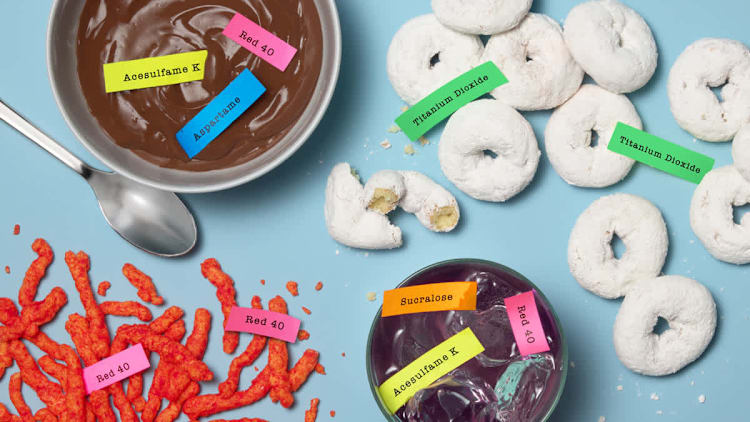
YONKERS and NEW YORK – A joint investigation by Consumer Reports and Yuka has measured the levels of eight controversial additives in 40 widely consumed packaged food products in the United States. The results show that one quarter of the products tested contained additive levels, in a single serving, that exceeded daily safety levels identified by U.S. or European public health agencies. When measured against broader levels of concern identified in peer-reviewed scientific research, nearly two-thirds, 25 of the 40 products, exceeded at least one reference level
“Americans are eating products every day that contain additives at levels recognized as concerning by health authorities elsewhere in the world,” said Julie Chapon, Co-Founder of Yuka. “Science has moved. U.S. regulation hasn’t. That gap is what we measured.”
“People shouldn’t have to navigate a food system where outdated standards leave families exposed to substances that science has raised new concerns about,” said Phil Radford, president and CEO of Consumer Reports. “This investigation highlights the need for food safety oversight that reflects how Americans actually eat today, especially children, who are often the most exposed.”
What the Tests Found
Our investigation highlights products with concerning levels of five additives: Red 40, titanium dioxide, sucralose, aspartame, and acesulfame potassium (Ace-K). The products were tested by an ISO 17025-accredited laboratory, an international reference standard for analytical reliability. 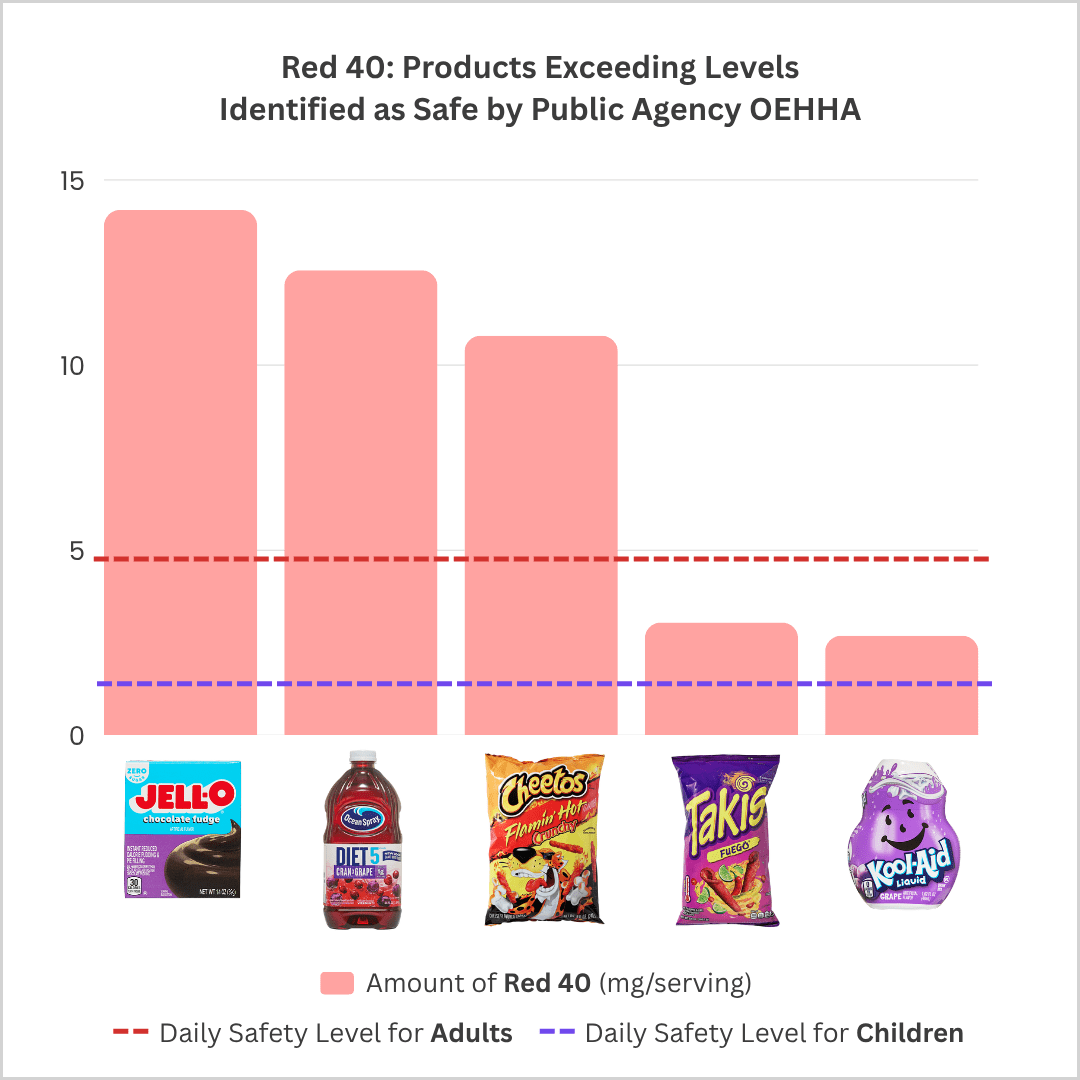
Of the 13 products analyzed containing Red 40, five exceeded, in a single serving, the daily safety level for children identified by the California’s Office of Environmental Health Hazard Assessment (OEHHA). Several studies indicate that chronic exposure to Red 40 may contribute to behavioral changes in children, including hyperactivity and attention disorders.
A California law banning Red Dye 40 in food served in the state’s schools based on the risks to children goes into effect on December 31st, 2027.
Three of those products also surpassed the threshold identified for adults.
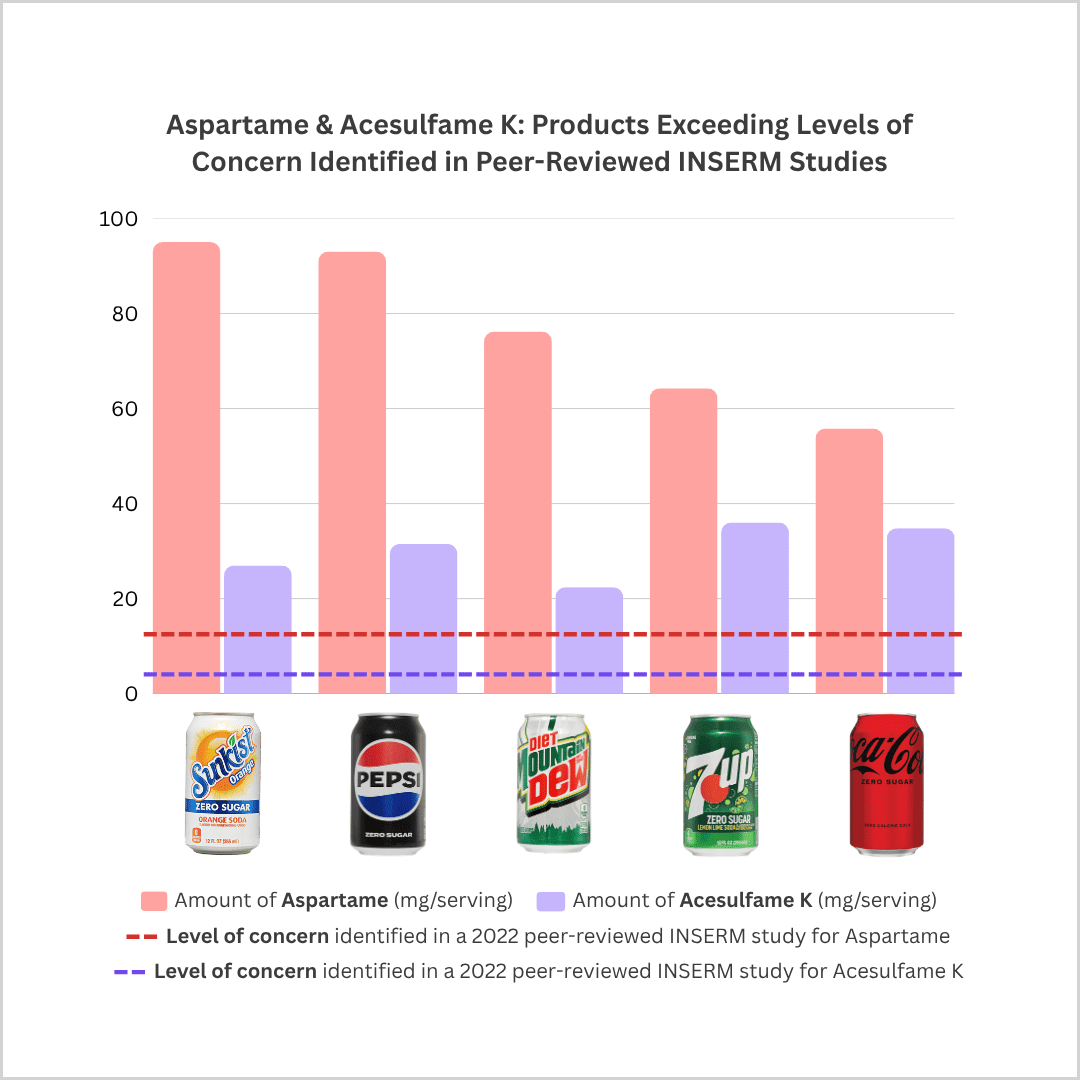
19 of the 21 products tested for acesulfame K, aspartame, and sucralose contained enough of at least one artificial sweetener in a single serving to exceed levels of concern associated with an increased risk of cancer, cardiovascular disease, or type 2 diabetes.
These levels of concern are based on findings from peer-reviewed studies that analyzed the dietary habits of more than 100,000 French adults over 12 years.
These studies found that low levels of daily artificial sweetener consumption was associated with an increased likelihood of developing chronic diseases. In sugar-free sodas from Pepsi and Coca-Cola, drinking just one-sixth of a can was enough to cross the level for acesulfame-K or aspartame.
We also tested four products containing titanium dioxide, a synthetic whitening agent that was banned as a food additive in the European Union in 2022 over concerns about genotoxicity.
One product stood out dramatically: Hostess’ Donettes Mini Powdered Donuts contained 261 milligrams of titanium dioxide in a single serving, representing more than 760 times the combined amount found in the three other products tested containing the additive.
Many of the additives we flagged show up in products kids eat every day including cereals, flavored drinks, candies, and puddings. And because children weigh less, a single serving represents a much bigger share of their daily exposure than it does for an adult.
A Regulatory Framework That Hasn’t Kept Up
The U.S. does set limits on some additives. But many were established decades ago, and have not been revisited since, even as new evidence of harm has emerged. The European Food Safety Authority is legally required to reevaluate the safety of all approved food additives, and has published reassessments for over 240 such substances since 2009 alone. The U.S. has no equivalent. And for 38 percent of the 50 most commonly used additives Yuka has flagged for health concerns, no quantitative U.S. enforceable limits exists at all.
The biggest driver of this gap is the “Generally Recognized as Safe” pathway, or GRAS, which lets manufacturers introduce new substances into the food supply without independent FDA review and, in some cases, without notifying the agency at all.
Nearly 99 percent of new substances added to U.S. food since the 2000s came in through GRAS, according to the Environmental Working Group.
Manufacturers of several products highlighted in the investigation told Consumer Reports that their products comply with current FDA regulations.
The FDA declined to comment on the investigation’s specific findings but said it has launched a stronger post-market review process for chemicals and additives already on the market.
Consumer Reports and Yuka are calling on people to join them in urging the FDA to strengthen oversight of food additives and update outdated safety standards.
About Yuka
Founded in 2017, Yuka is an entirely independent impact project. The app lets users scan the barcodes of food and cosmetic products to assess their health impact, with the aim of bringing more transparency to product composition and empowering consumers to make better choices for their health. Today, the app has over 85 million users worldwide, including 27 million in the United States. https://yuka.io/en/
Media Contacts
About Consumer Reports
Founded in 1936, CR has a mission to create a fair and just marketplace for all. Widely known for our rigorous research and testing of products and services, we also survey millions of consumers each year, report extensively on marketplace issues, and advocate for consumer rights and protections around safety as well as digital rights, financial fairness, and sustainability. CR is independent and nonprofit.
© 2026 Consumer Reports. The material above is intended for legitimate news entities only; it may not be used for advertising or promotional purposes. Consumer Reports® is an expert, independent, nonprofit organization whose mission is to work side by side with consumers to create a fairer, safer, and healthier world. We accept no advertising and pay for all the products we test. We are not beholden to any commercial interest. Our income is derived from the sale of Consumer Reports® magazine, ConsumerReports.org® and our other publications and information products, services, fees, and noncommercial contributions and grants. Our Ratings and reports are intended solely for the use of our readers. Neither the Ratings nor the reports may be used in advertising or for any other commercial purpose without our prior written permission. Consumer Reports will take all steps open to it to prevent unauthorized commercial use of its content and trademarks.